{"title":"在原位witting反应中,作为三组分一锅Mizoroki-Heck偶联的新型非均相催化剂的聚合物锚定Schiff碱固定化醋酸钯(II)","authors":"Akash V. Gujarati and Divyesh K. Patel","doi":"10.1039/D4DT03509G","DOIUrl":null,"url":null,"abstract":"<p >In this work, 4-((4-methylbenzyl)oxy)benzaldehyde resin-supported Pd<small><sup>(II)</sup></small>-Schiff base PS@Pd(OAc)<small><sub>2</sub></small> was synthesized. FT-IR, XPS, TGA, ICP-MS, and powder XRD established the structure of PS@Pd(OAc)<small><sub>2</sub></small>. The morphology and distribution of elements on PS@Pd(OAc)<small><sub>2</sub></small> were determined using SEM, TEM, and elemental mapping analysis. The heterogenized PS@Pd(OAc)<small><sub>2</sub></small> catalyst was found to be efficient in promoting three-component Mizoroki–Heck coupling <em>via</em> an <em>in situ</em> Witting reaction, where (<em>E</em>)-1,2-diphenylethenes were efficiently synthesized from the Witting salt. In this one-pot reaction, this catalyst exhibits a distinct synergistic effect. The significant mass-transfer limitation results from a nonsignificant distribution of active sites amalgamated with the crumpling of catalysts, which facilitates the smooth, easy movement of the reactants and products toward the well-spaced active catalytic sites on the catalyst's surface. These characteristics increase the catalytic activity of PS@Pd(OAc)<small><sub>2</sub></small>. Moreover, the catalyst was found to be quite robust for this reaction with very little metal leaching; thus, it can be efficiently recycled. Hence, multiple uses were established, and its reusability was proven in this important reaction.</p>","PeriodicalId":71,"journal":{"name":"Dalton Transactions","volume":" 10","pages":" 4049-4060"},"PeriodicalIF":3.3000,"publicationDate":"2025-02-10","publicationTypes":"Journal Article","fieldsOfStudy":null,"isOpenAccess":false,"openAccessPdf":"","citationCount":"0","resultStr":"{\"title\":\"Immobilization of palladium(ii) acetate on a polymer-anchored Schiff base as a new heterogeneous catalyst for three-component one-Pot Mizoroki–Heck coupling via an in situ witting reaction†\",\"authors\":\"Akash V. Gujarati and Divyesh K. Patel\",\"doi\":\"10.1039/D4DT03509G\",\"DOIUrl\":null,\"url\":null,\"abstract\":\"<p >In this work, 4-((4-methylbenzyl)oxy)benzaldehyde resin-supported Pd<small><sup>(II)</sup></small>-Schiff base PS@Pd(OAc)<small><sub>2</sub></small> was synthesized. FT-IR, XPS, TGA, ICP-MS, and powder XRD established the structure of PS@Pd(OAc)<small><sub>2</sub></small>. The morphology and distribution of elements on PS@Pd(OAc)<small><sub>2</sub></small> were determined using SEM, TEM, and elemental mapping analysis. The heterogenized PS@Pd(OAc)<small><sub>2</sub></small> catalyst was found to be efficient in promoting three-component Mizoroki–Heck coupling <em>via</em> an <em>in situ</em> Witting reaction, where (<em>E</em>)-1,2-diphenylethenes were efficiently synthesized from the Witting salt. In this one-pot reaction, this catalyst exhibits a distinct synergistic effect. The significant mass-transfer limitation results from a nonsignificant distribution of active sites amalgamated with the crumpling of catalysts, which facilitates the smooth, easy movement of the reactants and products toward the well-spaced active catalytic sites on the catalyst's surface. These characteristics increase the catalytic activity of PS@Pd(OAc)<small><sub>2</sub></small>. Moreover, the catalyst was found to be quite robust for this reaction with very little metal leaching; thus, it can be efficiently recycled. Hence, multiple uses were established, and its reusability was proven in this important reaction.</p>\",\"PeriodicalId\":71,\"journal\":{\"name\":\"Dalton Transactions\",\"volume\":\" 10\",\"pages\":\" 4049-4060\"},\"PeriodicalIF\":3.3000,\"publicationDate\":\"2025-02-10\",\"publicationTypes\":\"Journal Article\",\"fieldsOfStudy\":null,\"isOpenAccess\":false,\"openAccessPdf\":\"\",\"citationCount\":\"0\",\"resultStr\":null,\"platform\":\"Semanticscholar\",\"paperid\":null,\"PeriodicalName\":\"Dalton Transactions\",\"FirstCategoryId\":\"92\",\"ListUrlMain\":\"https://pubs.rsc.org/en/content/articlelanding/2025/dt/d4dt03509g\",\"RegionNum\":3,\"RegionCategory\":\"化学\",\"ArticlePicture\":[],\"TitleCN\":null,\"AbstractTextCN\":null,\"PMCID\":null,\"EPubDate\":\"\",\"PubModel\":\"\",\"JCR\":\"Q2\",\"JCRName\":\"CHEMISTRY, INORGANIC & NUCLEAR\",\"Score\":null,\"Total\":0}","platform":"Semanticscholar","paperid":null,"PeriodicalName":"Dalton Transactions","FirstCategoryId":"92","ListUrlMain":"https://pubs.rsc.org/en/content/articlelanding/2025/dt/d4dt03509g","RegionNum":3,"RegionCategory":"化学","ArticlePicture":[],"TitleCN":null,"AbstractTextCN":null,"PMCID":null,"EPubDate":"","PubModel":"","JCR":"Q2","JCRName":"CHEMISTRY, INORGANIC & NUCLEAR","Score":null,"Total":0}
Immobilization of palladium(ii) acetate on a polymer-anchored Schiff base as a new heterogeneous catalyst for three-component one-Pot Mizoroki–Heck coupling via an in situ witting reaction†
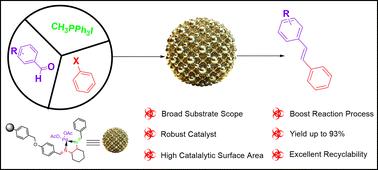
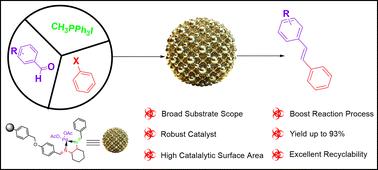
In this work, 4-((4-methylbenzyl)oxy)benzaldehyde resin-supported Pd(II)-Schiff base PS@Pd(OAc)2 was synthesized. FT-IR, XPS, TGA, ICP-MS, and powder XRD established the structure of PS@Pd(OAc)2. The morphology and distribution of elements on PS@Pd(OAc)2 were determined using SEM, TEM, and elemental mapping analysis. The heterogenized PS@Pd(OAc)2 catalyst was found to be efficient in promoting three-component Mizoroki–Heck coupling via an in situ Witting reaction, where (E)-1,2-diphenylethenes were efficiently synthesized from the Witting salt. In this one-pot reaction, this catalyst exhibits a distinct synergistic effect. The significant mass-transfer limitation results from a nonsignificant distribution of active sites amalgamated with the crumpling of catalysts, which facilitates the smooth, easy movement of the reactants and products toward the well-spaced active catalytic sites on the catalyst's surface. These characteristics increase the catalytic activity of PS@Pd(OAc)2. Moreover, the catalyst was found to be quite robust for this reaction with very little metal leaching; thus, it can be efficiently recycled. Hence, multiple uses were established, and its reusability was proven in this important reaction.
期刊介绍:
Dalton Transactions is a journal for all areas of inorganic chemistry, which encompasses the organometallic, bioinorganic and materials chemistry of the elements, with applications including synthesis, catalysis, energy conversion/storage, electrical devices and medicine. Dalton Transactions welcomes high-quality, original submissions in all of these areas and more, where the advancement of knowledge in inorganic chemistry is significant.




 京公网安备 11010802042870号
京ICP备2023020795号-1
京公网安备 11010802042870号
京ICP备2023020795号-1

 分享
分享
 求助内容:
求助内容: 应助结果提醒方式:
 扫码关注我们
