Partha Kumbhakar*, Subhendu Mishra, Prapti V. Nayak, Angela Sunny and Abhishek Kumar Singh*,
{"title":"用于低频能量收集的二维材料涂层柔性折纸","authors":"Partha Kumbhakar*, Subhendu Mishra, Prapti V. Nayak, Angela Sunny and Abhishek Kumar Singh*, ","doi":"10.1021/acsaelm.4c01958","DOIUrl":null,"url":null,"abstract":"<p >Wave energy is one of the most abundant energy sources. Triboelectric nanogenerators (TENGs) are becoming more popular for sustainable energy generation from waves. Concerning the renewable energy demands, we focus on developing cost-effective and adaptable origami-TENGs (O-TENGs) for harvesting wave energy, specifically utilizing paper-based (cellulose) materials. An origami-inspired lightweight and scalable design is proposed to create high-performance O-TENGs suitable for the complex conditions of low-frequency wave excitation. The paper-based spring-like O-TENG is coated with two-dimensional (2D) molybdenum disulfide (MoS<sub>2</sub>) nanosheets and demonstrates efficacy in harvesting mechanical energy in the ambient environment and the output performance compared with reduced graphene oxides (rGO). A detailed density functional theory (DFT) calculation was used to analyze the charge transfer mechanism in the coated origami structures. Furthermore, a barrel-shaped floating generator incorporating multiple origami TENGs is introduced to capture ocean wave energy across various frequencies, amplitudes, and directional movements. Since the coated origami structures show a good self-rebounding spring-like nature and energy harvesting properties, they are suitable for blue energy harvesting.</p>","PeriodicalId":3,"journal":{"name":"ACS Applied Electronic Materials","volume":"7 3","pages":"1111–1119 1111–1119"},"PeriodicalIF":4.7000,"publicationDate":"2025-01-28","publicationTypes":"Journal Article","fieldsOfStudy":null,"isOpenAccess":false,"openAccessPdf":"","citationCount":"0","resultStr":"{\"title\":\"2D Materials Coated Flexible Origami for Low-Frequency Energy Harvesting\",\"authors\":\"Partha Kumbhakar*, Subhendu Mishra, Prapti V. Nayak, Angela Sunny and Abhishek Kumar Singh*, \",\"doi\":\"10.1021/acsaelm.4c01958\",\"DOIUrl\":null,\"url\":null,\"abstract\":\"<p >Wave energy is one of the most abundant energy sources. Triboelectric nanogenerators (TENGs) are becoming more popular for sustainable energy generation from waves. Concerning the renewable energy demands, we focus on developing cost-effective and adaptable origami-TENGs (O-TENGs) for harvesting wave energy, specifically utilizing paper-based (cellulose) materials. An origami-inspired lightweight and scalable design is proposed to create high-performance O-TENGs suitable for the complex conditions of low-frequency wave excitation. The paper-based spring-like O-TENG is coated with two-dimensional (2D) molybdenum disulfide (MoS<sub>2</sub>) nanosheets and demonstrates efficacy in harvesting mechanical energy in the ambient environment and the output performance compared with reduced graphene oxides (rGO). A detailed density functional theory (DFT) calculation was used to analyze the charge transfer mechanism in the coated origami structures. Furthermore, a barrel-shaped floating generator incorporating multiple origami TENGs is introduced to capture ocean wave energy across various frequencies, amplitudes, and directional movements. Since the coated origami structures show a good self-rebounding spring-like nature and energy harvesting properties, they are suitable for blue energy harvesting.</p>\",\"PeriodicalId\":3,\"journal\":{\"name\":\"ACS Applied Electronic Materials\",\"volume\":\"7 3\",\"pages\":\"1111–1119 1111–1119\"},\"PeriodicalIF\":4.7000,\"publicationDate\":\"2025-01-28\",\"publicationTypes\":\"Journal Article\",\"fieldsOfStudy\":null,\"isOpenAccess\":false,\"openAccessPdf\":\"\",\"citationCount\":\"0\",\"resultStr\":null,\"platform\":\"Semanticscholar\",\"paperid\":null,\"PeriodicalName\":\"ACS Applied Electronic Materials\",\"FirstCategoryId\":\"88\",\"ListUrlMain\":\"https://pubs.acs.org/doi/10.1021/acsaelm.4c01958\",\"RegionNum\":3,\"RegionCategory\":\"材料科学\",\"ArticlePicture\":[],\"TitleCN\":null,\"AbstractTextCN\":null,\"PMCID\":null,\"EPubDate\":\"\",\"PubModel\":\"\",\"JCR\":\"Q1\",\"JCRName\":\"ENGINEERING, ELECTRICAL & ELECTRONIC\",\"Score\":null,\"Total\":0}","platform":"Semanticscholar","paperid":null,"PeriodicalName":"ACS Applied Electronic Materials","FirstCategoryId":"88","ListUrlMain":"https://pubs.acs.org/doi/10.1021/acsaelm.4c01958","RegionNum":3,"RegionCategory":"材料科学","ArticlePicture":[],"TitleCN":null,"AbstractTextCN":null,"PMCID":null,"EPubDate":"","PubModel":"","JCR":"Q1","JCRName":"ENGINEERING, ELECTRICAL & ELECTRONIC","Score":null,"Total":0}
2D Materials Coated Flexible Origami for Low-Frequency Energy Harvesting
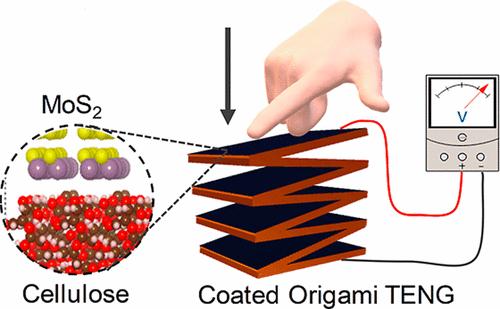
Wave energy is one of the most abundant energy sources. Triboelectric nanogenerators (TENGs) are becoming more popular for sustainable energy generation from waves. Concerning the renewable energy demands, we focus on developing cost-effective and adaptable origami-TENGs (O-TENGs) for harvesting wave energy, specifically utilizing paper-based (cellulose) materials. An origami-inspired lightweight and scalable design is proposed to create high-performance O-TENGs suitable for the complex conditions of low-frequency wave excitation. The paper-based spring-like O-TENG is coated with two-dimensional (2D) molybdenum disulfide (MoS2) nanosheets and demonstrates efficacy in harvesting mechanical energy in the ambient environment and the output performance compared with reduced graphene oxides (rGO). A detailed density functional theory (DFT) calculation was used to analyze the charge transfer mechanism in the coated origami structures. Furthermore, a barrel-shaped floating generator incorporating multiple origami TENGs is introduced to capture ocean wave energy across various frequencies, amplitudes, and directional movements. Since the coated origami structures show a good self-rebounding spring-like nature and energy harvesting properties, they are suitable for blue energy harvesting.
期刊介绍:
ACS Applied Electronic Materials is an interdisciplinary journal publishing original research covering all aspects of electronic materials. The journal is devoted to reports of new and original experimental and theoretical research of an applied nature that integrate knowledge in the areas of materials science, engineering, optics, physics, and chemistry into important applications of electronic materials. Sample research topics that span the journal's scope are inorganic, organic, ionic and polymeric materials with properties that include conducting, semiconducting, superconducting, insulating, dielectric, magnetic, optoelectronic, piezoelectric, ferroelectric and thermoelectric.
Indexed/Abstracted:
Web of Science SCIE
Scopus
CAS
INSPEC
Portico





 京公网安备 11010802042870号
京ICP备2023020795号-1
京公网安备 11010802042870号
京ICP备2023020795号-1

 分享
分享
 求助内容:
求助内容: 应助结果提醒方式:
 扫码关注我们
