Shenzhi Wang , Tong Liu , Tao Li , Guanqun Wang , Chuanchuan Guo , Mengyao Zhu , Ri Liu , Zhibo Zhang , Hongmei Xu , Jia Xu , Zuobin Wang , Wenhao Li , Zhankun Weng
{"title":"激光干涉光固化:一步法制备透射衍射光栅","authors":"Shenzhi Wang , Tong Liu , Tao Li , Guanqun Wang , Chuanchuan Guo , Mengyao Zhu , Ri Liu , Zhibo Zhang , Hongmei Xu , Jia Xu , Zuobin Wang , Wenhao Li , Zhankun Weng","doi":"10.1016/j.optlastec.2025.112585","DOIUrl":null,"url":null,"abstract":"<div><div>To face the challenges of expensive photoresist and complex process flow for fabricating diffraction grating structures, we propose an additive manufacturing (AM) strategy to obtain transmissive diffraction grating structures by laser interference photocuring (LIP). In this paper, the transmission diffraction gratings with a period of 7.5 μm is designed, and SEM images showed that the obtained period is about 7.40 μm ± 0.02 μm (the error approximately1.3 %). Furthermore, the energy dispersive X-ray spectroscopy (EDS) revealed that the carbon element is uniformly distributed on the structure of the transmission diffraction grating structures, and that the carbon element has a linear increasing trend with the increase of the LIP time. Eventually, the carbon element completely covered whole area after the LIP for 2 s. Moreover, these gratings also showed obviously diffractive performance, in which the efficiency was about 37 % at the zero-order, and it reach about 18 % at the first-order. Finally, a model was established to discuss the evolution of the grating structures. In conclusion, we have explored a new way to fabricate transmissive grating structures by LIP, which also provides new insights for scientists to achieve low-cost and high-efficiency fabrication of micro- and nanostructures on the surface of transparent substrates.</div></div>","PeriodicalId":19511,"journal":{"name":"Optics and Laser Technology","volume":"185 ","pages":"Article 112585"},"PeriodicalIF":5.0000,"publicationDate":"2025-02-09","publicationTypes":"Journal Article","fieldsOfStudy":null,"isOpenAccess":false,"openAccessPdf":"","citationCount":"0","resultStr":"{\"title\":\"Laser interference Photocuring: Fabrication of transmission diffraction gratings by one-step method\",\"authors\":\"Shenzhi Wang , Tong Liu , Tao Li , Guanqun Wang , Chuanchuan Guo , Mengyao Zhu , Ri Liu , Zhibo Zhang , Hongmei Xu , Jia Xu , Zuobin Wang , Wenhao Li , Zhankun Weng\",\"doi\":\"10.1016/j.optlastec.2025.112585\",\"DOIUrl\":null,\"url\":null,\"abstract\":\"<div><div>To face the challenges of expensive photoresist and complex process flow for fabricating diffraction grating structures, we propose an additive manufacturing (AM) strategy to obtain transmissive diffraction grating structures by laser interference photocuring (LIP). In this paper, the transmission diffraction gratings with a period of 7.5 μm is designed, and SEM images showed that the obtained period is about 7.40 μm ± 0.02 μm (the error approximately1.3 %). Furthermore, the energy dispersive X-ray spectroscopy (EDS) revealed that the carbon element is uniformly distributed on the structure of the transmission diffraction grating structures, and that the carbon element has a linear increasing trend with the increase of the LIP time. Eventually, the carbon element completely covered whole area after the LIP for 2 s. Moreover, these gratings also showed obviously diffractive performance, in which the efficiency was about 37 % at the zero-order, and it reach about 18 % at the first-order. Finally, a model was established to discuss the evolution of the grating structures. In conclusion, we have explored a new way to fabricate transmissive grating structures by LIP, which also provides new insights for scientists to achieve low-cost and high-efficiency fabrication of micro- and nanostructures on the surface of transparent substrates.</div></div>\",\"PeriodicalId\":19511,\"journal\":{\"name\":\"Optics and Laser Technology\",\"volume\":\"185 \",\"pages\":\"Article 112585\"},\"PeriodicalIF\":5.0000,\"publicationDate\":\"2025-02-09\",\"publicationTypes\":\"Journal Article\",\"fieldsOfStudy\":null,\"isOpenAccess\":false,\"openAccessPdf\":\"\",\"citationCount\":\"0\",\"resultStr\":null,\"platform\":\"Semanticscholar\",\"paperid\":null,\"PeriodicalName\":\"Optics and Laser Technology\",\"FirstCategoryId\":\"101\",\"ListUrlMain\":\"https://www.sciencedirect.com/science/article/pii/S0030399225001732\",\"RegionNum\":2,\"RegionCategory\":\"物理与天体物理\",\"ArticlePicture\":[],\"TitleCN\":null,\"AbstractTextCN\":null,\"PMCID\":null,\"EPubDate\":\"\",\"PubModel\":\"\",\"JCR\":\"Q1\",\"JCRName\":\"OPTICS\",\"Score\":null,\"Total\":0}","platform":"Semanticscholar","paperid":null,"PeriodicalName":"Optics and Laser Technology","FirstCategoryId":"101","ListUrlMain":"https://www.sciencedirect.com/science/article/pii/S0030399225001732","RegionNum":2,"RegionCategory":"物理与天体物理","ArticlePicture":[],"TitleCN":null,"AbstractTextCN":null,"PMCID":null,"EPubDate":"","PubModel":"","JCR":"Q1","JCRName":"OPTICS","Score":null,"Total":0}
Laser interference Photocuring: Fabrication of transmission diffraction gratings by one-step method
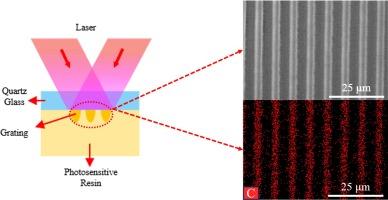
To face the challenges of expensive photoresist and complex process flow for fabricating diffraction grating structures, we propose an additive manufacturing (AM) strategy to obtain transmissive diffraction grating structures by laser interference photocuring (LIP). In this paper, the transmission diffraction gratings with a period of 7.5 μm is designed, and SEM images showed that the obtained period is about 7.40 μm ± 0.02 μm (the error approximately1.3 %). Furthermore, the energy dispersive X-ray spectroscopy (EDS) revealed that the carbon element is uniformly distributed on the structure of the transmission diffraction grating structures, and that the carbon element has a linear increasing trend with the increase of the LIP time. Eventually, the carbon element completely covered whole area after the LIP for 2 s. Moreover, these gratings also showed obviously diffractive performance, in which the efficiency was about 37 % at the zero-order, and it reach about 18 % at the first-order. Finally, a model was established to discuss the evolution of the grating structures. In conclusion, we have explored a new way to fabricate transmissive grating structures by LIP, which also provides new insights for scientists to achieve low-cost and high-efficiency fabrication of micro- and nanostructures on the surface of transparent substrates.
期刊介绍:
Optics & Laser Technology aims to provide a vehicle for the publication of a broad range of high quality research and review papers in those fields of scientific and engineering research appertaining to the development and application of the technology of optics and lasers. Papers describing original work in these areas are submitted to rigorous refereeing prior to acceptance for publication.
The scope of Optics & Laser Technology encompasses, but is not restricted to, the following areas:
•development in all types of lasers
•developments in optoelectronic devices and photonics
•developments in new photonics and optical concepts
•developments in conventional optics, optical instruments and components
•techniques of optical metrology, including interferometry and optical fibre sensors
•LIDAR and other non-contact optical measurement techniques, including optical methods in heat and fluid flow
•applications of lasers to materials processing, optical NDT display (including holography) and optical communication
•research and development in the field of laser safety including studies of hazards resulting from the applications of lasers (laser safety, hazards of laser fume)
•developments in optical computing and optical information processing
•developments in new optical materials
•developments in new optical characterization methods and techniques
•developments in quantum optics
•developments in light assisted micro and nanofabrication methods and techniques
•developments in nanophotonics and biophotonics
•developments in imaging processing and systems



 京公网安备 11010802042870号
京ICP备2023020795号-1
京公网安备 11010802042870号
京ICP备2023020795号-1

 分享
分享
 求助内容:
求助内容: 应助结果提醒方式:
 扫码关注我们
