Qurat-Ul-Ain , Fawad Ahmad , Muhammad Irfan , Muhammad Imran Khan , Komal Ali Rao , Naseem Akhter , Abdallah Shanableh , Muhammad Babar Taj , Leonid G. Voskressensky , Rafael Luque
{"title":"氧还原反应中一种高活性、低成本的钴锌铁氧体电催化剂","authors":"Qurat-Ul-Ain , Fawad Ahmad , Muhammad Irfan , Muhammad Imran Khan , Komal Ali Rao , Naseem Akhter , Abdallah Shanableh , Muhammad Babar Taj , Leonid G. Voskressensky , Rafael Luque","doi":"10.1016/j.rechem.2025.102095","DOIUrl":null,"url":null,"abstract":"<div><div>Fuel cell technology offers a promising alternative to fossil fuel combustion, providing a clean, eco-friendly and a more efficient energy source. However, the oxygen reduction reaction (ORR) is the most sluggish reaction within fuel cells. A bimetallic iron ferrite material (BMIF) has been developed as a less costly alternative compared to Pt-based electrodes with high electrochemical activity. The particle size of BMIF ranges from 0.08 to 0.3 μm, and its spinel structure has been confirmed through FTIR and XRD analysis. TGA shows high thermal stability of catalyst. Spinel structure remained unchanged even after electrochemical analysis as confirmed by FTIR. With increasing electrolyte concentration, the cathodic peak current decreases in accordance with De-Bye Huckle Limiting law. Onset potential for BMIF is 0.0296 V vs. RHE, significantly lower than that of Pt, which is 0.783 V vs. RHE. Additionally, the mass activity of BMIF at −0.998 V is 253 mA mg<sup>−1</sup>, surpassing that of Pt/C (96.9 mA mg<sup>−1</sup></div><div>Chronoamperometry result shows appreciable durability of BMIF as initially for only 1 min current density was declined and then no further decline was observed till 1000s.</div></div>","PeriodicalId":420,"journal":{"name":"Results in Chemistry","volume":"14 ","pages":"Article 102095"},"PeriodicalIF":4.2000,"publicationDate":"2025-03-01","publicationTypes":"Journal Article","fieldsOfStudy":null,"isOpenAccess":false,"openAccessPdf":"","citationCount":"0","resultStr":"{\"title\":\"A highly active, low-cost CoZn ferrite electrocatalyst in oxygen reduction reactions\",\"authors\":\"Qurat-Ul-Ain , Fawad Ahmad , Muhammad Irfan , Muhammad Imran Khan , Komal Ali Rao , Naseem Akhter , Abdallah Shanableh , Muhammad Babar Taj , Leonid G. Voskressensky , Rafael Luque\",\"doi\":\"10.1016/j.rechem.2025.102095\",\"DOIUrl\":null,\"url\":null,\"abstract\":\"<div><div>Fuel cell technology offers a promising alternative to fossil fuel combustion, providing a clean, eco-friendly and a more efficient energy source. However, the oxygen reduction reaction (ORR) is the most sluggish reaction within fuel cells. A bimetallic iron ferrite material (BMIF) has been developed as a less costly alternative compared to Pt-based electrodes with high electrochemical activity. The particle size of BMIF ranges from 0.08 to 0.3 μm, and its spinel structure has been confirmed through FTIR and XRD analysis. TGA shows high thermal stability of catalyst. Spinel structure remained unchanged even after electrochemical analysis as confirmed by FTIR. With increasing electrolyte concentration, the cathodic peak current decreases in accordance with De-Bye Huckle Limiting law. Onset potential for BMIF is 0.0296 V vs. RHE, significantly lower than that of Pt, which is 0.783 V vs. RHE. Additionally, the mass activity of BMIF at −0.998 V is 253 mA mg<sup>−1</sup>, surpassing that of Pt/C (96.9 mA mg<sup>−1</sup></div><div>Chronoamperometry result shows appreciable durability of BMIF as initially for only 1 min current density was declined and then no further decline was observed till 1000s.</div></div>\",\"PeriodicalId\":420,\"journal\":{\"name\":\"Results in Chemistry\",\"volume\":\"14 \",\"pages\":\"Article 102095\"},\"PeriodicalIF\":4.2000,\"publicationDate\":\"2025-03-01\",\"publicationTypes\":\"Journal Article\",\"fieldsOfStudy\":null,\"isOpenAccess\":false,\"openAccessPdf\":\"\",\"citationCount\":\"0\",\"resultStr\":null,\"platform\":\"Semanticscholar\",\"paperid\":null,\"PeriodicalName\":\"Results in Chemistry\",\"FirstCategoryId\":\"1085\",\"ListUrlMain\":\"https://www.sciencedirect.com/science/article/pii/S2211715625000785\",\"RegionNum\":0,\"RegionCategory\":null,\"ArticlePicture\":[],\"TitleCN\":null,\"AbstractTextCN\":null,\"PMCID\":null,\"EPubDate\":\"2025/2/3 0:00:00\",\"PubModel\":\"Epub\",\"JCR\":\"Q2\",\"JCRName\":\"CHEMISTRY, MULTIDISCIPLINARY\",\"Score\":null,\"Total\":0}","platform":"Semanticscholar","paperid":null,"PeriodicalName":"Results in Chemistry","FirstCategoryId":"1085","ListUrlMain":"https://www.sciencedirect.com/science/article/pii/S2211715625000785","RegionNum":0,"RegionCategory":null,"ArticlePicture":[],"TitleCN":null,"AbstractTextCN":null,"PMCID":null,"EPubDate":"2025/2/3 0:00:00","PubModel":"Epub","JCR":"Q2","JCRName":"CHEMISTRY, MULTIDISCIPLINARY","Score":null,"Total":0}
引用次数: 0
摘要
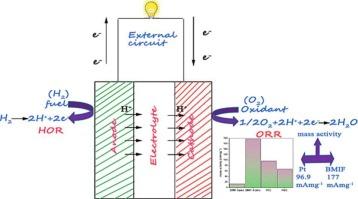
燃料电池技术为化石燃料燃烧提供了一个很有前途的替代品,提供了一种清洁、环保和更高效的能源。然而,氧还原反应(ORR)是燃料电池中最缓慢的反应。双金属铁铁氧体材料(BMIF)是一种成本较低、电化学活性高的替代pt基电极的材料。BMIF的粒径范围为0.08 ~ 0.3 μm,通过FTIR和XRD分析证实了其尖晶石结构。热重分析表明催化剂具有较高的热稳定性。经FTIR证实,电化学分析后尖晶石结构仍未改变。随着电解液浓度的增加,阴极峰值电流减小,符合De-Bye - Huckle极限定律。BMIF的起病电位为0.0296 V / RHE,显著低于Pt的0.783 V / RHE。此外,在- 0.998 V时,BMIF的质量活度为253 mA mg - 1,超过Pt/C (96.9 mA mg - 1)。计时电流测量结果表明,BMIF的耐久性很好,最初只有1 min电流密度下降,然后直到1000s都没有进一步下降。
A highly active, low-cost CoZn ferrite electrocatalyst in oxygen reduction reactions
Fuel cell technology offers a promising alternative to fossil fuel combustion, providing a clean, eco-friendly and a more efficient energy source. However, the oxygen reduction reaction (ORR) is the most sluggish reaction within fuel cells. A bimetallic iron ferrite material (BMIF) has been developed as a less costly alternative compared to Pt-based electrodes with high electrochemical activity. The particle size of BMIF ranges from 0.08 to 0.3 μm, and its spinel structure has been confirmed through FTIR and XRD analysis. TGA shows high thermal stability of catalyst. Spinel structure remained unchanged even after electrochemical analysis as confirmed by FTIR. With increasing electrolyte concentration, the cathodic peak current decreases in accordance with De-Bye Huckle Limiting law. Onset potential for BMIF is 0.0296 V vs. RHE, significantly lower than that of Pt, which is 0.783 V vs. RHE. Additionally, the mass activity of BMIF at −0.998 V is 253 mA mg−1, surpassing that of Pt/C (96.9 mA mg−1
Chronoamperometry result shows appreciable durability of BMIF as initially for only 1 min current density was declined and then no further decline was observed till 1000s.





 京公网安备 11010802042870号
京ICP备2023020795号-1
京公网安备 11010802042870号
京ICP备2023020795号-1

 分享
分享
 求助内容:
求助内容: 应助结果提醒方式:
 扫码关注我们
