Shaan Bibi Jaffri , Khuram Shahzad Ahmad , Bhumikaben Makawana , Ram K. Gupta , Ahmed Nadeem , Sabry M. Attia
{"title":"利用二硫代氨基甲酸酯配体增强能量存储:Cu2S:Sb2S3:Ni3S2三氯配合物在电池技术中的进展","authors":"Shaan Bibi Jaffri , Khuram Shahzad Ahmad , Bhumikaben Makawana , Ram K. Gupta , Ahmed Nadeem , Sabry M. Attia","doi":"10.1016/j.est.2025.115737","DOIUrl":null,"url":null,"abstract":"<div><div>Chelation with the diethyldithiocarbamate ligand yields a novel semiconducting Cu<sub>2</sub>S: Sb<sub>2</sub>S<sub>3</sub>: Ni<sub>3</sub>S<sub>2</sub> metal chalcogen. The current work intends to improve the performance of charge storing contraptions for the first time by using dithiocarbamate ligands. Having a band gap of 2.55 eV and diverse crystallographic features with a median crystallite size of 44.21 nm, this photo-active material exhibits exceptional optical performance. Infrared spectroscopy identified metallic sulfide connections, ranging from 519 to 909 cm<sup>−1</sup>. The electrochemical characteristics of the Cu<sub>2</sub>S: Sb<sub>2</sub>S<sub>3</sub>: Ni<sub>3</sub>S<sub>2</sub> was evaluated utilizing a KOH background electrolyte (1 M) and a standard three-electrode arrangement. The trichalcogenide has a power density of 7053.64 W kg<sup>−1</sup> and a very substantial unit capacity of as high as 487.36 mAh g<sup>−1</sup>, making it the perfect electrode material for battery applications. The similar serial resistance (R<sub>s</sub>) of 0.09 Ω further confirmed the excellent electrochemical result. Chronoamperometric analysis over 1500 min showed stable electrochemical behaviour of the Cu<sub>2</sub>S: Sb<sub>2</sub>S<sub>3</sub>: Ni<sub>3</sub>S<sub>2</sub> composite.</div></div>","PeriodicalId":15942,"journal":{"name":"Journal of energy storage","volume":"114 ","pages":"Article 115737"},"PeriodicalIF":8.9000,"publicationDate":"2025-04-01","publicationTypes":"Journal Article","fieldsOfStudy":null,"isOpenAccess":false,"openAccessPdf":"","citationCount":"0","resultStr":"{\"title\":\"Harnessing dithiocarbamate ligands for enhanced energy storage: Advancing with Cu2S:Sb2S3:Ni3S2 trichalcogen complexes in battery technology\",\"authors\":\"Shaan Bibi Jaffri , Khuram Shahzad Ahmad , Bhumikaben Makawana , Ram K. Gupta , Ahmed Nadeem , Sabry M. Attia\",\"doi\":\"10.1016/j.est.2025.115737\",\"DOIUrl\":null,\"url\":null,\"abstract\":\"<div><div>Chelation with the diethyldithiocarbamate ligand yields a novel semiconducting Cu<sub>2</sub>S: Sb<sub>2</sub>S<sub>3</sub>: Ni<sub>3</sub>S<sub>2</sub> metal chalcogen. The current work intends to improve the performance of charge storing contraptions for the first time by using dithiocarbamate ligands. Having a band gap of 2.55 eV and diverse crystallographic features with a median crystallite size of 44.21 nm, this photo-active material exhibits exceptional optical performance. Infrared spectroscopy identified metallic sulfide connections, ranging from 519 to 909 cm<sup>−1</sup>. The electrochemical characteristics of the Cu<sub>2</sub>S: Sb<sub>2</sub>S<sub>3</sub>: Ni<sub>3</sub>S<sub>2</sub> was evaluated utilizing a KOH background electrolyte (1 M) and a standard three-electrode arrangement. The trichalcogenide has a power density of 7053.64 W kg<sup>−1</sup> and a very substantial unit capacity of as high as 487.36 mAh g<sup>−1</sup>, making it the perfect electrode material for battery applications. The similar serial resistance (R<sub>s</sub>) of 0.09 Ω further confirmed the excellent electrochemical result. Chronoamperometric analysis over 1500 min showed stable electrochemical behaviour of the Cu<sub>2</sub>S: Sb<sub>2</sub>S<sub>3</sub>: Ni<sub>3</sub>S<sub>2</sub> composite.</div></div>\",\"PeriodicalId\":15942,\"journal\":{\"name\":\"Journal of energy storage\",\"volume\":\"114 \",\"pages\":\"Article 115737\"},\"PeriodicalIF\":8.9000,\"publicationDate\":\"2025-04-01\",\"publicationTypes\":\"Journal Article\",\"fieldsOfStudy\":null,\"isOpenAccess\":false,\"openAccessPdf\":\"\",\"citationCount\":\"0\",\"resultStr\":null,\"platform\":\"Semanticscholar\",\"paperid\":null,\"PeriodicalName\":\"Journal of energy storage\",\"FirstCategoryId\":\"5\",\"ListUrlMain\":\"https://www.sciencedirect.com/science/article/pii/S2352152X25004505\",\"RegionNum\":2,\"RegionCategory\":\"工程技术\",\"ArticlePicture\":[],\"TitleCN\":null,\"AbstractTextCN\":null,\"PMCID\":null,\"EPubDate\":\"2025/2/10 0:00:00\",\"PubModel\":\"Epub\",\"JCR\":\"Q1\",\"JCRName\":\"ENERGY & FUELS\",\"Score\":null,\"Total\":0}","platform":"Semanticscholar","paperid":null,"PeriodicalName":"Journal of energy storage","FirstCategoryId":"5","ListUrlMain":"https://www.sciencedirect.com/science/article/pii/S2352152X25004505","RegionNum":2,"RegionCategory":"工程技术","ArticlePicture":[],"TitleCN":null,"AbstractTextCN":null,"PMCID":null,"EPubDate":"2025/2/10 0:00:00","PubModel":"Epub","JCR":"Q1","JCRName":"ENERGY & FUELS","Score":null,"Total":0}
引用次数: 0
摘要
与二乙基二硫代氨基甲酸酯配体螯合生成一种新型半导体Cu2S: Sb2S3: Ni3S2金属硫。本研究旨在首次利用二硫代氨基甲酸酯配体改善电荷存储装置的性能。该光活性材料的带隙为2.55 eV,晶体结构多样,中位晶尺寸为44.21 nm,具有优异的光学性能。红外光谱鉴定出金属硫化物连接,范围从519到909 cm−1。采用KOH背景电解液(1 M)和标准三电极布置,对Cu2S: Sb2S3: Ni3S2的电化学特性进行了评价。三硫化物的功率密度为7053.64 W kg−1,单位容量高达487.36 mAh g−1,是电池应用的理想电极材料。相似的串联电阻(Rs)为0.09 Ω进一步证实了优异的电化学效果。在1500 min的时间内,计时电流分析表明Cu2S: Sb2S3: Ni3S2复合材料的电化学行为稳定。
Harnessing dithiocarbamate ligands for enhanced energy storage: Advancing with Cu2S:Sb2S3:Ni3S2 trichalcogen complexes in battery technology
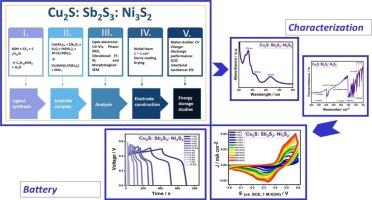
Chelation with the diethyldithiocarbamate ligand yields a novel semiconducting Cu2S: Sb2S3: Ni3S2 metal chalcogen. The current work intends to improve the performance of charge storing contraptions for the first time by using dithiocarbamate ligands. Having a band gap of 2.55 eV and diverse crystallographic features with a median crystallite size of 44.21 nm, this photo-active material exhibits exceptional optical performance. Infrared spectroscopy identified metallic sulfide connections, ranging from 519 to 909 cm−1. The electrochemical characteristics of the Cu2S: Sb2S3: Ni3S2 was evaluated utilizing a KOH background electrolyte (1 M) and a standard three-electrode arrangement. The trichalcogenide has a power density of 7053.64 W kg−1 and a very substantial unit capacity of as high as 487.36 mAh g−1, making it the perfect electrode material for battery applications. The similar serial resistance (Rs) of 0.09 Ω further confirmed the excellent electrochemical result. Chronoamperometric analysis over 1500 min showed stable electrochemical behaviour of the Cu2S: Sb2S3: Ni3S2 composite.
期刊介绍:
Journal of energy storage focusses on all aspects of energy storage, in particular systems integration, electric grid integration, modelling and analysis, novel energy storage technologies, sizing and management strategies, business models for operation of storage systems and energy storage developments worldwide.




 京公网安备 11010802042870号
京ICP备2023020795号-1
京公网安备 11010802042870号
京ICP备2023020795号-1

 分享
分享
 求助内容:
求助内容: 应助结果提醒方式:
 扫码关注我们
