Bo Qiao , Zhongxian Wu , Ling Zhang , Shuo Yang , Dongping Tao
{"title":"水动力空化纳米气泡去除煤表面粘土涂层的效果及机理","authors":"Bo Qiao , Zhongxian Wu , Ling Zhang , Shuo Yang , Dongping Tao","doi":"10.1016/j.powtec.2025.120748","DOIUrl":null,"url":null,"abstract":"<div><div>The clay coating on coal particle surface is one of the main reasons for poor coal flotation performance. It hinders the adsorption of flotation collector on coal particles and their subsequent attachment to air bubbles, leading to deteriorated flotation. This study was aimed to explore the effects and mechanisms of clay coating removal in coal flotation by hydrodynamic cavitation nanobubbles. The main characterization and analysis techniques employed included micro-flotation tests, spectrophotometer, focused beam reflectance measurement (FBRM), scanning electron microscopy (SEM), nanoparticle tracking analyzer (NTA). The flotation tests showed that nanobubbles enhanced the flotation recovery by up to 86.6 %. Nanobubbles significantly reduced the adverse effects of clay coating and thus produced a cleaner coal product. The kerosene adsorption capacity was almost doubled at a cavitation flow rate of 1000 mL/min. The in-situ FBRM characterization of particle sizes showed that the number of kaolinite particles increased dramatically in solution following the cavitation treatment of coal slurry. Meanwhile, a significant correlation was identified between nanobubble concentration and particle number in the solution. These results showed that the combined effect of hydrodynamic cavitation and nanobubbles effectively removed the clay coating from coal surface.</div></div>","PeriodicalId":407,"journal":{"name":"Powder Technology","volume":"455 ","pages":"Article 120748"},"PeriodicalIF":4.6000,"publicationDate":"2025-04-15","publicationTypes":"Journal Article","fieldsOfStudy":null,"isOpenAccess":false,"openAccessPdf":"","citationCount":"0","resultStr":"{\"title\":\"Effects and mechanisms of clay coating removal from coal surface by hydrodynamic cavitation nanobubbles\",\"authors\":\"Bo Qiao , Zhongxian Wu , Ling Zhang , Shuo Yang , Dongping Tao\",\"doi\":\"10.1016/j.powtec.2025.120748\",\"DOIUrl\":null,\"url\":null,\"abstract\":\"<div><div>The clay coating on coal particle surface is one of the main reasons for poor coal flotation performance. It hinders the adsorption of flotation collector on coal particles and their subsequent attachment to air bubbles, leading to deteriorated flotation. This study was aimed to explore the effects and mechanisms of clay coating removal in coal flotation by hydrodynamic cavitation nanobubbles. The main characterization and analysis techniques employed included micro-flotation tests, spectrophotometer, focused beam reflectance measurement (FBRM), scanning electron microscopy (SEM), nanoparticle tracking analyzer (NTA). The flotation tests showed that nanobubbles enhanced the flotation recovery by up to 86.6 %. Nanobubbles significantly reduced the adverse effects of clay coating and thus produced a cleaner coal product. The kerosene adsorption capacity was almost doubled at a cavitation flow rate of 1000 mL/min. The in-situ FBRM characterization of particle sizes showed that the number of kaolinite particles increased dramatically in solution following the cavitation treatment of coal slurry. Meanwhile, a significant correlation was identified between nanobubble concentration and particle number in the solution. These results showed that the combined effect of hydrodynamic cavitation and nanobubbles effectively removed the clay coating from coal surface.</div></div>\",\"PeriodicalId\":407,\"journal\":{\"name\":\"Powder Technology\",\"volume\":\"455 \",\"pages\":\"Article 120748\"},\"PeriodicalIF\":4.6000,\"publicationDate\":\"2025-04-15\",\"publicationTypes\":\"Journal Article\",\"fieldsOfStudy\":null,\"isOpenAccess\":false,\"openAccessPdf\":\"\",\"citationCount\":\"0\",\"resultStr\":null,\"platform\":\"Semanticscholar\",\"paperid\":null,\"PeriodicalName\":\"Powder Technology\",\"FirstCategoryId\":\"5\",\"ListUrlMain\":\"https://www.sciencedirect.com/science/article/pii/S0032591025001433\",\"RegionNum\":2,\"RegionCategory\":\"工程技术\",\"ArticlePicture\":[],\"TitleCN\":null,\"AbstractTextCN\":null,\"PMCID\":null,\"EPubDate\":\"2025/2/8 0:00:00\",\"PubModel\":\"Epub\",\"JCR\":\"Q2\",\"JCRName\":\"ENGINEERING, CHEMICAL\",\"Score\":null,\"Total\":0}","platform":"Semanticscholar","paperid":null,"PeriodicalName":"Powder Technology","FirstCategoryId":"5","ListUrlMain":"https://www.sciencedirect.com/science/article/pii/S0032591025001433","RegionNum":2,"RegionCategory":"工程技术","ArticlePicture":[],"TitleCN":null,"AbstractTextCN":null,"PMCID":null,"EPubDate":"2025/2/8 0:00:00","PubModel":"Epub","JCR":"Q2","JCRName":"ENGINEERING, CHEMICAL","Score":null,"Total":0}
Effects and mechanisms of clay coating removal from coal surface by hydrodynamic cavitation nanobubbles
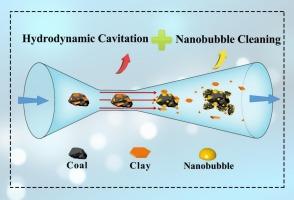
The clay coating on coal particle surface is one of the main reasons for poor coal flotation performance. It hinders the adsorption of flotation collector on coal particles and their subsequent attachment to air bubbles, leading to deteriorated flotation. This study was aimed to explore the effects and mechanisms of clay coating removal in coal flotation by hydrodynamic cavitation nanobubbles. The main characterization and analysis techniques employed included micro-flotation tests, spectrophotometer, focused beam reflectance measurement (FBRM), scanning electron microscopy (SEM), nanoparticle tracking analyzer (NTA). The flotation tests showed that nanobubbles enhanced the flotation recovery by up to 86.6 %. Nanobubbles significantly reduced the adverse effects of clay coating and thus produced a cleaner coal product. The kerosene adsorption capacity was almost doubled at a cavitation flow rate of 1000 mL/min. The in-situ FBRM characterization of particle sizes showed that the number of kaolinite particles increased dramatically in solution following the cavitation treatment of coal slurry. Meanwhile, a significant correlation was identified between nanobubble concentration and particle number in the solution. These results showed that the combined effect of hydrodynamic cavitation and nanobubbles effectively removed the clay coating from coal surface.
期刊介绍:
Powder Technology is an International Journal on the Science and Technology of Wet and Dry Particulate Systems. Powder Technology publishes papers on all aspects of the formation of particles and their characterisation and on the study of systems containing particulate solids. No limitation is imposed on the size of the particles, which may range from nanometre scale, as in pigments or aerosols, to that of mined or quarried materials. The following list of topics is not intended to be comprehensive, but rather to indicate typical subjects which fall within the scope of the journal's interests:
Formation and synthesis of particles by precipitation and other methods.
Modification of particles by agglomeration, coating, comminution and attrition.
Characterisation of the size, shape, surface area, pore structure and strength of particles and agglomerates (including the origins and effects of inter particle forces).
Packing, failure, flow and permeability of assemblies of particles.
Particle-particle interactions and suspension rheology.
Handling and processing operations such as slurry flow, fluidization, pneumatic conveying.
Interactions between particles and their environment, including delivery of particulate products to the body.
Applications of particle technology in production of pharmaceuticals, chemicals, foods, pigments, structural, and functional materials and in environmental and energy related matters.
For materials-oriented contributions we are looking for articles revealing the effect of particle/powder characteristics (size, morphology and composition, in that order) on material performance or functionality and, ideally, comparison to any industrial standard.




 京公网安备 11010802042870号
京ICP备2023020795号-1
京公网安备 11010802042870号
京ICP备2023020795号-1

 分享
分享
 求助内容:
求助内容: 应助结果提醒方式:
 扫码关注我们
