Jiamei Wang , Xin Hao , Xinyi Liu , Wei Ouyang , Tianzhi Li , Xintong Cui , Jietong Pei , Shangwei Zhang , Weihong Zhu , Ri Jin
{"title":"地下水-地表水交换影响季节性冻融流域硝酸盐的命运:来源、迁移和去除","authors":"Jiamei Wang , Xin Hao , Xinyi Liu , Wei Ouyang , Tianzhi Li , Xintong Cui , Jietong Pei , Shangwei Zhang , Weihong Zhu , Ri Jin","doi":"10.1016/j.jhydrol.2025.132803","DOIUrl":null,"url":null,"abstract":"<div><div>The interaction between groundwater and surface water (GW–SW) affects the hydrogeochemical cycle, leading to changes in nitrate sources, migration, and transformation within watersheds. Seasonal freeze–thaw cycles also complicate the above processes. This study employed hydrochemistry, stable isotope analysis, and statistical methods to investigate the dynamic characteristics of GW–SW exchange in a seasonal freeze–thaw watershed, identify the conversion intensities during different periods, and elucidate potential nitrate sources and their relative biogeochemical processes. GW and SW were replenished primarily by atmospheric precipitation, which switched to snowmelt water during the thawing period. Recharge sources and aquifer lithology controlled the seasonal variation in GW–SW exchange. From upstream to downstream, the conversion intensity ranges of SW loss into GW during the wet period were 54.6%, 32.7–55.5%, and 26.5–37.4%, respectively. The percentages of streams that gained GW during the dry period were 62.2–83.7%, 47.1–62.0%, and 35.2–46.0%, respectively. The primary sources of nitrate in GW and SW were fertilizers and livestock waste, with their contributions exhibiting seasonal variations with GW–SW interactions. Agricultural activities and livestock breeding led to high nitrate contents in groundwater, with manure and sewage accounting for up to 90% of the nitrate content during the dry period. Notably, GW–SW interactions during the wet and dry seasons enhanced the denitrification process, contributing to nitrate removal in groundwater. This study revealed that GW–SW interactions significantly impact the fate of nitrate in watersheds and the influence of human activities on watershed environments, providing technical support for watershed water resource management and diffuse pollution control.</div></div>","PeriodicalId":362,"journal":{"name":"Journal of Hydrology","volume":"654 ","pages":"Article 132803"},"PeriodicalIF":6.3000,"publicationDate":"2025-06-01","publicationTypes":"Journal Article","fieldsOfStudy":null,"isOpenAccess":false,"openAccessPdf":"","citationCount":"0","resultStr":"{\"title\":\"Groundwater–surface water exchange affects nitrate fate in a seasonal freeze–thaw watershed: Sources, migration and removal\",\"authors\":\"Jiamei Wang , Xin Hao , Xinyi Liu , Wei Ouyang , Tianzhi Li , Xintong Cui , Jietong Pei , Shangwei Zhang , Weihong Zhu , Ri Jin\",\"doi\":\"10.1016/j.jhydrol.2025.132803\",\"DOIUrl\":null,\"url\":null,\"abstract\":\"<div><div>The interaction between groundwater and surface water (GW–SW) affects the hydrogeochemical cycle, leading to changes in nitrate sources, migration, and transformation within watersheds. Seasonal freeze–thaw cycles also complicate the above processes. This study employed hydrochemistry, stable isotope analysis, and statistical methods to investigate the dynamic characteristics of GW–SW exchange in a seasonal freeze–thaw watershed, identify the conversion intensities during different periods, and elucidate potential nitrate sources and their relative biogeochemical processes. GW and SW were replenished primarily by atmospheric precipitation, which switched to snowmelt water during the thawing period. Recharge sources and aquifer lithology controlled the seasonal variation in GW–SW exchange. From upstream to downstream, the conversion intensity ranges of SW loss into GW during the wet period were 54.6%, 32.7–55.5%, and 26.5–37.4%, respectively. The percentages of streams that gained GW during the dry period were 62.2–83.7%, 47.1–62.0%, and 35.2–46.0%, respectively. The primary sources of nitrate in GW and SW were fertilizers and livestock waste, with their contributions exhibiting seasonal variations with GW–SW interactions. Agricultural activities and livestock breeding led to high nitrate contents in groundwater, with manure and sewage accounting for up to 90% of the nitrate content during the dry period. Notably, GW–SW interactions during the wet and dry seasons enhanced the denitrification process, contributing to nitrate removal in groundwater. This study revealed that GW–SW interactions significantly impact the fate of nitrate in watersheds and the influence of human activities on watershed environments, providing technical support for watershed water resource management and diffuse pollution control.</div></div>\",\"PeriodicalId\":362,\"journal\":{\"name\":\"Journal of Hydrology\",\"volume\":\"654 \",\"pages\":\"Article 132803\"},\"PeriodicalIF\":6.3000,\"publicationDate\":\"2025-06-01\",\"publicationTypes\":\"Journal Article\",\"fieldsOfStudy\":null,\"isOpenAccess\":false,\"openAccessPdf\":\"\",\"citationCount\":\"0\",\"resultStr\":null,\"platform\":\"Semanticscholar\",\"paperid\":null,\"PeriodicalName\":\"Journal of Hydrology\",\"FirstCategoryId\":\"89\",\"ListUrlMain\":\"https://www.sciencedirect.com/science/article/pii/S0022169425001416\",\"RegionNum\":1,\"RegionCategory\":\"地球科学\",\"ArticlePicture\":[],\"TitleCN\":null,\"AbstractTextCN\":null,\"PMCID\":null,\"EPubDate\":\"2025/2/8 0:00:00\",\"PubModel\":\"Epub\",\"JCR\":\"Q1\",\"JCRName\":\"ENGINEERING, CIVIL\",\"Score\":null,\"Total\":0}","platform":"Semanticscholar","paperid":null,"PeriodicalName":"Journal of Hydrology","FirstCategoryId":"89","ListUrlMain":"https://www.sciencedirect.com/science/article/pii/S0022169425001416","RegionNum":1,"RegionCategory":"地球科学","ArticlePicture":[],"TitleCN":null,"AbstractTextCN":null,"PMCID":null,"EPubDate":"2025/2/8 0:00:00","PubModel":"Epub","JCR":"Q1","JCRName":"ENGINEERING, CIVIL","Score":null,"Total":0}
Groundwater–surface water exchange affects nitrate fate in a seasonal freeze–thaw watershed: Sources, migration and removal
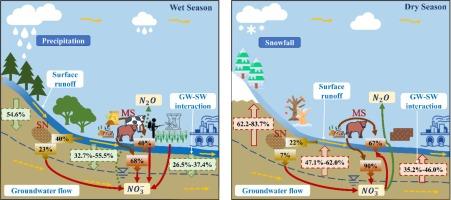
The interaction between groundwater and surface water (GW–SW) affects the hydrogeochemical cycle, leading to changes in nitrate sources, migration, and transformation within watersheds. Seasonal freeze–thaw cycles also complicate the above processes. This study employed hydrochemistry, stable isotope analysis, and statistical methods to investigate the dynamic characteristics of GW–SW exchange in a seasonal freeze–thaw watershed, identify the conversion intensities during different periods, and elucidate potential nitrate sources and their relative biogeochemical processes. GW and SW were replenished primarily by atmospheric precipitation, which switched to snowmelt water during the thawing period. Recharge sources and aquifer lithology controlled the seasonal variation in GW–SW exchange. From upstream to downstream, the conversion intensity ranges of SW loss into GW during the wet period were 54.6%, 32.7–55.5%, and 26.5–37.4%, respectively. The percentages of streams that gained GW during the dry period were 62.2–83.7%, 47.1–62.0%, and 35.2–46.0%, respectively. The primary sources of nitrate in GW and SW were fertilizers and livestock waste, with their contributions exhibiting seasonal variations with GW–SW interactions. Agricultural activities and livestock breeding led to high nitrate contents in groundwater, with manure and sewage accounting for up to 90% of the nitrate content during the dry period. Notably, GW–SW interactions during the wet and dry seasons enhanced the denitrification process, contributing to nitrate removal in groundwater. This study revealed that GW–SW interactions significantly impact the fate of nitrate in watersheds and the influence of human activities on watershed environments, providing technical support for watershed water resource management and diffuse pollution control.
期刊介绍:
The Journal of Hydrology publishes original research papers and comprehensive reviews in all the subfields of the hydrological sciences including water based management and policy issues that impact on economics and society. These comprise, but are not limited to the physical, chemical, biogeochemical, stochastic and systems aspects of surface and groundwater hydrology, hydrometeorology and hydrogeology. Relevant topics incorporating the insights and methodologies of disciplines such as climatology, water resource systems, hydraulics, agrohydrology, geomorphology, soil science, instrumentation and remote sensing, civil and environmental engineering are included. Social science perspectives on hydrological problems such as resource and ecological economics, environmental sociology, psychology and behavioural science, management and policy analysis are also invited. Multi-and interdisciplinary analyses of hydrological problems are within scope. The science published in the Journal of Hydrology is relevant to catchment scales rather than exclusively to a local scale or site.




 京公网安备 11010802042870号
京ICP备2023020795号-1
京公网安备 11010802042870号
京ICP备2023020795号-1

 分享
分享
 求助内容:
求助内容: 应助结果提醒方式:
 扫码关注我们
