Tingting Zhang , Jin He , Ning Xu , Wang Yin , Dongli Liu , Chang Liu , Meidong Lang
{"title":"改善I型和II型层间断裂韧性和抗冲击性能的玻璃纤维增强改性PDCPD复合材料:基体性能的影响","authors":"Tingting Zhang , Jin He , Ning Xu , Wang Yin , Dongli Liu , Chang Liu , Meidong Lang","doi":"10.1016/j.compositesb.2025.112225","DOIUrl":null,"url":null,"abstract":"<div><div>During the service life of thermoset matrix fiber-reinforced polymer composites, they are susceptible to structural damage such as delamination after low-velocity impacts, thereby affecting their mechanical properties and structural integrity. Therefore, this paper adjusted the properties of polydicyclopentadiene matrix through copolymerization and incorporation of elastomers to obtain modified polydicyclopentadiene/glass fiber composites with improved interlaminar fracture toughness and impact resistance without significantly sacrificing rigidity. The results indicated that compared to polydicyclopentadiene/glass fiber, the G<sub>Ⅰ,R</sub> increased from 2.61 kJ/m<sup>2</sup> to 4.33 kJ/m<sup>2</sup> and the G<sub>ⅡC</sub> increased from 3.04 kJ/m<sup>2</sup> to 4.07 kJ/m<sup>2</sup> by incorporating 10 wt% cyclooctadiene and 2 phr styrene-ethylene-butylene-styrene. The energy dissipation mechanisms leading to these improvements included matrix ductile fracture, shear yielding, particle crack bridging, particle fracture, and particle debonding. Additionally, compared to polydicyclopentadiene/glass fiber, the damage area decreased under drop weight impact by incorporating styrene-ethylene-butylene-styrene. Moreover, compared with epoxy/glass fiber composites, modified polydicyclopentadiene/glass fiber composites demonstrated superior interlaminar fracture toughness and impact resistance. The interlaminar fracture toughness of modified polydicyclopentadiene/glass fiber was comparable to that of thermoplastic matrix composites. This study provided a significant method for enhancing the interlaminar toughness and impact resistance of polydicyclopentadiene/glass fiber composites by adjusting the matrix toughness.</div></div>","PeriodicalId":10660,"journal":{"name":"Composites Part B: Engineering","volume":"296 ","pages":"Article 112225"},"PeriodicalIF":14.2000,"publicationDate":"2025-05-01","publicationTypes":"Journal Article","fieldsOfStudy":null,"isOpenAccess":false,"openAccessPdf":"","citationCount":"0","resultStr":"{\"title\":\"Glass fiber-reinforced modified PDCPD composites with improving mode I and mode II interlaminar fracture toughness and impact resistance: Effects of matrix properties\",\"authors\":\"Tingting Zhang , Jin He , Ning Xu , Wang Yin , Dongli Liu , Chang Liu , Meidong Lang\",\"doi\":\"10.1016/j.compositesb.2025.112225\",\"DOIUrl\":null,\"url\":null,\"abstract\":\"<div><div>During the service life of thermoset matrix fiber-reinforced polymer composites, they are susceptible to structural damage such as delamination after low-velocity impacts, thereby affecting their mechanical properties and structural integrity. Therefore, this paper adjusted the properties of polydicyclopentadiene matrix through copolymerization and incorporation of elastomers to obtain modified polydicyclopentadiene/glass fiber composites with improved interlaminar fracture toughness and impact resistance without significantly sacrificing rigidity. The results indicated that compared to polydicyclopentadiene/glass fiber, the G<sub>Ⅰ,R</sub> increased from 2.61 kJ/m<sup>2</sup> to 4.33 kJ/m<sup>2</sup> and the G<sub>ⅡC</sub> increased from 3.04 kJ/m<sup>2</sup> to 4.07 kJ/m<sup>2</sup> by incorporating 10 wt% cyclooctadiene and 2 phr styrene-ethylene-butylene-styrene. The energy dissipation mechanisms leading to these improvements included matrix ductile fracture, shear yielding, particle crack bridging, particle fracture, and particle debonding. Additionally, compared to polydicyclopentadiene/glass fiber, the damage area decreased under drop weight impact by incorporating styrene-ethylene-butylene-styrene. Moreover, compared with epoxy/glass fiber composites, modified polydicyclopentadiene/glass fiber composites demonstrated superior interlaminar fracture toughness and impact resistance. The interlaminar fracture toughness of modified polydicyclopentadiene/glass fiber was comparable to that of thermoplastic matrix composites. This study provided a significant method for enhancing the interlaminar toughness and impact resistance of polydicyclopentadiene/glass fiber composites by adjusting the matrix toughness.</div></div>\",\"PeriodicalId\":10660,\"journal\":{\"name\":\"Composites Part B: Engineering\",\"volume\":\"296 \",\"pages\":\"Article 112225\"},\"PeriodicalIF\":14.2000,\"publicationDate\":\"2025-05-01\",\"publicationTypes\":\"Journal Article\",\"fieldsOfStudy\":null,\"isOpenAccess\":false,\"openAccessPdf\":\"\",\"citationCount\":\"0\",\"resultStr\":null,\"platform\":\"Semanticscholar\",\"paperid\":null,\"PeriodicalName\":\"Composites Part B: Engineering\",\"FirstCategoryId\":\"5\",\"ListUrlMain\":\"https://www.sciencedirect.com/science/article/pii/S1359836825001155\",\"RegionNum\":1,\"RegionCategory\":\"材料科学\",\"ArticlePicture\":[],\"TitleCN\":null,\"AbstractTextCN\":null,\"PMCID\":null,\"EPubDate\":\"2025/2/10 0:00:00\",\"PubModel\":\"Epub\",\"JCR\":\"Q1\",\"JCRName\":\"ENGINEERING, MULTIDISCIPLINARY\",\"Score\":null,\"Total\":0}","platform":"Semanticscholar","paperid":null,"PeriodicalName":"Composites Part B: Engineering","FirstCategoryId":"5","ListUrlMain":"https://www.sciencedirect.com/science/article/pii/S1359836825001155","RegionNum":1,"RegionCategory":"材料科学","ArticlePicture":[],"TitleCN":null,"AbstractTextCN":null,"PMCID":null,"EPubDate":"2025/2/10 0:00:00","PubModel":"Epub","JCR":"Q1","JCRName":"ENGINEERING, MULTIDISCIPLINARY","Score":null,"Total":0}
Glass fiber-reinforced modified PDCPD composites with improving mode I and mode II interlaminar fracture toughness and impact resistance: Effects of matrix properties
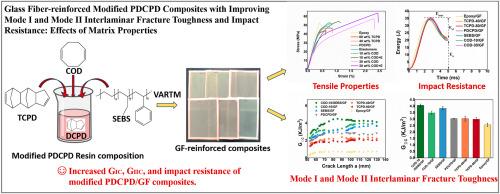
During the service life of thermoset matrix fiber-reinforced polymer composites, they are susceptible to structural damage such as delamination after low-velocity impacts, thereby affecting their mechanical properties and structural integrity. Therefore, this paper adjusted the properties of polydicyclopentadiene matrix through copolymerization and incorporation of elastomers to obtain modified polydicyclopentadiene/glass fiber composites with improved interlaminar fracture toughness and impact resistance without significantly sacrificing rigidity. The results indicated that compared to polydicyclopentadiene/glass fiber, the GⅠ,R increased from 2.61 kJ/m2 to 4.33 kJ/m2 and the GⅡC increased from 3.04 kJ/m2 to 4.07 kJ/m2 by incorporating 10 wt% cyclooctadiene and 2 phr styrene-ethylene-butylene-styrene. The energy dissipation mechanisms leading to these improvements included matrix ductile fracture, shear yielding, particle crack bridging, particle fracture, and particle debonding. Additionally, compared to polydicyclopentadiene/glass fiber, the damage area decreased under drop weight impact by incorporating styrene-ethylene-butylene-styrene. Moreover, compared with epoxy/glass fiber composites, modified polydicyclopentadiene/glass fiber composites demonstrated superior interlaminar fracture toughness and impact resistance. The interlaminar fracture toughness of modified polydicyclopentadiene/glass fiber was comparable to that of thermoplastic matrix composites. This study provided a significant method for enhancing the interlaminar toughness and impact resistance of polydicyclopentadiene/glass fiber composites by adjusting the matrix toughness.
期刊介绍:
Composites Part B: Engineering is a journal that publishes impactful research of high quality on composite materials. This research is supported by fundamental mechanics and materials science and engineering approaches. The targeted research can cover a wide range of length scales, ranging from nano to micro and meso, and even to the full product and structure level. The journal specifically focuses on engineering applications that involve high performance composites. These applications can range from low volume and high cost to high volume and low cost composite development.
The main goal of the journal is to provide a platform for the prompt publication of original and high quality research. The emphasis is on design, development, modeling, validation, and manufacturing of engineering details and concepts. The journal welcomes both basic research papers and proposals for review articles. Authors are encouraged to address challenges across various application areas. These areas include, but are not limited to, aerospace, automotive, and other surface transportation. The journal also covers energy-related applications, with a focus on renewable energy. Other application areas include infrastructure, off-shore and maritime projects, health care technology, and recreational products.




 京公网安备 11010802042870号
京ICP备2023020795号-1
京公网安备 11010802042870号
京ICP备2023020795号-1

 分享
分享
 求助内容:
求助内容: 应助结果提醒方式:
 扫码关注我们
