Jingna Wu, Xiaoya Wang, Kun Qiao, Nan Pan, Xiaoting Chen, Zhiyu Liu, Yuanxin Chen
{"title":"鲍鱼肽的筛选及抗氧化活性评价","authors":"Jingna Wu, Xiaoya Wang, Kun Qiao, Nan Pan, Xiaoting Chen, Zhiyu Liu, Yuanxin Chen","doi":"10.1002/fsn3.70028","DOIUrl":null,"url":null,"abstract":"<p>Marine organisms are rich in antioxidant peptides; however, extracting these peptides is time-consuming, labor-intensive, and costly, with sequence losses leading to uncertain results. This study aimed to identify abalone-derived antioxidant peptides with strong Keap1 binding ability and validate their antioxidative activities using a cellular oxidative damage model. We constructed an abalone-derived peptide library comprising 363 peptides using virtual enzymatic hydrolysis techniques. Of the 98 human Keap1 protein structures available in the protein data bank database, 2FLU was selected as the receptor. Using the CDOCKER module in Discovery Studio software, molecular docking was performed with the peptide library as ligands and 2FLU as the receptor, targeting the binding site at coordinates <i>x</i>: 5.000222, <i>y</i>: 7.103889 and <i>z</i>: 5.058000. Ten abalone-derived peptides with the strongest inhibition against Keap1–Nrf2 interaction were identified. A 2,2′-azobis (2-methylpropionamidine) dihydrochloride (AAPH)-induced oxidative damage model in human umbilical vein endothelial cells (HUVECs) was used to verify the molecular docking results and identified DEDEDEDK as the most active antioxidant peptide. DEDEDEDK interferes with Keap1–Nrf2 binding, significantly reducing reactive oxygen species levels in damaged cells, increasing superoxide dismutase and catalase activities, and elevated glutathione content, indicating its potential to mitigate AAPH-induced oxidative damage in HUVECs.</p>","PeriodicalId":12418,"journal":{"name":"Food Science & Nutrition","volume":"13 2","pages":""},"PeriodicalIF":5.0000,"publicationDate":"2025-02-09","publicationTypes":"Journal Article","fieldsOfStudy":null,"isOpenAccess":false,"openAccessPdf":"https://onlinelibrary.wiley.com/doi/epdf/10.1002/fsn3.70028","citationCount":"0","resultStr":"{\"title\":\"Screening and Antioxidant Activities Evaluation of Peptides From Abalone (Haliotis discus hannai Ino)\",\"authors\":\"Jingna Wu, Xiaoya Wang, Kun Qiao, Nan Pan, Xiaoting Chen, Zhiyu Liu, Yuanxin Chen\",\"doi\":\"10.1002/fsn3.70028\",\"DOIUrl\":null,\"url\":null,\"abstract\":\"<p>Marine organisms are rich in antioxidant peptides; however, extracting these peptides is time-consuming, labor-intensive, and costly, with sequence losses leading to uncertain results. This study aimed to identify abalone-derived antioxidant peptides with strong Keap1 binding ability and validate their antioxidative activities using a cellular oxidative damage model. We constructed an abalone-derived peptide library comprising 363 peptides using virtual enzymatic hydrolysis techniques. Of the 98 human Keap1 protein structures available in the protein data bank database, 2FLU was selected as the receptor. Using the CDOCKER module in Discovery Studio software, molecular docking was performed with the peptide library as ligands and 2FLU as the receptor, targeting the binding site at coordinates <i>x</i>: 5.000222, <i>y</i>: 7.103889 and <i>z</i>: 5.058000. Ten abalone-derived peptides with the strongest inhibition against Keap1–Nrf2 interaction were identified. A 2,2′-azobis (2-methylpropionamidine) dihydrochloride (AAPH)-induced oxidative damage model in human umbilical vein endothelial cells (HUVECs) was used to verify the molecular docking results and identified DEDEDEDK as the most active antioxidant peptide. DEDEDEDK interferes with Keap1–Nrf2 binding, significantly reducing reactive oxygen species levels in damaged cells, increasing superoxide dismutase and catalase activities, and elevated glutathione content, indicating its potential to mitigate AAPH-induced oxidative damage in HUVECs.</p>\",\"PeriodicalId\":12418,\"journal\":{\"name\":\"Food Science & Nutrition\",\"volume\":\"13 2\",\"pages\":\"\"},\"PeriodicalIF\":5.0000,\"publicationDate\":\"2025-02-09\",\"publicationTypes\":\"Journal Article\",\"fieldsOfStudy\":null,\"isOpenAccess\":false,\"openAccessPdf\":\"https://onlinelibrary.wiley.com/doi/epdf/10.1002/fsn3.70028\",\"citationCount\":\"0\",\"resultStr\":null,\"platform\":\"Semanticscholar\",\"paperid\":null,\"PeriodicalName\":\"Food Science & Nutrition\",\"FirstCategoryId\":\"97\",\"ListUrlMain\":\"https://onlinelibrary.wiley.com/doi/10.1002/fsn3.70028\",\"RegionNum\":2,\"RegionCategory\":\"农林科学\",\"ArticlePicture\":[],\"TitleCN\":null,\"AbstractTextCN\":null,\"PMCID\":null,\"EPubDate\":\"\",\"PubModel\":\"\",\"JCR\":\"Q2\",\"JCRName\":\"FOOD SCIENCE & TECHNOLOGY\",\"Score\":null,\"Total\":0}","platform":"Semanticscholar","paperid":null,"PeriodicalName":"Food Science & Nutrition","FirstCategoryId":"97","ListUrlMain":"https://onlinelibrary.wiley.com/doi/10.1002/fsn3.70028","RegionNum":2,"RegionCategory":"农林科学","ArticlePicture":[],"TitleCN":null,"AbstractTextCN":null,"PMCID":null,"EPubDate":"","PubModel":"","JCR":"Q2","JCRName":"FOOD SCIENCE & TECHNOLOGY","Score":null,"Total":0}
Screening and Antioxidant Activities Evaluation of Peptides From Abalone (Haliotis discus hannai Ino)
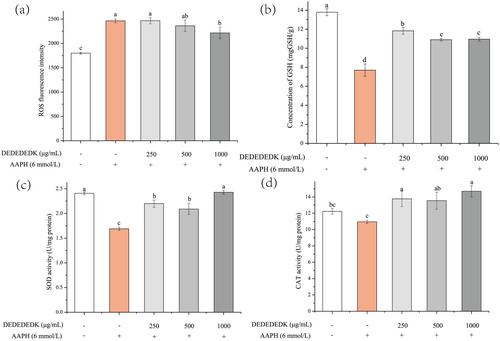
Marine organisms are rich in antioxidant peptides; however, extracting these peptides is time-consuming, labor-intensive, and costly, with sequence losses leading to uncertain results. This study aimed to identify abalone-derived antioxidant peptides with strong Keap1 binding ability and validate their antioxidative activities using a cellular oxidative damage model. We constructed an abalone-derived peptide library comprising 363 peptides using virtual enzymatic hydrolysis techniques. Of the 98 human Keap1 protein structures available in the protein data bank database, 2FLU was selected as the receptor. Using the CDOCKER module in Discovery Studio software, molecular docking was performed with the peptide library as ligands and 2FLU as the receptor, targeting the binding site at coordinates x: 5.000222, y: 7.103889 and z: 5.058000. Ten abalone-derived peptides with the strongest inhibition against Keap1–Nrf2 interaction were identified. A 2,2′-azobis (2-methylpropionamidine) dihydrochloride (AAPH)-induced oxidative damage model in human umbilical vein endothelial cells (HUVECs) was used to verify the molecular docking results and identified DEDEDEDK as the most active antioxidant peptide. DEDEDEDK interferes with Keap1–Nrf2 binding, significantly reducing reactive oxygen species levels in damaged cells, increasing superoxide dismutase and catalase activities, and elevated glutathione content, indicating its potential to mitigate AAPH-induced oxidative damage in HUVECs.
期刊介绍:
Food Science & Nutrition is the peer-reviewed journal for rapid dissemination of research in all areas of food science and nutrition. The Journal will consider submissions of quality papers describing the results of fundamental and applied research related to all aspects of human food and nutrition, as well as interdisciplinary research that spans these two fields.




 京公网安备 11010802042870号
京ICP备2023020795号-1
京公网安备 11010802042870号
京ICP备2023020795号-1

 分享
分享
 求助内容:
求助内容: 应助结果提醒方式:
 扫码关注我们
