Yue He , Hui Yun , Liang Peng , Wenxue Wang , Ting Xu , Wenjie Zhang , Xiangkai Li
{"title":"合成微生物群落在环境扰动下维持好氧反硝化的功能稳定:种间分工机制的新认识","authors":"Yue He , Hui Yun , Liang Peng , Wenxue Wang , Ting Xu , Wenjie Zhang , Xiangkai Li","doi":"10.1016/j.watres.2025.123270","DOIUrl":null,"url":null,"abstract":"<div><div>Understanding how synthetic microbial community (SMC) respond to environmental disturbances is the key to realizing SMC engineering applications. Here, dibutyl phthalate (DBP) and levofloxacin (LOFX) were used as environmental disturbances to study their effects on the aerobic denitrification functional stability of SMC composed of <em>Pseudomonas aeruginosa</em> N2 (PA), <em>Acinetobacter baumannii</em> N1(AC) and <em>Aeromonas hydrophila</em> (AH). The results showed that aerobic denitrification efficiency could be maintained at about 93 % under DBP or LOFX disturbance, and interspecific communication was mainly carried out through N-butyryl-L-homoserine lactone (C<sub>4</sub>-HSL) and N-(3-oxododecanoyl)-L-homoserine lactone (3OC<sub>12</sub>-HSL), correspondingly. DBP and LOFX induced the acceleration of tricarboxylic acid (TCA) cycle, which facilitated the energy flux and extracellular polymeric substances (EPS) production, thereby allowing SMC to adapt to disturbances. Under DBP disturbance, DBP stimulated phenazine-1-carboxylic acid production to accelerate electron transfer from the quinone pool to complex III, resulting in an increase in electron transfer activity. Up-regulation of complex I, complex III and heme synthesis genes under LOFX disturbance led to enhanced denitrification enzymes expression and electron transfer efficiency. SMC re-regulated different metabolic pathways to build metabolic networks to maintain normal metabolic activity under different disturbances. Overall, SMC maintained functional stability through the labor division in modulation of interspecific communication, formation of defensive barriers, promotion of energy flux, directional transfer of electron flux, and reconstruction of metabolic networks. DBP stimulated AH and PA to occupy functional dominance, while LOFX induced AC and PA to play a major role. The understanding of the stability mechanism under different environmental disturbances provides valuable guidance for stability maintenance and engineering applications of SMC.</div></div>","PeriodicalId":443,"journal":{"name":"Water Research","volume":"277 ","pages":"Article 123270"},"PeriodicalIF":12.4000,"publicationDate":"2025-06-01","publicationTypes":"Journal Article","fieldsOfStudy":null,"isOpenAccess":false,"openAccessPdf":"","citationCount":"0","resultStr":"{\"title\":\"Synthetic microbial community maintains the functional stability of aerobic denitrification under environmental disturbances: Insight into the mechanism of interspecific division of labor\",\"authors\":\"Yue He , Hui Yun , Liang Peng , Wenxue Wang , Ting Xu , Wenjie Zhang , Xiangkai Li\",\"doi\":\"10.1016/j.watres.2025.123270\",\"DOIUrl\":null,\"url\":null,\"abstract\":\"<div><div>Understanding how synthetic microbial community (SMC) respond to environmental disturbances is the key to realizing SMC engineering applications. Here, dibutyl phthalate (DBP) and levofloxacin (LOFX) were used as environmental disturbances to study their effects on the aerobic denitrification functional stability of SMC composed of <em>Pseudomonas aeruginosa</em> N2 (PA), <em>Acinetobacter baumannii</em> N1(AC) and <em>Aeromonas hydrophila</em> (AH). The results showed that aerobic denitrification efficiency could be maintained at about 93 % under DBP or LOFX disturbance, and interspecific communication was mainly carried out through N-butyryl-L-homoserine lactone (C<sub>4</sub>-HSL) and N-(3-oxododecanoyl)-L-homoserine lactone (3OC<sub>12</sub>-HSL), correspondingly. DBP and LOFX induced the acceleration of tricarboxylic acid (TCA) cycle, which facilitated the energy flux and extracellular polymeric substances (EPS) production, thereby allowing SMC to adapt to disturbances. Under DBP disturbance, DBP stimulated phenazine-1-carboxylic acid production to accelerate electron transfer from the quinone pool to complex III, resulting in an increase in electron transfer activity. Up-regulation of complex I, complex III and heme synthesis genes under LOFX disturbance led to enhanced denitrification enzymes expression and electron transfer efficiency. SMC re-regulated different metabolic pathways to build metabolic networks to maintain normal metabolic activity under different disturbances. Overall, SMC maintained functional stability through the labor division in modulation of interspecific communication, formation of defensive barriers, promotion of energy flux, directional transfer of electron flux, and reconstruction of metabolic networks. DBP stimulated AH and PA to occupy functional dominance, while LOFX induced AC and PA to play a major role. The understanding of the stability mechanism under different environmental disturbances provides valuable guidance for stability maintenance and engineering applications of SMC.</div></div>\",\"PeriodicalId\":443,\"journal\":{\"name\":\"Water Research\",\"volume\":\"277 \",\"pages\":\"Article 123270\"},\"PeriodicalIF\":12.4000,\"publicationDate\":\"2025-06-01\",\"publicationTypes\":\"Journal Article\",\"fieldsOfStudy\":null,\"isOpenAccess\":false,\"openAccessPdf\":\"\",\"citationCount\":\"0\",\"resultStr\":null,\"platform\":\"Semanticscholar\",\"paperid\":null,\"PeriodicalName\":\"Water Research\",\"FirstCategoryId\":\"93\",\"ListUrlMain\":\"https://www.sciencedirect.com/science/article/pii/S0043135425001848\",\"RegionNum\":1,\"RegionCategory\":\"环境科学与生态学\",\"ArticlePicture\":[],\"TitleCN\":null,\"AbstractTextCN\":null,\"PMCID\":null,\"EPubDate\":\"2025/2/10 0:00:00\",\"PubModel\":\"Epub\",\"JCR\":\"Q1\",\"JCRName\":\"ENGINEERING, ENVIRONMENTAL\",\"Score\":null,\"Total\":0}","platform":"Semanticscholar","paperid":null,"PeriodicalName":"Water Research","FirstCategoryId":"93","ListUrlMain":"https://www.sciencedirect.com/science/article/pii/S0043135425001848","RegionNum":1,"RegionCategory":"环境科学与生态学","ArticlePicture":[],"TitleCN":null,"AbstractTextCN":null,"PMCID":null,"EPubDate":"2025/2/10 0:00:00","PubModel":"Epub","JCR":"Q1","JCRName":"ENGINEERING, ENVIRONMENTAL","Score":null,"Total":0}
Synthetic microbial community maintains the functional stability of aerobic denitrification under environmental disturbances: Insight into the mechanism of interspecific division of labor
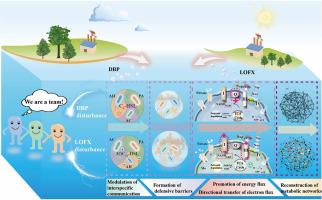
Understanding how synthetic microbial community (SMC) respond to environmental disturbances is the key to realizing SMC engineering applications. Here, dibutyl phthalate (DBP) and levofloxacin (LOFX) were used as environmental disturbances to study their effects on the aerobic denitrification functional stability of SMC composed of Pseudomonas aeruginosa N2 (PA), Acinetobacter baumannii N1(AC) and Aeromonas hydrophila (AH). The results showed that aerobic denitrification efficiency could be maintained at about 93 % under DBP or LOFX disturbance, and interspecific communication was mainly carried out through N-butyryl-L-homoserine lactone (C4-HSL) and N-(3-oxododecanoyl)-L-homoserine lactone (3OC12-HSL), correspondingly. DBP and LOFX induced the acceleration of tricarboxylic acid (TCA) cycle, which facilitated the energy flux and extracellular polymeric substances (EPS) production, thereby allowing SMC to adapt to disturbances. Under DBP disturbance, DBP stimulated phenazine-1-carboxylic acid production to accelerate electron transfer from the quinone pool to complex III, resulting in an increase in electron transfer activity. Up-regulation of complex I, complex III and heme synthesis genes under LOFX disturbance led to enhanced denitrification enzymes expression and electron transfer efficiency. SMC re-regulated different metabolic pathways to build metabolic networks to maintain normal metabolic activity under different disturbances. Overall, SMC maintained functional stability through the labor division in modulation of interspecific communication, formation of defensive barriers, promotion of energy flux, directional transfer of electron flux, and reconstruction of metabolic networks. DBP stimulated AH and PA to occupy functional dominance, while LOFX induced AC and PA to play a major role. The understanding of the stability mechanism under different environmental disturbances provides valuable guidance for stability maintenance and engineering applications of SMC.
期刊介绍:
Water Research, along with its open access companion journal Water Research X, serves as a platform for publishing original research papers covering various aspects of the science and technology related to the anthropogenic water cycle, water quality, and its management worldwide. The audience targeted by the journal comprises biologists, chemical engineers, chemists, civil engineers, environmental engineers, limnologists, and microbiologists. The scope of the journal include:
•Treatment processes for water and wastewaters (municipal, agricultural, industrial, and on-site treatment), including resource recovery and residuals management;
•Urban hydrology including sewer systems, stormwater management, and green infrastructure;
•Drinking water treatment and distribution;
•Potable and non-potable water reuse;
•Sanitation, public health, and risk assessment;
•Anaerobic digestion, solid and hazardous waste management, including source characterization and the effects and control of leachates and gaseous emissions;
•Contaminants (chemical, microbial, anthropogenic particles such as nanoparticles or microplastics) and related water quality sensing, monitoring, fate, and assessment;
•Anthropogenic impacts on inland, tidal, coastal and urban waters, focusing on surface and ground waters, and point and non-point sources of pollution;
•Environmental restoration, linked to surface water, groundwater and groundwater remediation;
•Analysis of the interfaces between sediments and water, and between water and atmosphere, focusing specifically on anthropogenic impacts;
•Mathematical modelling, systems analysis, machine learning, and beneficial use of big data related to the anthropogenic water cycle;
•Socio-economic, policy, and regulations studies.





 京公网安备 11010802042870号
京ICP备2023020795号-1
京公网安备 11010802042870号
京ICP备2023020795号-1

 分享
分享
 求助内容:
求助内容: 应助结果提醒方式:
 扫码关注我们
