Huan Liu, Chenghan Yang, Tong Bian, Huijun Yu, Yuming Zhou, Yiwei Zhang, Li Sun
{"title":"通过调节铜和锡氧化物之间的界面相来调节CO2电还原成乙烯或乙醇的选择性","authors":"Huan Liu, Chenghan Yang, Tong Bian, Huijun Yu, Yuming Zhou, Yiwei Zhang, Li Sun","doi":"10.1002/aenm.202405658","DOIUrl":null,"url":null,"abstract":"<p>Enhancing the selectivity of C<sub>2</sub> products and revealing the reaction mechanisms in CO<sub>2</sub> electroreduction reaction (CO<sub>2</sub>RR) remain challenging. Regulating the interphases in catalysts is one of the most promising pathways. Herein, the interphases between copper (Cu) and tin (Sn) oxides are regulated by controlling the degree of reduction during the self-assembly process, which exhibits obvious different selectivity to ethylene and ethanol, respectively. The interphase in Cu-SnO<sub>2</sub> exhibits selectivity to ethanol as high as 74.6%, while the interphase in Cu<sub>2</sub>O-SnO<sub>2</sub> shows selectivity to ethylene as high as 71.4% at –0.6 V versus RHE. In situ Fourier-transform infrared spectroscopy measurements and density functional theory calculations demonstrate that the interphase in Cu-SnO<sub>2</sub> shows strong electron interaction, preferentially forming the key *COH intermediates for asymmetrical C─C coupling to produce ethanol. In contrast, Cu<sub>2</sub>O-SnO<sub>2</sub> possesses oxygen vacancies at both sites, thus enriching *CO intermediates for symmetrical C─C coupling to produce ethylene at the interphase. The findings in this work offer an advanced strategy by regulating the interphases to adjust C<sub>2</sub> selectivity in CO<sub>2</sub>RR.</p>","PeriodicalId":111,"journal":{"name":"Advanced Energy Materials","volume":"15 23","pages":""},"PeriodicalIF":26.0000,"publicationDate":"2025-02-10","publicationTypes":"Journal Article","fieldsOfStudy":null,"isOpenAccess":false,"openAccessPdf":"","citationCount":"0","resultStr":"{\"title\":\"Adjustable Selectivity for CO2 Electroreduction to Ethylene or Ethanol by Regulating Interphases Between Copper and Tin Oxides\",\"authors\":\"Huan Liu, Chenghan Yang, Tong Bian, Huijun Yu, Yuming Zhou, Yiwei Zhang, Li Sun\",\"doi\":\"10.1002/aenm.202405658\",\"DOIUrl\":null,\"url\":null,\"abstract\":\"<p>Enhancing the selectivity of C<sub>2</sub> products and revealing the reaction mechanisms in CO<sub>2</sub> electroreduction reaction (CO<sub>2</sub>RR) remain challenging. Regulating the interphases in catalysts is one of the most promising pathways. Herein, the interphases between copper (Cu) and tin (Sn) oxides are regulated by controlling the degree of reduction during the self-assembly process, which exhibits obvious different selectivity to ethylene and ethanol, respectively. The interphase in Cu-SnO<sub>2</sub> exhibits selectivity to ethanol as high as 74.6%, while the interphase in Cu<sub>2</sub>O-SnO<sub>2</sub> shows selectivity to ethylene as high as 71.4% at –0.6 V versus RHE. In situ Fourier-transform infrared spectroscopy measurements and density functional theory calculations demonstrate that the interphase in Cu-SnO<sub>2</sub> shows strong electron interaction, preferentially forming the key *COH intermediates for asymmetrical C─C coupling to produce ethanol. In contrast, Cu<sub>2</sub>O-SnO<sub>2</sub> possesses oxygen vacancies at both sites, thus enriching *CO intermediates for symmetrical C─C coupling to produce ethylene at the interphase. The findings in this work offer an advanced strategy by regulating the interphases to adjust C<sub>2</sub> selectivity in CO<sub>2</sub>RR.</p>\",\"PeriodicalId\":111,\"journal\":{\"name\":\"Advanced Energy Materials\",\"volume\":\"15 23\",\"pages\":\"\"},\"PeriodicalIF\":26.0000,\"publicationDate\":\"2025-02-10\",\"publicationTypes\":\"Journal Article\",\"fieldsOfStudy\":null,\"isOpenAccess\":false,\"openAccessPdf\":\"\",\"citationCount\":\"0\",\"resultStr\":null,\"platform\":\"Semanticscholar\",\"paperid\":null,\"PeriodicalName\":\"Advanced Energy Materials\",\"FirstCategoryId\":\"88\",\"ListUrlMain\":\"https://advanced.onlinelibrary.wiley.com/doi/10.1002/aenm.202405658\",\"RegionNum\":1,\"RegionCategory\":\"材料科学\",\"ArticlePicture\":[],\"TitleCN\":null,\"AbstractTextCN\":null,\"PMCID\":null,\"EPubDate\":\"\",\"PubModel\":\"\",\"JCR\":\"Q1\",\"JCRName\":\"CHEMISTRY, PHYSICAL\",\"Score\":null,\"Total\":0}","platform":"Semanticscholar","paperid":null,"PeriodicalName":"Advanced Energy Materials","FirstCategoryId":"88","ListUrlMain":"https://advanced.onlinelibrary.wiley.com/doi/10.1002/aenm.202405658","RegionNum":1,"RegionCategory":"材料科学","ArticlePicture":[],"TitleCN":null,"AbstractTextCN":null,"PMCID":null,"EPubDate":"","PubModel":"","JCR":"Q1","JCRName":"CHEMISTRY, PHYSICAL","Score":null,"Total":0}
Adjustable Selectivity for CO2 Electroreduction to Ethylene or Ethanol by Regulating Interphases Between Copper and Tin Oxides
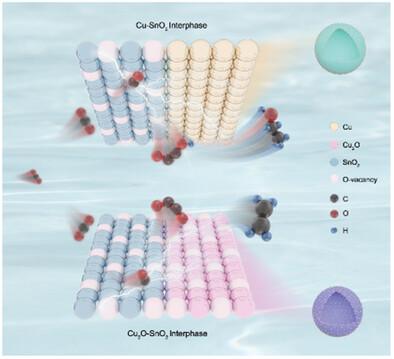
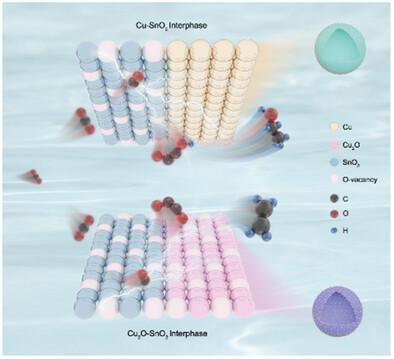
Enhancing the selectivity of C2 products and revealing the reaction mechanisms in CO2 electroreduction reaction (CO2RR) remain challenging. Regulating the interphases in catalysts is one of the most promising pathways. Herein, the interphases between copper (Cu) and tin (Sn) oxides are regulated by controlling the degree of reduction during the self-assembly process, which exhibits obvious different selectivity to ethylene and ethanol, respectively. The interphase in Cu-SnO2 exhibits selectivity to ethanol as high as 74.6%, while the interphase in Cu2O-SnO2 shows selectivity to ethylene as high as 71.4% at –0.6 V versus RHE. In situ Fourier-transform infrared spectroscopy measurements and density functional theory calculations demonstrate that the interphase in Cu-SnO2 shows strong electron interaction, preferentially forming the key *COH intermediates for asymmetrical C─C coupling to produce ethanol. In contrast, Cu2O-SnO2 possesses oxygen vacancies at both sites, thus enriching *CO intermediates for symmetrical C─C coupling to produce ethylene at the interphase. The findings in this work offer an advanced strategy by regulating the interphases to adjust C2 selectivity in CO2RR.
期刊介绍:
Established in 2011, Advanced Energy Materials is an international, interdisciplinary, English-language journal that focuses on materials used in energy harvesting, conversion, and storage. It is regarded as a top-quality journal alongside Advanced Materials, Advanced Functional Materials, and Small.
With a 2022 Impact Factor of 27.8, Advanced Energy Materials is considered a prime source for the best energy-related research. The journal covers a wide range of topics in energy-related research, including organic and inorganic photovoltaics, batteries and supercapacitors, fuel cells, hydrogen generation and storage, thermoelectrics, water splitting and photocatalysis, solar fuels and thermosolar power, magnetocalorics, and piezoelectronics.
The readership of Advanced Energy Materials includes materials scientists, chemists, physicists, and engineers in both academia and industry. The journal is indexed in various databases and collections, such as Advanced Technologies & Aerospace Database, FIZ Karlsruhe, INSPEC (IET), Science Citation Index Expanded, Technology Collection, and Web of Science, among others.







 京公网安备 11010802042870号
京ICP备2023020795号-1
京公网安备 11010802042870号
京ICP备2023020795号-1

 分享
分享
 求助内容:
求助内容: 应助结果提醒方式:
 扫码关注我们
