Yufeng Qin, Yixuan Huang, Qingqing Ye, Jiahao Wang, Morinobu Endo, Meiling Dou, Feng Wang
{"title":"在TiOx上原位构建IrOx纳米膜促进PEM电解低红外催化","authors":"Yufeng Qin, Yixuan Huang, Qingqing Ye, Jiahao Wang, Morinobu Endo, Meiling Dou, Feng Wang","doi":"10.1002/aenm.202405636","DOIUrl":null,"url":null,"abstract":"<p>Exploring low-iridium (Ir) electrocatalysts for oxygen evolution reaction (OER) is exigent to promote the commercialization of proton electrolyte membrane water electrolyzers (PEMWEs). Herein, the study presents a scalable and facile strategy to in situ construct an IrO<sub>x</sub> nanofilm continuously coated on TiO<sub>x</sub> support as efficient and durable OER catalyst through one-step annealing of Ir-salt-adsorbed titanium-based metal–organic frameworks (MOFs) precursor. The unique nanofilm structure forms a continuous p-n junction interface, endowing a strong interfacial electron transfer from TiO<sub>x</sub> to IrO<sub>x</sub> and also ensuring a well-connected conductive network in the anodic catalytic layer due to the continuous dispersion of IrO<sub>x</sub>. The optimal catalyst requires a low overpotential of 233 mV at 10 mA cm<sup>−2</sup> with a 40-fold of com. IrO<sub>2</sub> in mass activity. The assembled PEMWE shows a cell voltage of 1.762 V at 1 A cm<sup>−2</sup> with ≈220 h durable operation under start/shut-down operation. Operando characterizations and theoretical calculation reveal that the <i>p-n</i> junction not only reduces the energy barrier of water dissociation and deprotonation step of *OOH boosting OER kinetics but also prevents oxidation of Ir sites to form soluble Ir species that improves durability. This work offers a new avenue to rationally design and synthesize efficient low-Ir OER catalyst for PEMWE application.</p>","PeriodicalId":111,"journal":{"name":"Advanced Energy Materials","volume":"15 21","pages":""},"PeriodicalIF":26.0000,"publicationDate":"2025-02-10","publicationTypes":"Journal Article","fieldsOfStudy":null,"isOpenAccess":false,"openAccessPdf":"","citationCount":"0","resultStr":"{\"title\":\"In Situ Construction of IrOx Nanofilm on TiOx for Boosting Low-Ir Catalysis in Practical PEM Electrolyze\",\"authors\":\"Yufeng Qin, Yixuan Huang, Qingqing Ye, Jiahao Wang, Morinobu Endo, Meiling Dou, Feng Wang\",\"doi\":\"10.1002/aenm.202405636\",\"DOIUrl\":null,\"url\":null,\"abstract\":\"<p>Exploring low-iridium (Ir) electrocatalysts for oxygen evolution reaction (OER) is exigent to promote the commercialization of proton electrolyte membrane water electrolyzers (PEMWEs). Herein, the study presents a scalable and facile strategy to in situ construct an IrO<sub>x</sub> nanofilm continuously coated on TiO<sub>x</sub> support as efficient and durable OER catalyst through one-step annealing of Ir-salt-adsorbed titanium-based metal–organic frameworks (MOFs) precursor. The unique nanofilm structure forms a continuous p-n junction interface, endowing a strong interfacial electron transfer from TiO<sub>x</sub> to IrO<sub>x</sub> and also ensuring a well-connected conductive network in the anodic catalytic layer due to the continuous dispersion of IrO<sub>x</sub>. The optimal catalyst requires a low overpotential of 233 mV at 10 mA cm<sup>−2</sup> with a 40-fold of com. IrO<sub>2</sub> in mass activity. The assembled PEMWE shows a cell voltage of 1.762 V at 1 A cm<sup>−2</sup> with ≈220 h durable operation under start/shut-down operation. Operando characterizations and theoretical calculation reveal that the <i>p-n</i> junction not only reduces the energy barrier of water dissociation and deprotonation step of *OOH boosting OER kinetics but also prevents oxidation of Ir sites to form soluble Ir species that improves durability. This work offers a new avenue to rationally design and synthesize efficient low-Ir OER catalyst for PEMWE application.</p>\",\"PeriodicalId\":111,\"journal\":{\"name\":\"Advanced Energy Materials\",\"volume\":\"15 21\",\"pages\":\"\"},\"PeriodicalIF\":26.0000,\"publicationDate\":\"2025-02-10\",\"publicationTypes\":\"Journal Article\",\"fieldsOfStudy\":null,\"isOpenAccess\":false,\"openAccessPdf\":\"\",\"citationCount\":\"0\",\"resultStr\":null,\"platform\":\"Semanticscholar\",\"paperid\":null,\"PeriodicalName\":\"Advanced Energy Materials\",\"FirstCategoryId\":\"88\",\"ListUrlMain\":\"https://advanced.onlinelibrary.wiley.com/doi/10.1002/aenm.202405636\",\"RegionNum\":1,\"RegionCategory\":\"材料科学\",\"ArticlePicture\":[],\"TitleCN\":null,\"AbstractTextCN\":null,\"PMCID\":null,\"EPubDate\":\"\",\"PubModel\":\"\",\"JCR\":\"Q1\",\"JCRName\":\"CHEMISTRY, PHYSICAL\",\"Score\":null,\"Total\":0}","platform":"Semanticscholar","paperid":null,"PeriodicalName":"Advanced Energy Materials","FirstCategoryId":"88","ListUrlMain":"https://advanced.onlinelibrary.wiley.com/doi/10.1002/aenm.202405636","RegionNum":1,"RegionCategory":"材料科学","ArticlePicture":[],"TitleCN":null,"AbstractTextCN":null,"PMCID":null,"EPubDate":"","PubModel":"","JCR":"Q1","JCRName":"CHEMISTRY, PHYSICAL","Score":null,"Total":0}
引用次数: 0
摘要
开发低铱(Ir)析氧反应电催化剂是促进质子电解质膜式水电解槽(PEMWEs)商业化的迫切需要。本研究提出了一种可扩展且简单的策略,通过一步退火的方法,原位构建连续涂覆在TiOx载体上的IrOx纳米膜,作为高效耐用的OER催化剂。独特的纳米膜结构形成了一个连续的p-n结界面,赋予了从TiOx到IrOx的强大的界面电子转移,并且由于IrOx的连续分散,也确保了阳极催化层中连接良好的导电网络。最佳催化剂要求在10 mA cm−2下具有233 mV的低过电位和40倍的com。IrO2的质量活性。组装后的PEMWE在1 a cm−2时的电池电压为1.762 V,在启动/关闭操作下持续工作约220小时。Operando表征和理论计算表明,p-n结不仅降低了水解离和*OOH去质子化步骤的能量垒,提高了OER动力学,而且还阻止了Ir位点氧化形成可溶性Ir,提高了耐久性。本研究为合理设计和合成高效的低ir OER催化剂提供了新的途径。
In Situ Construction of IrOx Nanofilm on TiOx for Boosting Low-Ir Catalysis in Practical PEM Electrolyze
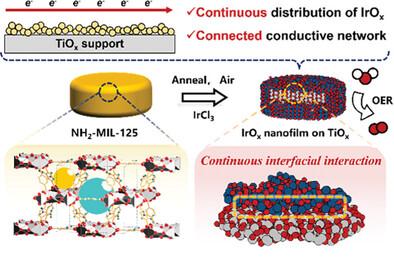
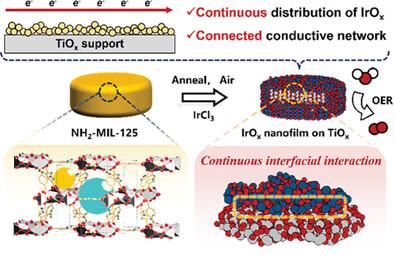
Exploring low-iridium (Ir) electrocatalysts for oxygen evolution reaction (OER) is exigent to promote the commercialization of proton electrolyte membrane water electrolyzers (PEMWEs). Herein, the study presents a scalable and facile strategy to in situ construct an IrOx nanofilm continuously coated on TiOx support as efficient and durable OER catalyst through one-step annealing of Ir-salt-adsorbed titanium-based metal–organic frameworks (MOFs) precursor. The unique nanofilm structure forms a continuous p-n junction interface, endowing a strong interfacial electron transfer from TiOx to IrOx and also ensuring a well-connected conductive network in the anodic catalytic layer due to the continuous dispersion of IrOx. The optimal catalyst requires a low overpotential of 233 mV at 10 mA cm−2 with a 40-fold of com. IrO2 in mass activity. The assembled PEMWE shows a cell voltage of 1.762 V at 1 A cm−2 with ≈220 h durable operation under start/shut-down operation. Operando characterizations and theoretical calculation reveal that the p-n junction not only reduces the energy barrier of water dissociation and deprotonation step of *OOH boosting OER kinetics but also prevents oxidation of Ir sites to form soluble Ir species that improves durability. This work offers a new avenue to rationally design and synthesize efficient low-Ir OER catalyst for PEMWE application.
期刊介绍:
Established in 2011, Advanced Energy Materials is an international, interdisciplinary, English-language journal that focuses on materials used in energy harvesting, conversion, and storage. It is regarded as a top-quality journal alongside Advanced Materials, Advanced Functional Materials, and Small.
With a 2022 Impact Factor of 27.8, Advanced Energy Materials is considered a prime source for the best energy-related research. The journal covers a wide range of topics in energy-related research, including organic and inorganic photovoltaics, batteries and supercapacitors, fuel cells, hydrogen generation and storage, thermoelectrics, water splitting and photocatalysis, solar fuels and thermosolar power, magnetocalorics, and piezoelectronics.
The readership of Advanced Energy Materials includes materials scientists, chemists, physicists, and engineers in both academia and industry. The journal is indexed in various databases and collections, such as Advanced Technologies & Aerospace Database, FIZ Karlsruhe, INSPEC (IET), Science Citation Index Expanded, Technology Collection, and Web of Science, among others.







 京公网安备 11010802042870号
京ICP备2023020795号-1
京公网安备 11010802042870号
京ICP备2023020795号-1

 分享
分享
 求助内容:
求助内容: 应助结果提醒方式:
 扫码关注我们
