{"title":"氧化还原添加剂电解质中可持续沸石咪唑酸框架-67的超高电容纳米结构及优越的能量和功率密度","authors":"Shruti Kaushik, Prakash Chand, Swati Sharma","doi":"10.1016/j.materresbull.2025.113348","DOIUrl":null,"url":null,"abstract":"<div><div>The present work reported a sustainable zeolitic imidazolate framework-67 in redox additive electrolyte with ultrahigh capacitance and superior energy & power density as potential electrode materials for energy storage applications. The interest stems from its unique combination of desirable characteristics and reveals novel high-performance supercapacitors (SCs). The work employs redox additive electrolyte (RAE), specifically 0.08 M [K<sub>3</sub>(Fe(CN)<sub>6</sub>)] in 6 M KOH. When synthesized dodecahedral structured material was tested in a 3-electrode (3E) setup, it presented an ultrahigh specific capacitance (C<sub>S</sub>) of 8307.38 Fg<sup>-1</sup> at a current density of 2 Ag<sup>-1</sup> and a worthy cycling performance with 88.25% initial capacitance retention after 10,000 cycles. The asymmetric supercapacitor device (ASSC) fabricated shows impressive energy density (E), reaching 49.80 Whkg<sup>-1</sup> at a current density of 4 Ag<sup>-1</sup> with an exceptional C<sub>S</sub> of 917.83 Fg<sup>-1</sup>. Remarkably, it also delivers a high power density (P) of 1361.38 Wkg<sup>-1</sup> at the same current density. The ASSC devices showed outstanding stability that stays almost 90% of the initial capacitance even after 10,000 charge-discharge cycles at an ultrahigh current density of 80 Ag<sup>-1</sup> along with good columbic efficiency. The wide potential window, ranging from 0.0 to 1.6 V, further increases their potential applications. In essence, this work paves the way for a new generation of supercapacitors by combining electrodes with a tailored electrolyte, achieving exceptional E and P alongside remarkable stability.</div></div>","PeriodicalId":18265,"journal":{"name":"Materials Research Bulletin","volume":"186 ","pages":"Article 113348"},"PeriodicalIF":5.7000,"publicationDate":"2025-06-01","publicationTypes":"Journal Article","fieldsOfStudy":null,"isOpenAccess":false,"openAccessPdf":"","citationCount":"0","resultStr":"{\"title\":\"Nanoarchitectonics for ultrahigh capacitance with superior energy and power density of sustainable zeolitic imidazolate framework-67 in redox additive electrolyte\",\"authors\":\"Shruti Kaushik, Prakash Chand, Swati Sharma\",\"doi\":\"10.1016/j.materresbull.2025.113348\",\"DOIUrl\":null,\"url\":null,\"abstract\":\"<div><div>The present work reported a sustainable zeolitic imidazolate framework-67 in redox additive electrolyte with ultrahigh capacitance and superior energy & power density as potential electrode materials for energy storage applications. The interest stems from its unique combination of desirable characteristics and reveals novel high-performance supercapacitors (SCs). The work employs redox additive electrolyte (RAE), specifically 0.08 M [K<sub>3</sub>(Fe(CN)<sub>6</sub>)] in 6 M KOH. When synthesized dodecahedral structured material was tested in a 3-electrode (3E) setup, it presented an ultrahigh specific capacitance (C<sub>S</sub>) of 8307.38 Fg<sup>-1</sup> at a current density of 2 Ag<sup>-1</sup> and a worthy cycling performance with 88.25% initial capacitance retention after 10,000 cycles. The asymmetric supercapacitor device (ASSC) fabricated shows impressive energy density (E), reaching 49.80 Whkg<sup>-1</sup> at a current density of 4 Ag<sup>-1</sup> with an exceptional C<sub>S</sub> of 917.83 Fg<sup>-1</sup>. Remarkably, it also delivers a high power density (P) of 1361.38 Wkg<sup>-1</sup> at the same current density. The ASSC devices showed outstanding stability that stays almost 90% of the initial capacitance even after 10,000 charge-discharge cycles at an ultrahigh current density of 80 Ag<sup>-1</sup> along with good columbic efficiency. The wide potential window, ranging from 0.0 to 1.6 V, further increases their potential applications. In essence, this work paves the way for a new generation of supercapacitors by combining electrodes with a tailored electrolyte, achieving exceptional E and P alongside remarkable stability.</div></div>\",\"PeriodicalId\":18265,\"journal\":{\"name\":\"Materials Research Bulletin\",\"volume\":\"186 \",\"pages\":\"Article 113348\"},\"PeriodicalIF\":5.7000,\"publicationDate\":\"2025-06-01\",\"publicationTypes\":\"Journal Article\",\"fieldsOfStudy\":null,\"isOpenAccess\":false,\"openAccessPdf\":\"\",\"citationCount\":\"0\",\"resultStr\":null,\"platform\":\"Semanticscholar\",\"paperid\":null,\"PeriodicalName\":\"Materials Research Bulletin\",\"FirstCategoryId\":\"88\",\"ListUrlMain\":\"https://www.sciencedirect.com/science/article/pii/S002554082500056X\",\"RegionNum\":3,\"RegionCategory\":\"材料科学\",\"ArticlePicture\":[],\"TitleCN\":null,\"AbstractTextCN\":null,\"PMCID\":null,\"EPubDate\":\"2025/2/6 0:00:00\",\"PubModel\":\"Epub\",\"JCR\":\"Q2\",\"JCRName\":\"MATERIALS SCIENCE, MULTIDISCIPLINARY\",\"Score\":null,\"Total\":0}","platform":"Semanticscholar","paperid":null,"PeriodicalName":"Materials Research Bulletin","FirstCategoryId":"88","ListUrlMain":"https://www.sciencedirect.com/science/article/pii/S002554082500056X","RegionNum":3,"RegionCategory":"材料科学","ArticlePicture":[],"TitleCN":null,"AbstractTextCN":null,"PMCID":null,"EPubDate":"2025/2/6 0:00:00","PubModel":"Epub","JCR":"Q2","JCRName":"MATERIALS SCIENCE, MULTIDISCIPLINARY","Score":null,"Total":0}
引用次数: 0
摘要
本文报道了一种在氧化还原添加剂电解质中具有超高电容和优越能量的可持续沸石咪唑酸框架-67。功率密度作为储能应用的潜在电极材料。这种兴趣源于其独特的理想特性组合,并揭示了新型高性能超级电容器(SCs)。本研究采用氧化还原添加剂电解质(RAE),即0.08 M [K3(Fe(CN)6)]在6 M KOH中。将合成的十二面体结构材料在3电极(3E)装置中进行测试,在电流密度为2 Ag-1时,其比电容(CS)达到8307.38 Fg-1,在10,000次循环后,其初始电容保持率为88.25%,具有良好的循环性能。制作的非对称超级电容器器件(ASSC)显示出令人印象深刻的能量密度(E),在电流密度为4 Ag-1时达到49.80 Whkg-1, CS为917.83 Fg-1。值得注意的是,在相同的电流密度下,它还提供1361.38 Wkg-1的高功率密度(P)。ASSC器件表现出出色的稳定性,在80 Ag-1的超高电流密度下,即使经过10,000次充放电循环,也能保持近90%的初始电容,并具有良好的哥伦比亚效率。宽电位窗口,范围从0.0到1.6 V,进一步增加了它们的潜在应用。从本质上讲,这项工作为新一代超级电容器铺平了道路,通过将电极与定制的电解质相结合,实现了卓越的E和P以及卓越的稳定性。
Nanoarchitectonics for ultrahigh capacitance with superior energy and power density of sustainable zeolitic imidazolate framework-67 in redox additive electrolyte
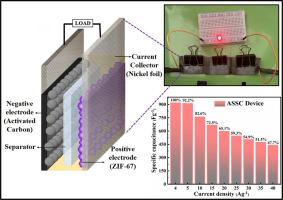
The present work reported a sustainable zeolitic imidazolate framework-67 in redox additive electrolyte with ultrahigh capacitance and superior energy & power density as potential electrode materials for energy storage applications. The interest stems from its unique combination of desirable characteristics and reveals novel high-performance supercapacitors (SCs). The work employs redox additive electrolyte (RAE), specifically 0.08 M [K3(Fe(CN)6)] in 6 M KOH. When synthesized dodecahedral structured material was tested in a 3-electrode (3E) setup, it presented an ultrahigh specific capacitance (CS) of 8307.38 Fg-1 at a current density of 2 Ag-1 and a worthy cycling performance with 88.25% initial capacitance retention after 10,000 cycles. The asymmetric supercapacitor device (ASSC) fabricated shows impressive energy density (E), reaching 49.80 Whkg-1 at a current density of 4 Ag-1 with an exceptional CS of 917.83 Fg-1. Remarkably, it also delivers a high power density (P) of 1361.38 Wkg-1 at the same current density. The ASSC devices showed outstanding stability that stays almost 90% of the initial capacitance even after 10,000 charge-discharge cycles at an ultrahigh current density of 80 Ag-1 along with good columbic efficiency. The wide potential window, ranging from 0.0 to 1.6 V, further increases their potential applications. In essence, this work paves the way for a new generation of supercapacitors by combining electrodes with a tailored electrolyte, achieving exceptional E and P alongside remarkable stability.
期刊介绍:
Materials Research Bulletin is an international journal reporting high-impact research on processing-structure-property relationships in functional materials and nanomaterials with interesting electronic, magnetic, optical, thermal, mechanical or catalytic properties. Papers purely on thermodynamics or theoretical calculations (e.g., density functional theory) do not fall within the scope of the journal unless they also demonstrate a clear link to physical properties. Topics covered include functional materials (e.g., dielectrics, pyroelectrics, piezoelectrics, ferroelectrics, relaxors, thermoelectrics, etc.); electrochemistry and solid-state ionics (e.g., photovoltaics, batteries, sensors, and fuel cells); nanomaterials, graphene, and nanocomposites; luminescence and photocatalysis; crystal-structure and defect-structure analysis; novel electronics; non-crystalline solids; flexible electronics; protein-material interactions; and polymeric ion-exchange membranes.




 京公网安备 11010802042870号
京ICP备2023020795号-1
京公网安备 11010802042870号
京ICP备2023020795号-1

 分享
分享
 求助内容:
求助内容: 应助结果提醒方式:
 扫码关注我们
