Johannes Hammerli , Anthony I.S. Kemp , Anne-Sophie Bouvier , Roberta L. Rudnick , Pierre Boivin , Robert M. Holder , Thomas Chacko , Kevin Blake
{"title":"含角长石麻粒岩在硫的封存和释放中的作用:下地壳掘出过程中地壳流体S同位素特征的意义","authors":"Johannes Hammerli , Anthony I.S. Kemp , Anne-Sophie Bouvier , Roberta L. Rudnick , Pierre Boivin , Robert M. Holder , Thomas Chacko , Kevin Blake","doi":"10.1016/j.gca.2025.01.010","DOIUrl":null,"url":null,"abstract":"<div><div>To understand sulfur and carbon sequestration and release within the continental crust, scapolite minerals from a variety of granulite facies rocks were analyzed for their elemental composition and S isotope signatures. These high-grade scapolites host significant amounts of SO<sub>3</sub> and CO<sub>2</sub>, up to approximately 5 wt% and 3 wt%, respectively, with δ<sup>34</sup>S<sub>VCDT</sub> from −3 to +10 ‰, and formed in relatively oxidizing environments characterized by low <em>a</em>H<sub>2</sub>O in which scapolite may form as a primary igneous mineral or via metamorphic reactions involving sulfides and silicates. The range of scapolite sulfur isotope compositions mirrors those observed in mantle xenoliths, suggesting transport of S from the mantle into the lower crust via fluids and melts. Although scapolite’s contribution to the global S and C cycles may be modest, it is significant in the context of sulfur fluxing from the mantle to the lower crust, particularly in its oxidized form. We estimate that at least 10 % of lower crustal sulfur is sequestered within scapolite. The exhumation of scapolite-bearing lower crustal rocks can therefore liberate substantial quantities of sulfur species and CO<sub>2</sub>, which may serve to both supply and compositionally buffer retrograde metamorphic fluids. These fluids may exhibit a range of S isotope compositions from mantle-like (δ<sup>34</sup>S<sub>VCDT</sub> ≈ 0 ‰) to relatively <sup>34</sup>S-enriched signatures. Consequently, retrograde fluids may have S isotope signatures indistinguishable from those of mantle fluids, even in the absence of direct mantle S input during fluid formation. Exhumation of scapolite-bearing lower crust may facilitate element mobilization through S and Cl complexing, particularly with respect to base metals, within exhumed lower crustal sections, thus providing sources of metals and fluids in mid- to high-grade metamorphic rocks. Globally, scapolite-bearing lower crust may help balance the global sulfur cycle through catch-and-release from scapolite.</div></div>","PeriodicalId":327,"journal":{"name":"Geochimica et Cosmochimica Acta","volume":"392 ","pages":"Pages 175-194"},"PeriodicalIF":5.2000,"publicationDate":"2025-03-01","publicationTypes":"Journal Article","fieldsOfStudy":null,"isOpenAccess":false,"openAccessPdf":"","citationCount":"0","resultStr":"{\"title\":\"The role of scapolite-bearing granulites in sequestering and releasing sulfur: Implications for S isotope signatures of crustal fluids during lower-crustal exhumation\",\"authors\":\"Johannes Hammerli , Anthony I.S. Kemp , Anne-Sophie Bouvier , Roberta L. Rudnick , Pierre Boivin , Robert M. Holder , Thomas Chacko , Kevin Blake\",\"doi\":\"10.1016/j.gca.2025.01.010\",\"DOIUrl\":null,\"url\":null,\"abstract\":\"<div><div>To understand sulfur and carbon sequestration and release within the continental crust, scapolite minerals from a variety of granulite facies rocks were analyzed for their elemental composition and S isotope signatures. These high-grade scapolites host significant amounts of SO<sub>3</sub> and CO<sub>2</sub>, up to approximately 5 wt% and 3 wt%, respectively, with δ<sup>34</sup>S<sub>VCDT</sub> from −3 to +10 ‰, and formed in relatively oxidizing environments characterized by low <em>a</em>H<sub>2</sub>O in which scapolite may form as a primary igneous mineral or via metamorphic reactions involving sulfides and silicates. The range of scapolite sulfur isotope compositions mirrors those observed in mantle xenoliths, suggesting transport of S from the mantle into the lower crust via fluids and melts. Although scapolite’s contribution to the global S and C cycles may be modest, it is significant in the context of sulfur fluxing from the mantle to the lower crust, particularly in its oxidized form. We estimate that at least 10 % of lower crustal sulfur is sequestered within scapolite. The exhumation of scapolite-bearing lower crustal rocks can therefore liberate substantial quantities of sulfur species and CO<sub>2</sub>, which may serve to both supply and compositionally buffer retrograde metamorphic fluids. These fluids may exhibit a range of S isotope compositions from mantle-like (δ<sup>34</sup>S<sub>VCDT</sub> ≈ 0 ‰) to relatively <sup>34</sup>S-enriched signatures. Consequently, retrograde fluids may have S isotope signatures indistinguishable from those of mantle fluids, even in the absence of direct mantle S input during fluid formation. Exhumation of scapolite-bearing lower crust may facilitate element mobilization through S and Cl complexing, particularly with respect to base metals, within exhumed lower crustal sections, thus providing sources of metals and fluids in mid- to high-grade metamorphic rocks. Globally, scapolite-bearing lower crust may help balance the global sulfur cycle through catch-and-release from scapolite.</div></div>\",\"PeriodicalId\":327,\"journal\":{\"name\":\"Geochimica et Cosmochimica Acta\",\"volume\":\"392 \",\"pages\":\"Pages 175-194\"},\"PeriodicalIF\":5.2000,\"publicationDate\":\"2025-03-01\",\"publicationTypes\":\"Journal Article\",\"fieldsOfStudy\":null,\"isOpenAccess\":false,\"openAccessPdf\":\"\",\"citationCount\":\"0\",\"resultStr\":null,\"platform\":\"Semanticscholar\",\"paperid\":null,\"PeriodicalName\":\"Geochimica et Cosmochimica Acta\",\"FirstCategoryId\":\"89\",\"ListUrlMain\":\"https://www.sciencedirect.com/science/article/pii/S0016703725000109\",\"RegionNum\":1,\"RegionCategory\":\"地球科学\",\"ArticlePicture\":[],\"TitleCN\":null,\"AbstractTextCN\":null,\"PMCID\":null,\"EPubDate\":\"2025/1/13 0:00:00\",\"PubModel\":\"Epub\",\"JCR\":\"Q1\",\"JCRName\":\"GEOCHEMISTRY & GEOPHYSICS\",\"Score\":null,\"Total\":0}","platform":"Semanticscholar","paperid":null,"PeriodicalName":"Geochimica et Cosmochimica Acta","FirstCategoryId":"89","ListUrlMain":"https://www.sciencedirect.com/science/article/pii/S0016703725000109","RegionNum":1,"RegionCategory":"地球科学","ArticlePicture":[],"TitleCN":null,"AbstractTextCN":null,"PMCID":null,"EPubDate":"2025/1/13 0:00:00","PubModel":"Epub","JCR":"Q1","JCRName":"GEOCHEMISTRY & GEOPHYSICS","Score":null,"Total":0}
The role of scapolite-bearing granulites in sequestering and releasing sulfur: Implications for S isotope signatures of crustal fluids during lower-crustal exhumation
To understand sulfur and carbon sequestration and release within the continental crust, scapolite minerals from a variety of granulite facies rocks were analyzed for their elemental composition and S isotope signatures. These high-grade scapolites host significant amounts of SO3 and CO2, up to approximately 5 wt% and 3 wt%, respectively, with δ34SVCDT from −3 to +10 ‰, and formed in relatively oxidizing environments characterized by low aH2O in which scapolite may form as a primary igneous mineral or via metamorphic reactions involving sulfides and silicates. The range of scapolite sulfur isotope compositions mirrors those observed in mantle xenoliths, suggesting transport of S from the mantle into the lower crust via fluids and melts. Although scapolite’s contribution to the global S and C cycles may be modest, it is significant in the context of sulfur fluxing from the mantle to the lower crust, particularly in its oxidized form. We estimate that at least 10 % of lower crustal sulfur is sequestered within scapolite. The exhumation of scapolite-bearing lower crustal rocks can therefore liberate substantial quantities of sulfur species and CO2, which may serve to both supply and compositionally buffer retrograde metamorphic fluids. These fluids may exhibit a range of S isotope compositions from mantle-like (δ34SVCDT ≈ 0 ‰) to relatively 34S-enriched signatures. Consequently, retrograde fluids may have S isotope signatures indistinguishable from those of mantle fluids, even in the absence of direct mantle S input during fluid formation. Exhumation of scapolite-bearing lower crust may facilitate element mobilization through S and Cl complexing, particularly with respect to base metals, within exhumed lower crustal sections, thus providing sources of metals and fluids in mid- to high-grade metamorphic rocks. Globally, scapolite-bearing lower crust may help balance the global sulfur cycle through catch-and-release from scapolite.
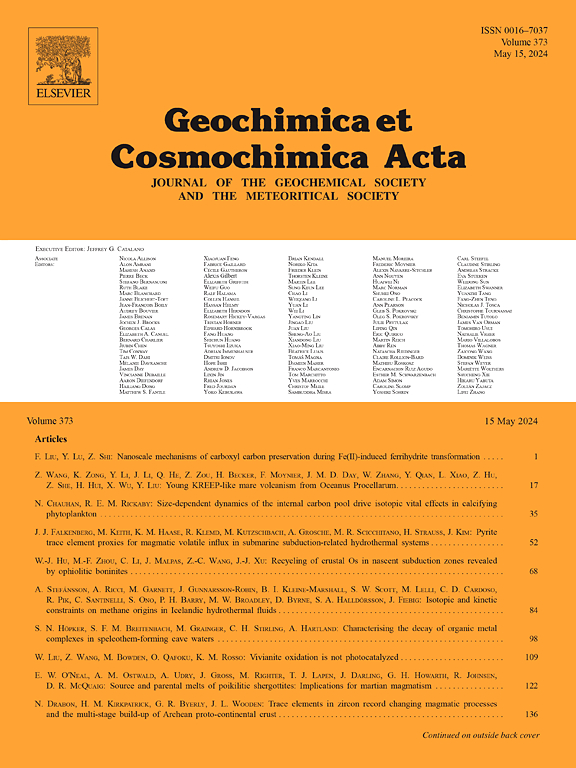
期刊介绍:
Geochimica et Cosmochimica Acta publishes research papers in a wide range of subjects in terrestrial geochemistry, meteoritics, and planetary geochemistry. The scope of the journal includes:
1). Physical chemistry of gases, aqueous solutions, glasses, and crystalline solids
2). Igneous and metamorphic petrology
3). Chemical processes in the atmosphere, hydrosphere, biosphere, and lithosphere of the Earth
4). Organic geochemistry
5). Isotope geochemistry
6). Meteoritics and meteorite impacts
7). Lunar science; and
8). Planetary geochemistry.




 京公网安备 11010802042870号
京ICP备2023020795号-1
京公网安备 11010802042870号
京ICP备2023020795号-1

 分享
分享
 求助内容:
求助内容: 应助结果提醒方式:
 扫码关注我们
