Krishna Bhattarai, Andrew B Ogden, Sudeep Pandey, Germán V Sandoya, Ainong Shi, Amol N Nankar, Murukarthick Jayakodi, Heqiang Huo, Tao Jiang, Pasquale Tripodi, Chris Dardick
{"title":"通过育种提高受控环境农业作物产量。","authors":"Krishna Bhattarai, Andrew B Ogden, Sudeep Pandey, Germán V Sandoya, Ainong Shi, Amol N Nankar, Murukarthick Jayakodi, Heqiang Huo, Tao Jiang, Pasquale Tripodi, Chris Dardick","doi":"10.3389/fpls.2024.1524601","DOIUrl":null,"url":null,"abstract":"<p><p>Controlled environment agriculture (CEA) represents one of the fastest-growing sectors of horticulture. Production in controlled environments ranges from highly controlled indoor environments with 100% artificial lighting (vertical farms or plant factories) to high-tech greenhouses with or without supplemental lighting, to simpler greenhouses and high tunnels. Although food production occurs in the soil inside high tunnels, most CEA operations use various hydroponic systems to meet crop irrigation and fertility needs. The expansion of CEA offers promise as a tool for increasing food production in and near urban systems as these systems do not rely on arable agricultural land. In addition, CEA offers resilience to climate instability by growing inside protective structures. Products harvested from CEA systems tend to be of high quality, both internal and external, and are sought after by consumers. Currently, CEA producers rely on cultivars bred for production in open-field agriculture. Because of high energy and other production costs in CEA, only a limited number of food crops have proven themselves to be profitable to produce. One factor contributing to this situation may be a lack of optimized cultivars. Indoor growing operations offer opportunities for breeding cultivars that are ideal for these systems. To facilitate breeding these specialized cultivars, a wide range of tools are available for plant breeders to help speed this process and increase its efficiency. This review aims to cover breeding opportunities and needs for a wide range of horticultural crops either already being produced in CEA systems or with potential for CEA production. It also reviews many of the tools available to breeders including genomics-informed breeding, marker-assisted selection, precision breeding, high-throughput phenotyping, and potential sources of germplasm suitable for CEA breeding. The availability of published genomes and trait-linked molecular markers should enable rapid progress in the breeding of CEA-specific food crops that will help drive the growth of this industry.</p>","PeriodicalId":12632,"journal":{"name":"Frontiers in Plant Science","volume":"15 ","pages":"1524601"},"PeriodicalIF":4.1000,"publicationDate":"2025-01-27","publicationTypes":"Journal Article","fieldsOfStudy":null,"isOpenAccess":false,"openAccessPdf":"https://www.ncbi.nlm.nih.gov/pmc/articles/PMC11808156/pdf/","citationCount":"0","resultStr":"{\"title\":\"Improvement of crop production in controlled environment agriculture through breeding.\",\"authors\":\"Krishna Bhattarai, Andrew B Ogden, Sudeep Pandey, Germán V Sandoya, Ainong Shi, Amol N Nankar, Murukarthick Jayakodi, Heqiang Huo, Tao Jiang, Pasquale Tripodi, Chris Dardick\",\"doi\":\"10.3389/fpls.2024.1524601\",\"DOIUrl\":null,\"url\":null,\"abstract\":\"<p><p>Controlled environment agriculture (CEA) represents one of the fastest-growing sectors of horticulture. Production in controlled environments ranges from highly controlled indoor environments with 100% artificial lighting (vertical farms or plant factories) to high-tech greenhouses with or without supplemental lighting, to simpler greenhouses and high tunnels. Although food production occurs in the soil inside high tunnels, most CEA operations use various hydroponic systems to meet crop irrigation and fertility needs. The expansion of CEA offers promise as a tool for increasing food production in and near urban systems as these systems do not rely on arable agricultural land. In addition, CEA offers resilience to climate instability by growing inside protective structures. Products harvested from CEA systems tend to be of high quality, both internal and external, and are sought after by consumers. Currently, CEA producers rely on cultivars bred for production in open-field agriculture. Because of high energy and other production costs in CEA, only a limited number of food crops have proven themselves to be profitable to produce. One factor contributing to this situation may be a lack of optimized cultivars. Indoor growing operations offer opportunities for breeding cultivars that are ideal for these systems. To facilitate breeding these specialized cultivars, a wide range of tools are available for plant breeders to help speed this process and increase its efficiency. This review aims to cover breeding opportunities and needs for a wide range of horticultural crops either already being produced in CEA systems or with potential for CEA production. It also reviews many of the tools available to breeders including genomics-informed breeding, marker-assisted selection, precision breeding, high-throughput phenotyping, and potential sources of germplasm suitable for CEA breeding. The availability of published genomes and trait-linked molecular markers should enable rapid progress in the breeding of CEA-specific food crops that will help drive the growth of this industry.</p>\",\"PeriodicalId\":12632,\"journal\":{\"name\":\"Frontiers in Plant Science\",\"volume\":\"15 \",\"pages\":\"1524601\"},\"PeriodicalIF\":4.1000,\"publicationDate\":\"2025-01-27\",\"publicationTypes\":\"Journal Article\",\"fieldsOfStudy\":null,\"isOpenAccess\":false,\"openAccessPdf\":\"https://www.ncbi.nlm.nih.gov/pmc/articles/PMC11808156/pdf/\",\"citationCount\":\"0\",\"resultStr\":null,\"platform\":\"Semanticscholar\",\"paperid\":null,\"PeriodicalName\":\"Frontiers in Plant Science\",\"FirstCategoryId\":\"99\",\"ListUrlMain\":\"https://doi.org/10.3389/fpls.2024.1524601\",\"RegionNum\":2,\"RegionCategory\":\"生物学\",\"ArticlePicture\":[],\"TitleCN\":null,\"AbstractTextCN\":null,\"PMCID\":null,\"EPubDate\":\"2024/1/1 0:00:00\",\"PubModel\":\"eCollection\",\"JCR\":\"Q1\",\"JCRName\":\"PLANT SCIENCES\",\"Score\":null,\"Total\":0}","platform":"Semanticscholar","paperid":null,"PeriodicalName":"Frontiers in Plant Science","FirstCategoryId":"99","ListUrlMain":"https://doi.org/10.3389/fpls.2024.1524601","RegionNum":2,"RegionCategory":"生物学","ArticlePicture":[],"TitleCN":null,"AbstractTextCN":null,"PMCID":null,"EPubDate":"2024/1/1 0:00:00","PubModel":"eCollection","JCR":"Q1","JCRName":"PLANT SCIENCES","Score":null,"Total":0}
Improvement of crop production in controlled environment agriculture through breeding.
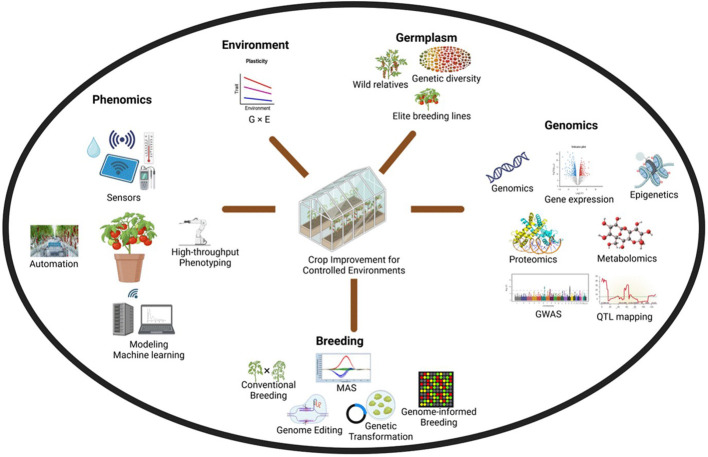
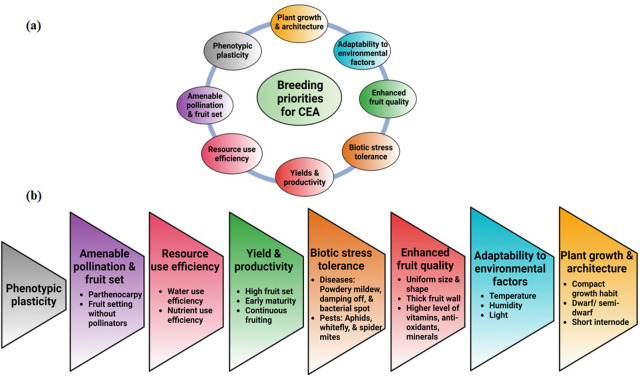
Controlled environment agriculture (CEA) represents one of the fastest-growing sectors of horticulture. Production in controlled environments ranges from highly controlled indoor environments with 100% artificial lighting (vertical farms or plant factories) to high-tech greenhouses with or without supplemental lighting, to simpler greenhouses and high tunnels. Although food production occurs in the soil inside high tunnels, most CEA operations use various hydroponic systems to meet crop irrigation and fertility needs. The expansion of CEA offers promise as a tool for increasing food production in and near urban systems as these systems do not rely on arable agricultural land. In addition, CEA offers resilience to climate instability by growing inside protective structures. Products harvested from CEA systems tend to be of high quality, both internal and external, and are sought after by consumers. Currently, CEA producers rely on cultivars bred for production in open-field agriculture. Because of high energy and other production costs in CEA, only a limited number of food crops have proven themselves to be profitable to produce. One factor contributing to this situation may be a lack of optimized cultivars. Indoor growing operations offer opportunities for breeding cultivars that are ideal for these systems. To facilitate breeding these specialized cultivars, a wide range of tools are available for plant breeders to help speed this process and increase its efficiency. This review aims to cover breeding opportunities and needs for a wide range of horticultural crops either already being produced in CEA systems or with potential for CEA production. It also reviews many of the tools available to breeders including genomics-informed breeding, marker-assisted selection, precision breeding, high-throughput phenotyping, and potential sources of germplasm suitable for CEA breeding. The availability of published genomes and trait-linked molecular markers should enable rapid progress in the breeding of CEA-specific food crops that will help drive the growth of this industry.
期刊介绍:
In an ever changing world, plant science is of the utmost importance for securing the future well-being of humankind. Plants provide oxygen, food, feed, fibers, and building materials. In addition, they are a diverse source of industrial and pharmaceutical chemicals. Plants are centrally important to the health of ecosystems, and their understanding is critical for learning how to manage and maintain a sustainable biosphere. Plant science is extremely interdisciplinary, reaching from agricultural science to paleobotany, and molecular physiology to ecology. It uses the latest developments in computer science, optics, molecular biology and genomics to address challenges in model systems, agricultural crops, and ecosystems. Plant science research inquires into the form, function, development, diversity, reproduction, evolution and uses of both higher and lower plants and their interactions with other organisms throughout the biosphere. Frontiers in Plant Science welcomes outstanding contributions in any field of plant science from basic to applied research, from organismal to molecular studies, from single plant analysis to studies of populations and whole ecosystems, and from molecular to biophysical to computational approaches.
Frontiers in Plant Science publishes articles on the most outstanding discoveries across a wide research spectrum of Plant Science. The mission of Frontiers in Plant Science is to bring all relevant Plant Science areas together on a single platform.





 京公网安备 11010802042870号
京ICP备2023020795号-1
京公网安备 11010802042870号
京ICP备2023020795号-1

 分享
分享
 求助内容:
求助内容: 应助结果提醒方式:
 扫码关注我们
