Maryam Nurhuda, Ken-ichi Otake, Susumu Kitagawa, Daniel M. Packwood
{"title":"mof -金属氧化物化学电阻传感器早期疾病检测的态密度和结合能信息学研究","authors":"Maryam Nurhuda, Ken-ichi Otake, Susumu Kitagawa, Daniel M. Packwood","doi":"10.1002/adts.202401404","DOIUrl":null,"url":null,"abstract":"<p>Human breath contains over 3000 volatile organic compounds, abnormal concentrations of which can indicate the presence of certain diseases. Recently, metal–organic framework (MOF)-metal oxide composite materials have been explored for chemiresistive sensor applications, however their ability to detect breath compounds associated with specific diseases remains unknown. In this work, a new high-throughput computational protocol for evaluating the sensing ability of MOF-metal oxide toward small organic compounds is presented. This protocol uses a cluster-based method for accelerated structure relaxation, and a combination of binding energies and density-of-states analysis to evaluate sensing ability, the latter measured using Wasserstein distances. This protocol is applied to the case of the MOF-metal oxide composite material NM125-TiO<sub>2</sub> and is shown to be consistent with previously reported experimental results for this system. The sensing ability of NM125-TiO<sub>2</sub> for over 100 human-breath compounds spanning 13 different diseases is examined. Statistical inference is then used to identify diseases which subsequent experimental efforts should focus on. Overall, this work provides new tools for computational sensor research, while also illustrating how computational materials science can be integrated into the field of preventative medicine.</p>","PeriodicalId":7219,"journal":{"name":"Advanced Theory and Simulations","volume":"8 5","pages":""},"PeriodicalIF":2.9000,"publicationDate":"2025-02-12","publicationTypes":"Journal Article","fieldsOfStudy":null,"isOpenAccess":false,"openAccessPdf":"https://onlinelibrary.wiley.com/doi/epdf/10.1002/adts.202401404","citationCount":"0","resultStr":"{\"title\":\"Density of States and Binding Energy Informatics for Exploring Early Disease Detection in MOF-Metal Oxide Chemiresistive Sensors\",\"authors\":\"Maryam Nurhuda, Ken-ichi Otake, Susumu Kitagawa, Daniel M. Packwood\",\"doi\":\"10.1002/adts.202401404\",\"DOIUrl\":null,\"url\":null,\"abstract\":\"<p>Human breath contains over 3000 volatile organic compounds, abnormal concentrations of which can indicate the presence of certain diseases. Recently, metal–organic framework (MOF)-metal oxide composite materials have been explored for chemiresistive sensor applications, however their ability to detect breath compounds associated with specific diseases remains unknown. In this work, a new high-throughput computational protocol for evaluating the sensing ability of MOF-metal oxide toward small organic compounds is presented. This protocol uses a cluster-based method for accelerated structure relaxation, and a combination of binding energies and density-of-states analysis to evaluate sensing ability, the latter measured using Wasserstein distances. This protocol is applied to the case of the MOF-metal oxide composite material NM125-TiO<sub>2</sub> and is shown to be consistent with previously reported experimental results for this system. The sensing ability of NM125-TiO<sub>2</sub> for over 100 human-breath compounds spanning 13 different diseases is examined. Statistical inference is then used to identify diseases which subsequent experimental efforts should focus on. Overall, this work provides new tools for computational sensor research, while also illustrating how computational materials science can be integrated into the field of preventative medicine.</p>\",\"PeriodicalId\":7219,\"journal\":{\"name\":\"Advanced Theory and Simulations\",\"volume\":\"8 5\",\"pages\":\"\"},\"PeriodicalIF\":2.9000,\"publicationDate\":\"2025-02-12\",\"publicationTypes\":\"Journal Article\",\"fieldsOfStudy\":null,\"isOpenAccess\":false,\"openAccessPdf\":\"https://onlinelibrary.wiley.com/doi/epdf/10.1002/adts.202401404\",\"citationCount\":\"0\",\"resultStr\":null,\"platform\":\"Semanticscholar\",\"paperid\":null,\"PeriodicalName\":\"Advanced Theory and Simulations\",\"FirstCategoryId\":\"5\",\"ListUrlMain\":\"https://advanced.onlinelibrary.wiley.com/doi/10.1002/adts.202401404\",\"RegionNum\":4,\"RegionCategory\":\"工程技术\",\"ArticlePicture\":[],\"TitleCN\":null,\"AbstractTextCN\":null,\"PMCID\":null,\"EPubDate\":\"\",\"PubModel\":\"\",\"JCR\":\"Q1\",\"JCRName\":\"MULTIDISCIPLINARY SCIENCES\",\"Score\":null,\"Total\":0}","platform":"Semanticscholar","paperid":null,"PeriodicalName":"Advanced Theory and Simulations","FirstCategoryId":"5","ListUrlMain":"https://advanced.onlinelibrary.wiley.com/doi/10.1002/adts.202401404","RegionNum":4,"RegionCategory":"工程技术","ArticlePicture":[],"TitleCN":null,"AbstractTextCN":null,"PMCID":null,"EPubDate":"","PubModel":"","JCR":"Q1","JCRName":"MULTIDISCIPLINARY SCIENCES","Score":null,"Total":0}
Density of States and Binding Energy Informatics for Exploring Early Disease Detection in MOF-Metal Oxide Chemiresistive Sensors
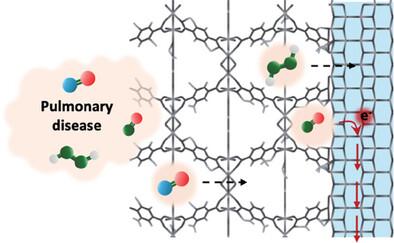
Human breath contains over 3000 volatile organic compounds, abnormal concentrations of which can indicate the presence of certain diseases. Recently, metal–organic framework (MOF)-metal oxide composite materials have been explored for chemiresistive sensor applications, however their ability to detect breath compounds associated with specific diseases remains unknown. In this work, a new high-throughput computational protocol for evaluating the sensing ability of MOF-metal oxide toward small organic compounds is presented. This protocol uses a cluster-based method for accelerated structure relaxation, and a combination of binding energies and density-of-states analysis to evaluate sensing ability, the latter measured using Wasserstein distances. This protocol is applied to the case of the MOF-metal oxide composite material NM125-TiO2 and is shown to be consistent with previously reported experimental results for this system. The sensing ability of NM125-TiO2 for over 100 human-breath compounds spanning 13 different diseases is examined. Statistical inference is then used to identify diseases which subsequent experimental efforts should focus on. Overall, this work provides new tools for computational sensor research, while also illustrating how computational materials science can be integrated into the field of preventative medicine.
期刊介绍:
Advanced Theory and Simulations is an interdisciplinary, international, English-language journal that publishes high-quality scientific results focusing on the development and application of theoretical methods, modeling and simulation approaches in all natural science and medicine areas, including:
materials, chemistry, condensed matter physics
engineering, energy
life science, biology, medicine
atmospheric/environmental science, climate science
planetary science, astronomy, cosmology
method development, numerical methods, statistics







 京公网安备 11010802042870号
京ICP备2023020795号-1
京公网安备 11010802042870号
京ICP备2023020795号-1

 分享
分享
 求助内容:
求助内容: 应助结果提醒方式:
 扫码关注我们
