Henna Lintusaari , Teemu Lepistö , Sanna Saarikoski , Laura Salo , Ville Silvonen , Luis M.F. Barreira , Minna Aurela , Jussi Hoivala , Lassi Markkula , Jakub Ondracek , Tina Wahle , Michal Vojtisek-Lom , Jan Topinka , Roel P.F. Schins , Pasi Jalava , Hilkka Timonen , Katja M. Kanninen , Topi Rönkkö
{"title":"交通环境中亚23nm粒子的重要性:粒子数、发射因子和胸外沉积剂量","authors":"Henna Lintusaari , Teemu Lepistö , Sanna Saarikoski , Laura Salo , Ville Silvonen , Luis M.F. Barreira , Minna Aurela , Jussi Hoivala , Lassi Markkula , Jakub Ondracek , Tina Wahle , Michal Vojtisek-Lom , Jan Topinka , Roel P.F. Schins , Pasi Jalava , Hilkka Timonen , Katja M. Kanninen , Topi Rönkkö","doi":"10.1016/j.envpol.2025.125835","DOIUrl":null,"url":null,"abstract":"<div><div>New research suggests that exposure to ultrafine particles (UFPs; particle diameter <em>d</em><sub><em>p</em></sub> < 100 nm) is particularly harmful to brain health. One pathway into the body is via deposition in the respiratory system, where the smallest UFPs deposit efficiently in human extrathoracic airways. Traffic is a major source of these particles, yet sub-23 nm (<em>d</em><sub><em>p</em></sub> < 23 nm) particles are currently unregulated in engine emission testing worldwide, including the stringent requirements of the European Union, nor are there requirements for ambient monitoring. In this study, we report size-resolved particle number emission factors (EFs) for traffic and estimates of extrathoracic dose rates of sub-23 nm particles. The EFs and dose rates are based on measurements conducted in different urban environments, including roads, tunnels, an airport, and a riverside, in two Central European cities (Düsseldorf and Prague) from March to April 2022. A key difference between the cities is that Düsseldorf has a low-emission zone in its central area and a newer vehicle fleet compared to Prague. Overall, traffic-influenced sites had large EFs for sub-23 nm particles. In the highway and tunnel environments, EFs of particles with <em>d</em><sub><em>p</em></sub> > 2.5 nm were between 2 and 18 times greater than the EFs of particles with <em>d</em><sub><em>p</em></sub> > 23 nm. Near the airport, the EF of particles with <em>d</em><sub><em>p</em></sub> > 23 nm was already high, being 2–9 times higher than in other environments. The number concentrations of sub-23 nm particles varied significantly within the studied cities, and dose rates (measured in billions of particles per hour) differed by up to a factor of ten or more depending on the location.</div></div>","PeriodicalId":311,"journal":{"name":"Environmental Pollution","volume":"369 ","pages":"Article 125835"},"PeriodicalIF":7.3000,"publicationDate":"2025-03-15","publicationTypes":"Journal Article","fieldsOfStudy":null,"isOpenAccess":false,"openAccessPdf":"","citationCount":"0","resultStr":"{\"title\":\"Importance of sub-23 nm particles in traffic environments: Particle number emission factors and extrathoracic deposition doses\",\"authors\":\"Henna Lintusaari , Teemu Lepistö , Sanna Saarikoski , Laura Salo , Ville Silvonen , Luis M.F. Barreira , Minna Aurela , Jussi Hoivala , Lassi Markkula , Jakub Ondracek , Tina Wahle , Michal Vojtisek-Lom , Jan Topinka , Roel P.F. Schins , Pasi Jalava , Hilkka Timonen , Katja M. Kanninen , Topi Rönkkö\",\"doi\":\"10.1016/j.envpol.2025.125835\",\"DOIUrl\":null,\"url\":null,\"abstract\":\"<div><div>New research suggests that exposure to ultrafine particles (UFPs; particle diameter <em>d</em><sub><em>p</em></sub> < 100 nm) is particularly harmful to brain health. One pathway into the body is via deposition in the respiratory system, where the smallest UFPs deposit efficiently in human extrathoracic airways. Traffic is a major source of these particles, yet sub-23 nm (<em>d</em><sub><em>p</em></sub> < 23 nm) particles are currently unregulated in engine emission testing worldwide, including the stringent requirements of the European Union, nor are there requirements for ambient monitoring. In this study, we report size-resolved particle number emission factors (EFs) for traffic and estimates of extrathoracic dose rates of sub-23 nm particles. The EFs and dose rates are based on measurements conducted in different urban environments, including roads, tunnels, an airport, and a riverside, in two Central European cities (Düsseldorf and Prague) from March to April 2022. A key difference between the cities is that Düsseldorf has a low-emission zone in its central area and a newer vehicle fleet compared to Prague. Overall, traffic-influenced sites had large EFs for sub-23 nm particles. In the highway and tunnel environments, EFs of particles with <em>d</em><sub><em>p</em></sub> > 2.5 nm were between 2 and 18 times greater than the EFs of particles with <em>d</em><sub><em>p</em></sub> > 23 nm. Near the airport, the EF of particles with <em>d</em><sub><em>p</em></sub> > 23 nm was already high, being 2–9 times higher than in other environments. The number concentrations of sub-23 nm particles varied significantly within the studied cities, and dose rates (measured in billions of particles per hour) differed by up to a factor of ten or more depending on the location.</div></div>\",\"PeriodicalId\":311,\"journal\":{\"name\":\"Environmental Pollution\",\"volume\":\"369 \",\"pages\":\"Article 125835\"},\"PeriodicalIF\":7.3000,\"publicationDate\":\"2025-03-15\",\"publicationTypes\":\"Journal Article\",\"fieldsOfStudy\":null,\"isOpenAccess\":false,\"openAccessPdf\":\"\",\"citationCount\":\"0\",\"resultStr\":null,\"platform\":\"Semanticscholar\",\"paperid\":null,\"PeriodicalName\":\"Environmental Pollution\",\"FirstCategoryId\":\"93\",\"ListUrlMain\":\"https://www.sciencedirect.com/science/article/pii/S0269749125002088\",\"RegionNum\":2,\"RegionCategory\":\"环境科学与生态学\",\"ArticlePicture\":[],\"TitleCN\":null,\"AbstractTextCN\":null,\"PMCID\":null,\"EPubDate\":\"2025/2/11 0:00:00\",\"PubModel\":\"Epub\",\"JCR\":\"Q1\",\"JCRName\":\"ENVIRONMENTAL SCIENCES\",\"Score\":null,\"Total\":0}","platform":"Semanticscholar","paperid":null,"PeriodicalName":"Environmental Pollution","FirstCategoryId":"93","ListUrlMain":"https://www.sciencedirect.com/science/article/pii/S0269749125002088","RegionNum":2,"RegionCategory":"环境科学与生态学","ArticlePicture":[],"TitleCN":null,"AbstractTextCN":null,"PMCID":null,"EPubDate":"2025/2/11 0:00:00","PubModel":"Epub","JCR":"Q1","JCRName":"ENVIRONMENTAL SCIENCES","Score":null,"Total":0}
Importance of sub-23 nm particles in traffic environments: Particle number emission factors and extrathoracic deposition doses
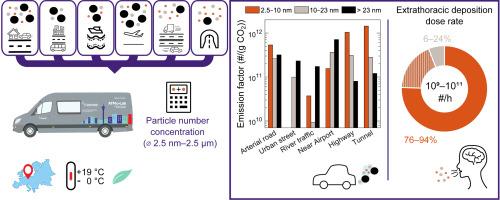
New research suggests that exposure to ultrafine particles (UFPs; particle diameter dp < 100 nm) is particularly harmful to brain health. One pathway into the body is via deposition in the respiratory system, where the smallest UFPs deposit efficiently in human extrathoracic airways. Traffic is a major source of these particles, yet sub-23 nm (dp < 23 nm) particles are currently unregulated in engine emission testing worldwide, including the stringent requirements of the European Union, nor are there requirements for ambient monitoring. In this study, we report size-resolved particle number emission factors (EFs) for traffic and estimates of extrathoracic dose rates of sub-23 nm particles. The EFs and dose rates are based on measurements conducted in different urban environments, including roads, tunnels, an airport, and a riverside, in two Central European cities (Düsseldorf and Prague) from March to April 2022. A key difference between the cities is that Düsseldorf has a low-emission zone in its central area and a newer vehicle fleet compared to Prague. Overall, traffic-influenced sites had large EFs for sub-23 nm particles. In the highway and tunnel environments, EFs of particles with dp > 2.5 nm were between 2 and 18 times greater than the EFs of particles with dp > 23 nm. Near the airport, the EF of particles with dp > 23 nm was already high, being 2–9 times higher than in other environments. The number concentrations of sub-23 nm particles varied significantly within the studied cities, and dose rates (measured in billions of particles per hour) differed by up to a factor of ten or more depending on the location.
期刊介绍:
Environmental Pollution is an international peer-reviewed journal that publishes high-quality research papers and review articles covering all aspects of environmental pollution and its impacts on ecosystems and human health.
Subject areas include, but are not limited to:
• Sources and occurrences of pollutants that are clearly defined and measured in environmental compartments, food and food-related items, and human bodies;
• Interlinks between contaminant exposure and biological, ecological, and human health effects, including those of climate change;
• Contaminants of emerging concerns (including but not limited to antibiotic resistant microorganisms or genes, microplastics/nanoplastics, electronic wastes, light, and noise) and/or their biological, ecological, or human health effects;
• Laboratory and field studies on the remediation/mitigation of environmental pollution via new techniques and with clear links to biological, ecological, or human health effects;
• Modeling of pollution processes, patterns, or trends that is of clear environmental and/or human health interest;
• New techniques that measure and examine environmental occurrences, transport, behavior, and effects of pollutants within the environment or the laboratory, provided that they can be clearly used to address problems within regional or global environmental compartments.





 京公网安备 11010802042870号
京ICP备2023020795号-1
京公网安备 11010802042870号
京ICP备2023020795号-1

 分享
分享
 求助内容:
求助内容: 应助结果提醒方式:
 扫码关注我们
