Matthew D. Haynes, Andrea O'Reilly, Alice J. M. Poole, Aisling F. Roper, Stefan Thum, Louis J. Morris, Martyn P. Coles, J. Robin Fulton, Sjoerd Harder, Zoë R. Turner and Dermot O'Hare
{"title":"重碱土和杂双金属s-嵌段二胺硅氧烷配体的“酸盐”配合物:固态结构和动态液相行为","authors":"Matthew D. Haynes, Andrea O'Reilly, Alice J. M. Poole, Aisling F. Roper, Stefan Thum, Louis J. Morris, Martyn P. Coles, J. Robin Fulton, Sjoerd Harder, Zoë R. Turner and Dermot O'Hare","doi":"10.1039/D5DT00044K","DOIUrl":null,"url":null,"abstract":"<p >The diverse solid-state structures and solution-phase dynamics of both neutral and heterometallic s-block “ate” complexes of the heavier alkaline earth metals (Ae; Ca–Ba) supported by a chelating and flexible di(amido)siloxane ligand ([<small><sup>NON-Dipp</sup></small>L]<small><sup>2−</sup></small> = [O(SiMe<small><sub>2</sub></small>NDipp)<small><sub>2</sub></small>]<small><sup>2−</sup></small>) are described, enabling comparison with those of closely related di(amido) ligands based on either flexible aliphatic or rigid xanthene-based backbones. Three dimeric alkaline earth complexes [(<small><sup>NON-Dipp</sup></small>L)Ae]<small><sub>2</sub></small> (Ae = Ca (<strong>2</strong>), Sr (<strong>3</strong>) and Ba (<strong>4</strong>)) which feature a κ<small><sup>3</sup></small>-N,O,N′-κ<small><sup>1</sup></small>-N′-tridentate coordination mode were prepared from protonolysis reactions between <small><sup>NON-Dipp</sup></small>LH<small><sub>2</sub></small> with <img> (Ae = Ca, Sr and Ba); N′′ = [N(SiMe<small><sub>3</sub></small>)<small><sub>2</sub></small>]<small><sup>−</sup></small>. In tetrahydrofuran, these complexes were readily converted into the monomeric adducts [(<small><sup>NON-Dipp</sup></small>L)Ae(thf)<small><sub><em>n</em></sub></small>] (<em>n</em> = 2, Ae = Ca (<strong>5</strong>); <em>n</em> = 3, Ae = Sr (<strong>6</strong>) and Ba (<strong>7</strong>)). Heterometallic Ae/K amide “ate” complexes were afforded through two routes: reaction of previously reported [(<small><sup>NON-Dipp</sup></small>L)Mg]<small><sub>2</sub></small> (<strong>1</strong>) with two equivalents of KN′′ at elevated temperatures resulted in [(<small><sup>NNO-Dipp</sup></small>L)Mg(μ-N′′)K]<small><sub><em>n</em></sub></small> (<strong>8</strong>; <small><sup>NNO-Dipp</sup></small>L = [OSiMe<small><sub>2</sub></small>NDippSiMe<small><sub>2</sub></small>NDipp]<small><sup>2−</sup></small>), whereas the equimolar reaction of <small><sup>NON-Dipp</sup></small>LH<small><sub>2</sub></small> with <img> led to [(<small><sup>NON-Dipp</sup></small>L)Ae(μ-N′′)K]<small><sub><em>n</em></sub></small> (Ae = Ca (<strong>9</strong>), Sr (<strong>10</strong>) and Ba (<strong>11</strong>)). Complexes <strong>8–11</strong> exist as one-dimensional coordination polymers propagated by K<small><sup>+</sup></small>–aryl π-facial interactions in the solid-state. The mixed amide/siloxide “NNO” ligand in <strong>8</strong> results from a 1,3-silyl retro-Brook rearrangement of the original di(amido)siloxane ligand, while the larger Ae<small><sup>2+</sup></small> congeners readily accommodate the coordination of KN′′ with the di(amido)siloxane ligand retaining a κ<small><sup>3</sup></small>-N,O,N′-tridentate motif in <strong>9–11</strong>. Finally, the solution-phase behaviour of <strong>8–11</strong> in both toluene and thf were investigated indicating the reversible dissociation of KN′′ from <strong>9–11</strong> and the thermodynamic parameters of this process were elucidated.</p>","PeriodicalId":71,"journal":{"name":"Dalton Transactions","volume":" 11","pages":" 4542-4555"},"PeriodicalIF":3.3000,"publicationDate":"2025-02-12","publicationTypes":"Journal Article","fieldsOfStudy":null,"isOpenAccess":false,"openAccessPdf":"https://pubs.rsc.org/en/content/articlepdf/2025/dt/d5dt00044k?page=search","citationCount":"0","resultStr":"{\"title\":\"Heavier alkaline earth and heterobimetallic s-block “ate” complexes of a di(amido)siloxane ligand: solid-state structure and dynamic solution-phase behaviour†\",\"authors\":\"Matthew D. Haynes, Andrea O'Reilly, Alice J. M. Poole, Aisling F. Roper, Stefan Thum, Louis J. Morris, Martyn P. Coles, J. Robin Fulton, Sjoerd Harder, Zoë R. Turner and Dermot O'Hare\",\"doi\":\"10.1039/D5DT00044K\",\"DOIUrl\":null,\"url\":null,\"abstract\":\"<p >The diverse solid-state structures and solution-phase dynamics of both neutral and heterometallic s-block “ate” complexes of the heavier alkaline earth metals (Ae; Ca–Ba) supported by a chelating and flexible di(amido)siloxane ligand ([<small><sup>NON-Dipp</sup></small>L]<small><sup>2−</sup></small> = [O(SiMe<small><sub>2</sub></small>NDipp)<small><sub>2</sub></small>]<small><sup>2−</sup></small>) are described, enabling comparison with those of closely related di(amido) ligands based on either flexible aliphatic or rigid xanthene-based backbones. Three dimeric alkaline earth complexes [(<small><sup>NON-Dipp</sup></small>L)Ae]<small><sub>2</sub></small> (Ae = Ca (<strong>2</strong>), Sr (<strong>3</strong>) and Ba (<strong>4</strong>)) which feature a κ<small><sup>3</sup></small>-N,O,N′-κ<small><sup>1</sup></small>-N′-tridentate coordination mode were prepared from protonolysis reactions between <small><sup>NON-Dipp</sup></small>LH<small><sub>2</sub></small> with <img> (Ae = Ca, Sr and Ba); N′′ = [N(SiMe<small><sub>3</sub></small>)<small><sub>2</sub></small>]<small><sup>−</sup></small>. In tetrahydrofuran, these complexes were readily converted into the monomeric adducts [(<small><sup>NON-Dipp</sup></small>L)Ae(thf)<small><sub><em>n</em></sub></small>] (<em>n</em> = 2, Ae = Ca (<strong>5</strong>); <em>n</em> = 3, Ae = Sr (<strong>6</strong>) and Ba (<strong>7</strong>)). Heterometallic Ae/K amide “ate” complexes were afforded through two routes: reaction of previously reported [(<small><sup>NON-Dipp</sup></small>L)Mg]<small><sub>2</sub></small> (<strong>1</strong>) with two equivalents of KN′′ at elevated temperatures resulted in [(<small><sup>NNO-Dipp</sup></small>L)Mg(μ-N′′)K]<small><sub><em>n</em></sub></small> (<strong>8</strong>; <small><sup>NNO-Dipp</sup></small>L = [OSiMe<small><sub>2</sub></small>NDippSiMe<small><sub>2</sub></small>NDipp]<small><sup>2−</sup></small>), whereas the equimolar reaction of <small><sup>NON-Dipp</sup></small>LH<small><sub>2</sub></small> with <img> led to [(<small><sup>NON-Dipp</sup></small>L)Ae(μ-N′′)K]<small><sub><em>n</em></sub></small> (Ae = Ca (<strong>9</strong>), Sr (<strong>10</strong>) and Ba (<strong>11</strong>)). Complexes <strong>8–11</strong> exist as one-dimensional coordination polymers propagated by K<small><sup>+</sup></small>–aryl π-facial interactions in the solid-state. The mixed amide/siloxide “NNO” ligand in <strong>8</strong> results from a 1,3-silyl retro-Brook rearrangement of the original di(amido)siloxane ligand, while the larger Ae<small><sup>2+</sup></small> congeners readily accommodate the coordination of KN′′ with the di(amido)siloxane ligand retaining a κ<small><sup>3</sup></small>-N,O,N′-tridentate motif in <strong>9–11</strong>. Finally, the solution-phase behaviour of <strong>8–11</strong> in both toluene and thf were investigated indicating the reversible dissociation of KN′′ from <strong>9–11</strong> and the thermodynamic parameters of this process were elucidated.</p>\",\"PeriodicalId\":71,\"journal\":{\"name\":\"Dalton Transactions\",\"volume\":\" 11\",\"pages\":\" 4542-4555\"},\"PeriodicalIF\":3.3000,\"publicationDate\":\"2025-02-12\",\"publicationTypes\":\"Journal Article\",\"fieldsOfStudy\":null,\"isOpenAccess\":false,\"openAccessPdf\":\"https://pubs.rsc.org/en/content/articlepdf/2025/dt/d5dt00044k?page=search\",\"citationCount\":\"0\",\"resultStr\":null,\"platform\":\"Semanticscholar\",\"paperid\":null,\"PeriodicalName\":\"Dalton Transactions\",\"FirstCategoryId\":\"92\",\"ListUrlMain\":\"https://pubs.rsc.org/en/content/articlelanding/2025/dt/d5dt00044k\",\"RegionNum\":3,\"RegionCategory\":\"化学\",\"ArticlePicture\":[],\"TitleCN\":null,\"AbstractTextCN\":null,\"PMCID\":null,\"EPubDate\":\"\",\"PubModel\":\"\",\"JCR\":\"Q2\",\"JCRName\":\"CHEMISTRY, INORGANIC & NUCLEAR\",\"Score\":null,\"Total\":0}","platform":"Semanticscholar","paperid":null,"PeriodicalName":"Dalton Transactions","FirstCategoryId":"92","ListUrlMain":"https://pubs.rsc.org/en/content/articlelanding/2025/dt/d5dt00044k","RegionNum":3,"RegionCategory":"化学","ArticlePicture":[],"TitleCN":null,"AbstractTextCN":null,"PMCID":null,"EPubDate":"","PubModel":"","JCR":"Q2","JCRName":"CHEMISTRY, INORGANIC & NUCLEAR","Score":null,"Total":0}
引用次数: 0
摘要
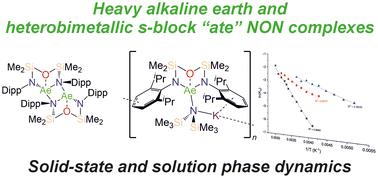
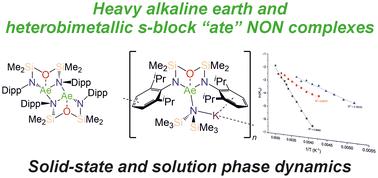
中性和异质金属s-嵌段“ate”配合物的固相结构和固相动力学(Ae;描述了由螯合和灵活的二氨基硅氧烷配体([NON-DippL]2−= [O(SiMe2NDipp)2]2−)支撑的Ca-Ba),可以与基于柔性脂肪族或刚性杂蒽基骨架的密切相关的二氨基配体进行比较。通过(Ae = Ca, Sr, Ba)与non - dippplh2的质子解反应,制备了三种二聚体碱土配合物[(NON-DippL)Ae]2 (Ae = Ca (2), Sr (3), Ba(4)),具有κ3-N,O,N ' -κ1-N ' -三齿配位模式;N " = [N(SiMe3)2]−。在四氢呋喃中,这些配合物很容易转化为单体加合物[(NON-DippL)Ae(thf)n] (n = 2, Ae = Ca (5);n = 3, Ae = Sr (6), Ba(7))。异质金属Ae/K酰胺“ate”配合物通过两种途径得到:先前报道的[(NON-DippL)Mg]2(1)与两个等效的KN”在高温下反应得到[(NNO-DippL)Mg(μ-N”)K]n (8);NNO-DippL = [OSiMe2NDippSiMe2NDipp]2−),而non - dipph2与之等摩尔反应生成[(NON-DippL)Ae(μ-N ")K]n (Ae = Ca (9), Sr(10)和Ba(11))。配合物8-11在固态中以K+ -芳基π-面相互作用传播的一维配位聚合物形式存在。8中的混合酰胺/硅氧化物“NNO”配体是由原二(氨基)硅氧烷配体的1,3-硅基逆转录布鲁克重排产生的,而较大的Ae2+同族体很容易容纳KN”与二(氨基)硅氧烷配体的配位,在9-11中保留了κ3-N,O,N ' -三基序。最后,研究了8-11在甲苯和thf中的溶液相行为,表明了9-11与KN“的可逆解离,并阐明了该过程的热力学参数。
Heavier alkaline earth and heterobimetallic s-block “ate” complexes of a di(amido)siloxane ligand: solid-state structure and dynamic solution-phase behaviour†
The diverse solid-state structures and solution-phase dynamics of both neutral and heterometallic s-block “ate” complexes of the heavier alkaline earth metals (Ae; Ca–Ba) supported by a chelating and flexible di(amido)siloxane ligand ([NON-DippL]2− = [O(SiMe2NDipp)2]2−) are described, enabling comparison with those of closely related di(amido) ligands based on either flexible aliphatic or rigid xanthene-based backbones. Three dimeric alkaline earth complexes [(NON-DippL)Ae]2 (Ae = Ca (2), Sr (3) and Ba (4)) which feature a κ3-N,O,N′-κ1-N′-tridentate coordination mode were prepared from protonolysis reactions between NON-DippLH2 with (Ae = Ca, Sr and Ba); N′′ = [N(SiMe3)2]−. In tetrahydrofuran, these complexes were readily converted into the monomeric adducts [(NON-DippL)Ae(thf)n] (n = 2, Ae = Ca (5); n = 3, Ae = Sr (6) and Ba (7)). Heterometallic Ae/K amide “ate” complexes were afforded through two routes: reaction of previously reported [(NON-DippL)Mg]2 (1) with two equivalents of KN′′ at elevated temperatures resulted in [(NNO-DippL)Mg(μ-N′′)K]n (8; NNO-DippL = [OSiMe2NDippSiMe2NDipp]2−), whereas the equimolar reaction of NON-DippLH2 with led to [(NON-DippL)Ae(μ-N′′)K]n (Ae = Ca (9), Sr (10) and Ba (11)). Complexes 8–11 exist as one-dimensional coordination polymers propagated by K+–aryl π-facial interactions in the solid-state. The mixed amide/siloxide “NNO” ligand in 8 results from a 1,3-silyl retro-Brook rearrangement of the original di(amido)siloxane ligand, while the larger Ae2+ congeners readily accommodate the coordination of KN′′ with the di(amido)siloxane ligand retaining a κ3-N,O,N′-tridentate motif in 9–11. Finally, the solution-phase behaviour of 8–11 in both toluene and thf were investigated indicating the reversible dissociation of KN′′ from 9–11 and the thermodynamic parameters of this process were elucidated.
期刊介绍:
Dalton Transactions is a journal for all areas of inorganic chemistry, which encompasses the organometallic, bioinorganic and materials chemistry of the elements, with applications including synthesis, catalysis, energy conversion/storage, electrical devices and medicine. Dalton Transactions welcomes high-quality, original submissions in all of these areas and more, where the advancement of knowledge in inorganic chemistry is significant.




 京公网安备 11010802042870号
京ICP备2023020795号-1
京公网安备 11010802042870号
京ICP备2023020795号-1

 分享
分享
 求助内容:
求助内容: 应助结果提醒方式:
 扫码关注我们
