Muhammad Imran, Da Bin Kim, Pan Xia, Francisco Yarur Villanueva, Benjamin Rehl, Joao M. Pina, Yanjiang Liu, Yangning Zhang, Oleksandr Voznyy, Eugenia Kumacheva, Sjoerd Hoogland, Edward H. Sargent
{"title":"控制金属卤化物反应性使InSb胶体量子点均匀生长,增强SWIR光检测","authors":"Muhammad Imran, Da Bin Kim, Pan Xia, Francisco Yarur Villanueva, Benjamin Rehl, Joao M. Pina, Yanjiang Liu, Yangning Zhang, Oleksandr Voznyy, Eugenia Kumacheva, Sjoerd Hoogland, Edward H. Sargent","doi":"10.1002/adma.202420273","DOIUrl":null,"url":null,"abstract":"<p>InSb colloidal quantum dots (CQDs) hold promise in short-wave infrared sensing; however, their synthesis presents ongoing challenges, particularly in achieving precise size control – this is the result of poorly controlled reactivity among the precursors. Herein, the use of alkyl-phosphine and amine-based organic additives to control the reactivity of In and Sb precursors during the nucleation and growth of CQDs is developed. This interplay between organic additive and precursors enables the synthesis of InSb CQDs having narrowed size distributions; and bandgaps tunable across the 1.2–1.5 µm spectral range; all this leading to peak-to-valley ratios >1.4 in absorption spectra. The CQDs are surface-terminated with a mixture of oleylamine, halides, and oxide-like species, and this hinders ligand exchange reactions and subsequent integration into photodiodes. We therefore resurface the CQDs with alkanethiols, displacing the native ligands via an acid-base mechanism, an approach that removes oxide species. Using a layer-by-layer fabrication process, the ligands of the resurfaced InSb CQDs are exchanged with short organic and halide ligands and incorporated films into <i>n-i-p</i> photodiode structures. The resultant devices exhibit a detectivity of 10¹<sup>2</sup> Jones, an external quantum efficiency (EQE) of 33% at 1380 nm, and <i>T<sub>90</sub></i> operating stability of >19 h under continuous illuminated operation.</p>","PeriodicalId":114,"journal":{"name":"Advanced Materials","volume":"37 12","pages":""},"PeriodicalIF":26.8000,"publicationDate":"2025-02-11","publicationTypes":"Journal Article","fieldsOfStudy":null,"isOpenAccess":false,"openAccessPdf":"https://onlinelibrary.wiley.com/doi/epdf/10.1002/adma.202420273","citationCount":"0","resultStr":"{\"title\":\"Control Over Metal-Halide Reactivity Enables Uniform Growth of InSb Colloidal Quantum Dots for Enhanced SWIR Light Detection\",\"authors\":\"Muhammad Imran, Da Bin Kim, Pan Xia, Francisco Yarur Villanueva, Benjamin Rehl, Joao M. Pina, Yanjiang Liu, Yangning Zhang, Oleksandr Voznyy, Eugenia Kumacheva, Sjoerd Hoogland, Edward H. Sargent\",\"doi\":\"10.1002/adma.202420273\",\"DOIUrl\":null,\"url\":null,\"abstract\":\"<p>InSb colloidal quantum dots (CQDs) hold promise in short-wave infrared sensing; however, their synthesis presents ongoing challenges, particularly in achieving precise size control – this is the result of poorly controlled reactivity among the precursors. Herein, the use of alkyl-phosphine and amine-based organic additives to control the reactivity of In and Sb precursors during the nucleation and growth of CQDs is developed. This interplay between organic additive and precursors enables the synthesis of InSb CQDs having narrowed size distributions; and bandgaps tunable across the 1.2–1.5 µm spectral range; all this leading to peak-to-valley ratios >1.4 in absorption spectra. The CQDs are surface-terminated with a mixture of oleylamine, halides, and oxide-like species, and this hinders ligand exchange reactions and subsequent integration into photodiodes. We therefore resurface the CQDs with alkanethiols, displacing the native ligands via an acid-base mechanism, an approach that removes oxide species. Using a layer-by-layer fabrication process, the ligands of the resurfaced InSb CQDs are exchanged with short organic and halide ligands and incorporated films into <i>n-i-p</i> photodiode structures. The resultant devices exhibit a detectivity of 10¹<sup>2</sup> Jones, an external quantum efficiency (EQE) of 33% at 1380 nm, and <i>T<sub>90</sub></i> operating stability of >19 h under continuous illuminated operation.</p>\",\"PeriodicalId\":114,\"journal\":{\"name\":\"Advanced Materials\",\"volume\":\"37 12\",\"pages\":\"\"},\"PeriodicalIF\":26.8000,\"publicationDate\":\"2025-02-11\",\"publicationTypes\":\"Journal Article\",\"fieldsOfStudy\":null,\"isOpenAccess\":false,\"openAccessPdf\":\"https://onlinelibrary.wiley.com/doi/epdf/10.1002/adma.202420273\",\"citationCount\":\"0\",\"resultStr\":null,\"platform\":\"Semanticscholar\",\"paperid\":null,\"PeriodicalName\":\"Advanced Materials\",\"FirstCategoryId\":\"88\",\"ListUrlMain\":\"https://advanced.onlinelibrary.wiley.com/doi/10.1002/adma.202420273\",\"RegionNum\":1,\"RegionCategory\":\"材料科学\",\"ArticlePicture\":[],\"TitleCN\":null,\"AbstractTextCN\":null,\"PMCID\":null,\"EPubDate\":\"\",\"PubModel\":\"\",\"JCR\":\"Q1\",\"JCRName\":\"CHEMISTRY, MULTIDISCIPLINARY\",\"Score\":null,\"Total\":0}","platform":"Semanticscholar","paperid":null,"PeriodicalName":"Advanced Materials","FirstCategoryId":"88","ListUrlMain":"https://advanced.onlinelibrary.wiley.com/doi/10.1002/adma.202420273","RegionNum":1,"RegionCategory":"材料科学","ArticlePicture":[],"TitleCN":null,"AbstractTextCN":null,"PMCID":null,"EPubDate":"","PubModel":"","JCR":"Q1","JCRName":"CHEMISTRY, MULTIDISCIPLINARY","Score":null,"Total":0}
Control Over Metal-Halide Reactivity Enables Uniform Growth of InSb Colloidal Quantum Dots for Enhanced SWIR Light Detection
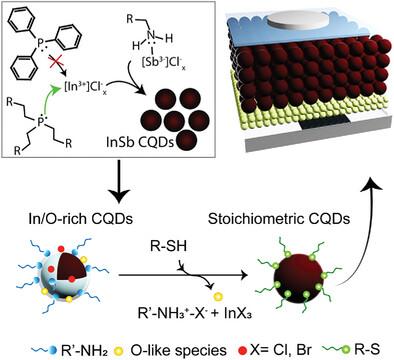
InSb colloidal quantum dots (CQDs) hold promise in short-wave infrared sensing; however, their synthesis presents ongoing challenges, particularly in achieving precise size control – this is the result of poorly controlled reactivity among the precursors. Herein, the use of alkyl-phosphine and amine-based organic additives to control the reactivity of In and Sb precursors during the nucleation and growth of CQDs is developed. This interplay between organic additive and precursors enables the synthesis of InSb CQDs having narrowed size distributions; and bandgaps tunable across the 1.2–1.5 µm spectral range; all this leading to peak-to-valley ratios >1.4 in absorption spectra. The CQDs are surface-terminated with a mixture of oleylamine, halides, and oxide-like species, and this hinders ligand exchange reactions and subsequent integration into photodiodes. We therefore resurface the CQDs with alkanethiols, displacing the native ligands via an acid-base mechanism, an approach that removes oxide species. Using a layer-by-layer fabrication process, the ligands of the resurfaced InSb CQDs are exchanged with short organic and halide ligands and incorporated films into n-i-p photodiode structures. The resultant devices exhibit a detectivity of 10¹2 Jones, an external quantum efficiency (EQE) of 33% at 1380 nm, and T90 operating stability of >19 h under continuous illuminated operation.
期刊介绍:
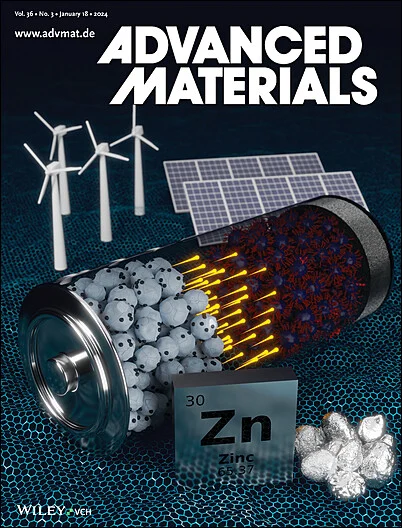
Advanced Materials, one of the world's most prestigious journals and the foundation of the Advanced portfolio, is the home of choice for best-in-class materials science for more than 30 years. Following this fast-growing and interdisciplinary field, we are considering and publishing the most important discoveries on any and all materials from materials scientists, chemists, physicists, engineers as well as health and life scientists and bringing you the latest results and trends in modern materials-related research every week.







 京公网安备 11010802042870号
京ICP备2023020795号-1
京公网安备 11010802042870号
京ICP备2023020795号-1

 分享
分享
 求助内容:
求助内容: 应助结果提醒方式:
 扫码关注我们
