Jiaming Li , Lunbin Xia , Yu Liu , Zhuwei Gu , Huasong Liang , Xuteng Wu , Zixuan Qian , Sihang Ji , Jialong Zhao , Xi Yuan
{"title":"优化蓝色发光二极管用合金CsPb1−xCdxBr3钙钛矿纳米晶体的发光性能","authors":"Jiaming Li , Lunbin Xia , Yu Liu , Zhuwei Gu , Huasong Liang , Xuteng Wu , Zixuan Qian , Sihang Ji , Jialong Zhao , Xi Yuan","doi":"10.1016/j.materresbull.2025.113355","DOIUrl":null,"url":null,"abstract":"<div><div>It is crucial to obtain pure blue perovskite nanocrystals (NCs) with high photoluminescence quantum yield (PL QY) and good stability. This work focuses on optimizing the luminescence properties of CsPbBr<sub>3</sub> NCs through the introduction of Cd<sup>2+</sup>, aiming to achieve stable and efficient pure blue perovskite NCs. By employing an improved hot-injection method, we successfully synthesized alloyed CsPb<sub>1-x</sub>Cd<sub>x</sub>Br<sub>3</sub> NCs. The introduction of Cd<sup>2+</sup> not only significantly tunes the bandgap of the NCs, realizing a blueshift in the emission wavelength, but also enhances the PL QY and stability of the NCs. Notably, the highest PL QY of 98% is achieved at a Cd/Pb molar ratio of 1:1. The changes in the luminescence properties of the NCs are attributed to lattice distortion induced by the incorporation of Cd<sup>2+</sup>, leading to a gradual transition from the CsPbBr<sub>3</sub> phase to the Cs(Pb/Cd)Br<sub>3</sub> and CsCdBr<sub>3</sub> phases. The alloyed CsPb<sub>1-x</sub>Cd<sub>x</sub>Br<sub>3</sub> NCs exhibit a smaller temperature dependent bandgap variation rate and a larger exciton binding energy, improving the water and thermal stability. Finally, we fabricated blue light emitting diodes (LEDs) using the alloyed CsPb<sub>1-x</sub>Cd<sub>x</sub>Br<sub>3</sub> NCs, achieving a maximum external quantum efficiency of 1.95% and a maximum brightness of 489.44 cd/m<sup>2</sup>. This study provides a material foundation for developing high-performance blue LED devices.</div></div>","PeriodicalId":18265,"journal":{"name":"Materials Research Bulletin","volume":"186 ","pages":"Article 113355"},"PeriodicalIF":5.7000,"publicationDate":"2025-06-01","publicationTypes":"Journal Article","fieldsOfStudy":null,"isOpenAccess":false,"openAccessPdf":"","citationCount":"0","resultStr":"{\"title\":\"Optimizing luminescence performance of alloyed CsPb1−xCdxBr3 perovskite nanocrystals for blue light-emitting diodes\",\"authors\":\"Jiaming Li , Lunbin Xia , Yu Liu , Zhuwei Gu , Huasong Liang , Xuteng Wu , Zixuan Qian , Sihang Ji , Jialong Zhao , Xi Yuan\",\"doi\":\"10.1016/j.materresbull.2025.113355\",\"DOIUrl\":null,\"url\":null,\"abstract\":\"<div><div>It is crucial to obtain pure blue perovskite nanocrystals (NCs) with high photoluminescence quantum yield (PL QY) and good stability. This work focuses on optimizing the luminescence properties of CsPbBr<sub>3</sub> NCs through the introduction of Cd<sup>2+</sup>, aiming to achieve stable and efficient pure blue perovskite NCs. By employing an improved hot-injection method, we successfully synthesized alloyed CsPb<sub>1-x</sub>Cd<sub>x</sub>Br<sub>3</sub> NCs. The introduction of Cd<sup>2+</sup> not only significantly tunes the bandgap of the NCs, realizing a blueshift in the emission wavelength, but also enhances the PL QY and stability of the NCs. Notably, the highest PL QY of 98% is achieved at a Cd/Pb molar ratio of 1:1. The changes in the luminescence properties of the NCs are attributed to lattice distortion induced by the incorporation of Cd<sup>2+</sup>, leading to a gradual transition from the CsPbBr<sub>3</sub> phase to the Cs(Pb/Cd)Br<sub>3</sub> and CsCdBr<sub>3</sub> phases. The alloyed CsPb<sub>1-x</sub>Cd<sub>x</sub>Br<sub>3</sub> NCs exhibit a smaller temperature dependent bandgap variation rate and a larger exciton binding energy, improving the water and thermal stability. Finally, we fabricated blue light emitting diodes (LEDs) using the alloyed CsPb<sub>1-x</sub>Cd<sub>x</sub>Br<sub>3</sub> NCs, achieving a maximum external quantum efficiency of 1.95% and a maximum brightness of 489.44 cd/m<sup>2</sup>. This study provides a material foundation for developing high-performance blue LED devices.</div></div>\",\"PeriodicalId\":18265,\"journal\":{\"name\":\"Materials Research Bulletin\",\"volume\":\"186 \",\"pages\":\"Article 113355\"},\"PeriodicalIF\":5.7000,\"publicationDate\":\"2025-06-01\",\"publicationTypes\":\"Journal Article\",\"fieldsOfStudy\":null,\"isOpenAccess\":false,\"openAccessPdf\":\"\",\"citationCount\":\"0\",\"resultStr\":null,\"platform\":\"Semanticscholar\",\"paperid\":null,\"PeriodicalName\":\"Materials Research Bulletin\",\"FirstCategoryId\":\"88\",\"ListUrlMain\":\"https://www.sciencedirect.com/science/article/pii/S0025540825000637\",\"RegionNum\":3,\"RegionCategory\":\"材料科学\",\"ArticlePicture\":[],\"TitleCN\":null,\"AbstractTextCN\":null,\"PMCID\":null,\"EPubDate\":\"2025/2/10 0:00:00\",\"PubModel\":\"Epub\",\"JCR\":\"Q2\",\"JCRName\":\"MATERIALS SCIENCE, MULTIDISCIPLINARY\",\"Score\":null,\"Total\":0}","platform":"Semanticscholar","paperid":null,"PeriodicalName":"Materials Research Bulletin","FirstCategoryId":"88","ListUrlMain":"https://www.sciencedirect.com/science/article/pii/S0025540825000637","RegionNum":3,"RegionCategory":"材料科学","ArticlePicture":[],"TitleCN":null,"AbstractTextCN":null,"PMCID":null,"EPubDate":"2025/2/10 0:00:00","PubModel":"Epub","JCR":"Q2","JCRName":"MATERIALS SCIENCE, MULTIDISCIPLINARY","Score":null,"Total":0}
Optimizing luminescence performance of alloyed CsPb1−xCdxBr3 perovskite nanocrystals for blue light-emitting diodes
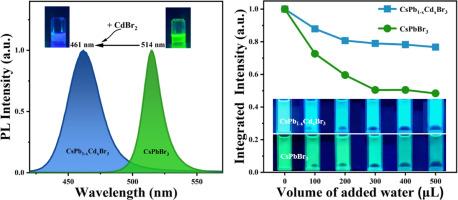
It is crucial to obtain pure blue perovskite nanocrystals (NCs) with high photoluminescence quantum yield (PL QY) and good stability. This work focuses on optimizing the luminescence properties of CsPbBr3 NCs through the introduction of Cd2+, aiming to achieve stable and efficient pure blue perovskite NCs. By employing an improved hot-injection method, we successfully synthesized alloyed CsPb1-xCdxBr3 NCs. The introduction of Cd2+ not only significantly tunes the bandgap of the NCs, realizing a blueshift in the emission wavelength, but also enhances the PL QY and stability of the NCs. Notably, the highest PL QY of 98% is achieved at a Cd/Pb molar ratio of 1:1. The changes in the luminescence properties of the NCs are attributed to lattice distortion induced by the incorporation of Cd2+, leading to a gradual transition from the CsPbBr3 phase to the Cs(Pb/Cd)Br3 and CsCdBr3 phases. The alloyed CsPb1-xCdxBr3 NCs exhibit a smaller temperature dependent bandgap variation rate and a larger exciton binding energy, improving the water and thermal stability. Finally, we fabricated blue light emitting diodes (LEDs) using the alloyed CsPb1-xCdxBr3 NCs, achieving a maximum external quantum efficiency of 1.95% and a maximum brightness of 489.44 cd/m2. This study provides a material foundation for developing high-performance blue LED devices.
期刊介绍:
Materials Research Bulletin is an international journal reporting high-impact research on processing-structure-property relationships in functional materials and nanomaterials with interesting electronic, magnetic, optical, thermal, mechanical or catalytic properties. Papers purely on thermodynamics or theoretical calculations (e.g., density functional theory) do not fall within the scope of the journal unless they also demonstrate a clear link to physical properties. Topics covered include functional materials (e.g., dielectrics, pyroelectrics, piezoelectrics, ferroelectrics, relaxors, thermoelectrics, etc.); electrochemistry and solid-state ionics (e.g., photovoltaics, batteries, sensors, and fuel cells); nanomaterials, graphene, and nanocomposites; luminescence and photocatalysis; crystal-structure and defect-structure analysis; novel electronics; non-crystalline solids; flexible electronics; protein-material interactions; and polymeric ion-exchange membranes.




 京公网安备 11010802042870号
京ICP备2023020795号-1
京公网安备 11010802042870号
京ICP备2023020795号-1

 分享
分享
 求助内容:
求助内容: 应助结果提醒方式:
 扫码关注我们
