Katherine A Ray, Sally N Lin, Adrian T Keatinge-Clay
{"title":"不同的酰基载体蛋白对接位点有助于调节A型和b型模块化聚酮合成酶酮还原酶的相反立体选择性。","authors":"Katherine A Ray, Sally N Lin, Adrian T Keatinge-Clay","doi":"10.1021/acs.biochem.4c00565","DOIUrl":null,"url":null,"abstract":"<p><p>The domains of modular polyketide synthases (PKSs) collaborate to extend and process polyketide intermediates; however, most of their interactions with one another remain mysterious. We used AlphaFold 2 to investigate how acyl carrier proteins (ACPs) present intermediates to ketoreductases (KRs), processing domains capable of not only setting the stereochemical orientations of β-hydroxyl substituents but also of α-substituents. In modules that do not contain a dehydratase (DH), the A- and B-type KRs that, respectively, generate l- and d-oriented β-hydroxy groups are predicted to possess distinct ACP docking sites. In modules containing DHs, where A-type KRs are much less common, both KR types are predicted to possess an ACP-docking site equivalent to that of B-type KRs from modules without DHs. To investigate this most common ACP docking site, mutagenesis was performed on 20 residues of the KR from the second pikromycin module within the model triketide synthase <b>P1</b>-<b>P2</b>-<b>P7</b>. The least active variants are those with mutations to a conserved hydrophobe, 2 residues downstream of the LDD motif of B-type KRs, predicted to insert into a hole adjacent to the phosphopantetheinylated serine of ACP.</p>","PeriodicalId":28,"journal":{"name":"Biochemistry Biochemistry","volume":" ","pages":"1136-1145"},"PeriodicalIF":3.0000,"publicationDate":"2025-03-04","publicationTypes":"Journal Article","fieldsOfStudy":null,"isOpenAccess":false,"openAccessPdf":"https://www.ncbi.nlm.nih.gov/pmc/articles/PMC11920649/pdf/","citationCount":"0","resultStr":"{\"title\":\"Distinct Acyl Carrier Protein Docking Sites Help Mediate the Opposite Stereoselectivities of A- and B-type Modular Polyketide Synthase Ketoreductases.\",\"authors\":\"Katherine A Ray, Sally N Lin, Adrian T Keatinge-Clay\",\"doi\":\"10.1021/acs.biochem.4c00565\",\"DOIUrl\":null,\"url\":null,\"abstract\":\"<p><p>The domains of modular polyketide synthases (PKSs) collaborate to extend and process polyketide intermediates; however, most of their interactions with one another remain mysterious. We used AlphaFold 2 to investigate how acyl carrier proteins (ACPs) present intermediates to ketoreductases (KRs), processing domains capable of not only setting the stereochemical orientations of β-hydroxyl substituents but also of α-substituents. In modules that do not contain a dehydratase (DH), the A- and B-type KRs that, respectively, generate l- and d-oriented β-hydroxy groups are predicted to possess distinct ACP docking sites. In modules containing DHs, where A-type KRs are much less common, both KR types are predicted to possess an ACP-docking site equivalent to that of B-type KRs from modules without DHs. To investigate this most common ACP docking site, mutagenesis was performed on 20 residues of the KR from the second pikromycin module within the model triketide synthase <b>P1</b>-<b>P2</b>-<b>P7</b>. The least active variants are those with mutations to a conserved hydrophobe, 2 residues downstream of the LDD motif of B-type KRs, predicted to insert into a hole adjacent to the phosphopantetheinylated serine of ACP.</p>\",\"PeriodicalId\":28,\"journal\":{\"name\":\"Biochemistry Biochemistry\",\"volume\":\" \",\"pages\":\"1136-1145\"},\"PeriodicalIF\":3.0000,\"publicationDate\":\"2025-03-04\",\"publicationTypes\":\"Journal Article\",\"fieldsOfStudy\":null,\"isOpenAccess\":false,\"openAccessPdf\":\"https://www.ncbi.nlm.nih.gov/pmc/articles/PMC11920649/pdf/\",\"citationCount\":\"0\",\"resultStr\":null,\"platform\":\"Semanticscholar\",\"paperid\":null,\"PeriodicalName\":\"Biochemistry Biochemistry\",\"FirstCategoryId\":\"1\",\"ListUrlMain\":\"https://doi.org/10.1021/acs.biochem.4c00565\",\"RegionNum\":3,\"RegionCategory\":\"生物学\",\"ArticlePicture\":[],\"TitleCN\":null,\"AbstractTextCN\":null,\"PMCID\":null,\"EPubDate\":\"2025/2/11 0:00:00\",\"PubModel\":\"Epub\",\"JCR\":\"Q3\",\"JCRName\":\"BIOCHEMISTRY & MOLECULAR BIOLOGY\",\"Score\":null,\"Total\":0}","platform":"Semanticscholar","paperid":null,"PeriodicalName":"Biochemistry Biochemistry","FirstCategoryId":"1","ListUrlMain":"https://doi.org/10.1021/acs.biochem.4c00565","RegionNum":3,"RegionCategory":"生物学","ArticlePicture":[],"TitleCN":null,"AbstractTextCN":null,"PMCID":null,"EPubDate":"2025/2/11 0:00:00","PubModel":"Epub","JCR":"Q3","JCRName":"BIOCHEMISTRY & MOLECULAR BIOLOGY","Score":null,"Total":0}
Distinct Acyl Carrier Protein Docking Sites Help Mediate the Opposite Stereoselectivities of A- and B-type Modular Polyketide Synthase Ketoreductases.
The domains of modular polyketide synthases (PKSs) collaborate to extend and process polyketide intermediates; however, most of their interactions with one another remain mysterious. We used AlphaFold 2 to investigate how acyl carrier proteins (ACPs) present intermediates to ketoreductases (KRs), processing domains capable of not only setting the stereochemical orientations of β-hydroxyl substituents but also of α-substituents. In modules that do not contain a dehydratase (DH), the A- and B-type KRs that, respectively, generate l- and d-oriented β-hydroxy groups are predicted to possess distinct ACP docking sites. In modules containing DHs, where A-type KRs are much less common, both KR types are predicted to possess an ACP-docking site equivalent to that of B-type KRs from modules without DHs. To investigate this most common ACP docking site, mutagenesis was performed on 20 residues of the KR from the second pikromycin module within the model triketide synthase P1-P2-P7. The least active variants are those with mutations to a conserved hydrophobe, 2 residues downstream of the LDD motif of B-type KRs, predicted to insert into a hole adjacent to the phosphopantetheinylated serine of ACP.
期刊介绍:
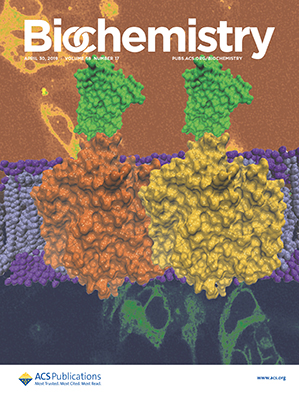
Biochemistry provides an international forum for publishing exceptional, rigorous, high-impact research across all of biological chemistry. This broad scope includes studies on the chemical, physical, mechanistic, and/or structural basis of biological or cell function, and encompasses the fields of chemical biology, synthetic biology, disease biology, cell biology, nucleic acid biology, neuroscience, structural biology, and biophysics. In addition to traditional Research Articles, Biochemistry also publishes Communications, Viewpoints, and Perspectives, as well as From the Bench articles that report new methods of particular interest to the biological chemistry community.




 京公网安备 11010802042870号
京ICP备2023020795号-1
京公网安备 11010802042870号
京ICP备2023020795号-1

 分享
分享
 求助内容:
求助内容: 应助结果提醒方式:
 扫码关注我们
