Chris Braumann, Kirsten Meurer, Marco Niedergethmann, Karl-Heinz Bauer, Alexis Ulrich, Florian Gebauer, Emile Rijcken, Uta Bultmann, Felicitas Giuliana Held, Björn Schmitz, Jasmina Hahn, André Schilling, Andreas Pascher, Konstantinos Zarras, Waldemar Uhl
{"title":"[高风险的医院计划——对北威州主治医生的调查:内脏手术的戏剧性影响]。","authors":"Chris Braumann, Kirsten Meurer, Marco Niedergethmann, Karl-Heinz Bauer, Alexis Ulrich, Florian Gebauer, Emile Rijcken, Uta Bultmann, Felicitas Giuliana Held, Björn Schmitz, Jasmina Hahn, André Schilling, Andreas Pascher, Konstantinos Zarras, Waldemar Uhl","doi":"10.1007/s00104-025-02253-8","DOIUrl":null,"url":null,"abstract":"<p><strong>Background: </strong>The hospital plan for North-Rhine/Westphalia (NRW) aims to enhance and optimize the quality and efficiency of healthcare in Germany's largest federal state and could potentially serve as a blueprint for the entire country. The State Ministry of Labor, Health and Social Affairs (MAGS) has issued determination notices for the service groups (LG), which were sent to hospitals with final implementation scheduled for April 2025.</p><p><strong>Method: </strong>A consensus-based questionnaire was distributed to 254 chief physicians of visceral surgery departments (CÄ). The survey queried information on age, number of beds, care levels, service groups, centralization, specialization, certification, changes in public perception, continuing education and threats to training authorization as well as the attractiveness of the discipline and concerns regarding junior staff.</p><p><strong>Results: </strong>Out of 254 questionnaires 108 were returned (42.5%). Approximately 50% of the respondents believe the reform is necessary; however, 32% of clinics were denied allocation of an LG despite having certification. In 45 clinics (42%) no LG was allocated at all. One hospital received an LG without applying for it. Additionally, 80 hospital administrators (74%) reported not seeing any meaningful political strategy behind the hospital plan, 35% of CÄs did not anticipate improvements in treatment quality from centralization, 59 head physicians (55%) expressed concerns that their hospital's public image would deteriorate and 86 CÄs (80%) believed the current training regulations can no longer be guaranteed. Furthermore, 72% of respondents felt that visceral surgery is losing its appeal as a discipline and 48% were worried about their personal future career prospects.</p><p><strong>Discussion: </strong>While the reform is generally supported by the respondents, the implementation method has received significant criticism. The certifications from the German Cancer Society (DKG) and the German Society for General and Visceral Surgery (DGAV) are not consistently recognized, raising doubts about the reliability of hospital services. Additionally, a detailed impact analysis and accompanying research are lacking (e.g., capacity bottlenecks, staff shortages, waiting times, hospital closures). The attractiveness of surgery as a discipline and advanced training in special visceral surgery are at risk.</p>","PeriodicalId":72588,"journal":{"name":"Chirurgie (Heidelberg, Germany)","volume":" ","pages":"222-231"},"PeriodicalIF":0.0000,"publicationDate":"2025-03-01","publicationTypes":"Journal Article","fieldsOfStudy":null,"isOpenAccess":false,"openAccessPdf":"https://www.ncbi.nlm.nih.gov/pmc/articles/PMC11842503/pdf/","citationCount":"0","resultStr":"{\"title\":\"[Risky hospital plan-A survey of head physicians in NRW: dramatic effects in visceral surgery].\",\"authors\":\"Chris Braumann, Kirsten Meurer, Marco Niedergethmann, Karl-Heinz Bauer, Alexis Ulrich, Florian Gebauer, Emile Rijcken, Uta Bultmann, Felicitas Giuliana Held, Björn Schmitz, Jasmina Hahn, André Schilling, Andreas Pascher, Konstantinos Zarras, Waldemar Uhl\",\"doi\":\"10.1007/s00104-025-02253-8\",\"DOIUrl\":null,\"url\":null,\"abstract\":\"<p><strong>Background: </strong>The hospital plan for North-Rhine/Westphalia (NRW) aims to enhance and optimize the quality and efficiency of healthcare in Germany's largest federal state and could potentially serve as a blueprint for the entire country. The State Ministry of Labor, Health and Social Affairs (MAGS) has issued determination notices for the service groups (LG), which were sent to hospitals with final implementation scheduled for April 2025.</p><p><strong>Method: </strong>A consensus-based questionnaire was distributed to 254 chief physicians of visceral surgery departments (CÄ). The survey queried information on age, number of beds, care levels, service groups, centralization, specialization, certification, changes in public perception, continuing education and threats to training authorization as well as the attractiveness of the discipline and concerns regarding junior staff.</p><p><strong>Results: </strong>Out of 254 questionnaires 108 were returned (42.5%). Approximately 50% of the respondents believe the reform is necessary; however, 32% of clinics were denied allocation of an LG despite having certification. In 45 clinics (42%) no LG was allocated at all. One hospital received an LG without applying for it. Additionally, 80 hospital administrators (74%) reported not seeing any meaningful political strategy behind the hospital plan, 35% of CÄs did not anticipate improvements in treatment quality from centralization, 59 head physicians (55%) expressed concerns that their hospital's public image would deteriorate and 86 CÄs (80%) believed the current training regulations can no longer be guaranteed. Furthermore, 72% of respondents felt that visceral surgery is losing its appeal as a discipline and 48% were worried about their personal future career prospects.</p><p><strong>Discussion: </strong>While the reform is generally supported by the respondents, the implementation method has received significant criticism. The certifications from the German Cancer Society (DKG) and the German Society for General and Visceral Surgery (DGAV) are not consistently recognized, raising doubts about the reliability of hospital services. Additionally, a detailed impact analysis and accompanying research are lacking (e.g., capacity bottlenecks, staff shortages, waiting times, hospital closures). The attractiveness of surgery as a discipline and advanced training in special visceral surgery are at risk.</p>\",\"PeriodicalId\":72588,\"journal\":{\"name\":\"Chirurgie (Heidelberg, Germany)\",\"volume\":\" \",\"pages\":\"222-231\"},\"PeriodicalIF\":0.0000,\"publicationDate\":\"2025-03-01\",\"publicationTypes\":\"Journal Article\",\"fieldsOfStudy\":null,\"isOpenAccess\":false,\"openAccessPdf\":\"https://www.ncbi.nlm.nih.gov/pmc/articles/PMC11842503/pdf/\",\"citationCount\":\"0\",\"resultStr\":null,\"platform\":\"Semanticscholar\",\"paperid\":null,\"PeriodicalName\":\"Chirurgie (Heidelberg, Germany)\",\"FirstCategoryId\":\"1085\",\"ListUrlMain\":\"https://doi.org/10.1007/s00104-025-02253-8\",\"RegionNum\":0,\"RegionCategory\":null,\"ArticlePicture\":[],\"TitleCN\":null,\"AbstractTextCN\":null,\"PMCID\":null,\"EPubDate\":\"2025/2/12 0:00:00\",\"PubModel\":\"Epub\",\"JCR\":\"\",\"JCRName\":\"\",\"Score\":null,\"Total\":0}","platform":"Semanticscholar","paperid":null,"PeriodicalName":"Chirurgie (Heidelberg, Germany)","FirstCategoryId":"1085","ListUrlMain":"https://doi.org/10.1007/s00104-025-02253-8","RegionNum":0,"RegionCategory":null,"ArticlePicture":[],"TitleCN":null,"AbstractTextCN":null,"PMCID":null,"EPubDate":"2025/2/12 0:00:00","PubModel":"Epub","JCR":"","JCRName":"","Score":null,"Total":0}
[Risky hospital plan-A survey of head physicians in NRW: dramatic effects in visceral surgery].
Background: The hospital plan for North-Rhine/Westphalia (NRW) aims to enhance and optimize the quality and efficiency of healthcare in Germany's largest federal state and could potentially serve as a blueprint for the entire country. The State Ministry of Labor, Health and Social Affairs (MAGS) has issued determination notices for the service groups (LG), which were sent to hospitals with final implementation scheduled for April 2025.
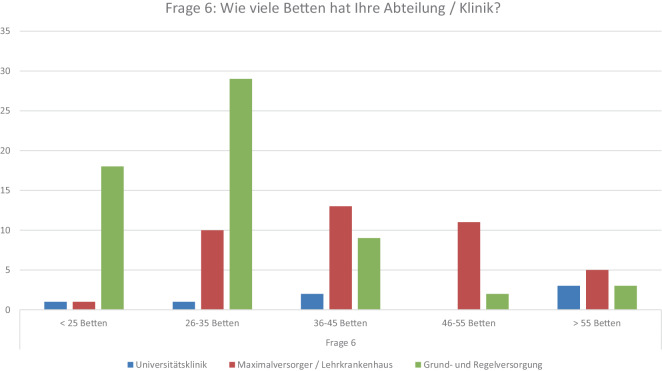
Method: A consensus-based questionnaire was distributed to 254 chief physicians of visceral surgery departments (CÄ). The survey queried information on age, number of beds, care levels, service groups, centralization, specialization, certification, changes in public perception, continuing education and threats to training authorization as well as the attractiveness of the discipline and concerns regarding junior staff.
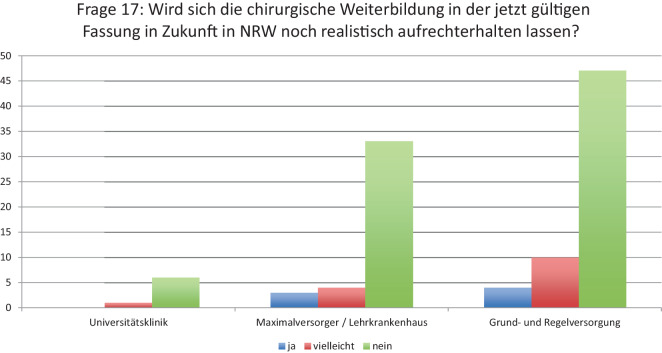
Results: Out of 254 questionnaires 108 were returned (42.5%). Approximately 50% of the respondents believe the reform is necessary; however, 32% of clinics were denied allocation of an LG despite having certification. In 45 clinics (42%) no LG was allocated at all. One hospital received an LG without applying for it. Additionally, 80 hospital administrators (74%) reported not seeing any meaningful political strategy behind the hospital plan, 35% of CÄs did not anticipate improvements in treatment quality from centralization, 59 head physicians (55%) expressed concerns that their hospital's public image would deteriorate and 86 CÄs (80%) believed the current training regulations can no longer be guaranteed. Furthermore, 72% of respondents felt that visceral surgery is losing its appeal as a discipline and 48% were worried about their personal future career prospects.
Discussion: While the reform is generally supported by the respondents, the implementation method has received significant criticism. The certifications from the German Cancer Society (DKG) and the German Society for General and Visceral Surgery (DGAV) are not consistently recognized, raising doubts about the reliability of hospital services. Additionally, a detailed impact analysis and accompanying research are lacking (e.g., capacity bottlenecks, staff shortages, waiting times, hospital closures). The attractiveness of surgery as a discipline and advanced training in special visceral surgery are at risk.





 京公网安备 11010802042870号
京ICP备2023020795号-1
京公网安备 11010802042870号
京ICP备2023020795号-1

 分享
分享

 求助内容:
求助内容: 应助结果提醒方式:
 扫码关注我们
