Jesus de la Fuente, Guillermo Serrano, Uxía Veleiro, Mikel Casals, Laura Vera, Marija Pizurica, Nuria Gómez-Cebrián, Leonor Puchades-Carrasco, Antonio Pineda-Lucena, Idoia Ochoa, Silve Vicent, Olivier Gevaert, Mikel Hernaez
{"title":"走向一个更加感性的药物再利用世界","authors":"Jesus de la Fuente, Guillermo Serrano, Uxía Veleiro, Mikel Casals, Laura Vera, Marija Pizurica, Nuria Gómez-Cebrián, Leonor Puchades-Carrasco, Antonio Pineda-Lucena, Idoia Ochoa, Silve Vicent, Olivier Gevaert, Mikel Hernaez","doi":"10.1038/s42256-025-00987-y","DOIUrl":null,"url":null,"abstract":"Drug–target interaction (DTI) prediction is a challenging albeit essential task in drug repurposing. Learning on graph models has drawn special attention as they can substantially reduce drug repurposing costs and time commitment. However, many current approaches require high-demand additional information besides DTIs that complicates their evaluation process and usability. Additionally, structural differences in the learning architecture of current models hinder their fair benchmarking. In this work, we first perform an in-depth evaluation of current DTI datasets and prediction models through a robust benchmarking process and show that DTI methods based on transductive models lack generalization and lead to inflated performance when traditionally evaluated, making them unsuitable for drug repurposing. We then propose a biologically driven strategy for negative-edge subsampling and uncovered previously unknown interactions via in vitro validation, missed by traditional subsampling. Finally, we provide a toolbox from all generated resources, crucial for fair benchmarking and robust model design. The authors address the challenge of predicting drug–target interactions, which is crucial for drug repurposing, by introducing a robust benchmarking framework. Using a biologically driven strategy, they uncover previously unknown interactions.","PeriodicalId":48533,"journal":{"name":"Nature Machine Intelligence","volume":"7 3","pages":"495-508"},"PeriodicalIF":23.9000,"publicationDate":"2025-02-13","publicationTypes":"Journal Article","fieldsOfStudy":null,"isOpenAccess":false,"openAccessPdf":"https://www.nature.com/articles/s42256-025-00987-y.pdf","citationCount":"0","resultStr":"{\"title\":\"Towards a more inductive world for drug repurposing approaches\",\"authors\":\"Jesus de la Fuente, Guillermo Serrano, Uxía Veleiro, Mikel Casals, Laura Vera, Marija Pizurica, Nuria Gómez-Cebrián, Leonor Puchades-Carrasco, Antonio Pineda-Lucena, Idoia Ochoa, Silve Vicent, Olivier Gevaert, Mikel Hernaez\",\"doi\":\"10.1038/s42256-025-00987-y\",\"DOIUrl\":null,\"url\":null,\"abstract\":\"Drug–target interaction (DTI) prediction is a challenging albeit essential task in drug repurposing. Learning on graph models has drawn special attention as they can substantially reduce drug repurposing costs and time commitment. However, many current approaches require high-demand additional information besides DTIs that complicates their evaluation process and usability. Additionally, structural differences in the learning architecture of current models hinder their fair benchmarking. In this work, we first perform an in-depth evaluation of current DTI datasets and prediction models through a robust benchmarking process and show that DTI methods based on transductive models lack generalization and lead to inflated performance when traditionally evaluated, making them unsuitable for drug repurposing. We then propose a biologically driven strategy for negative-edge subsampling and uncovered previously unknown interactions via in vitro validation, missed by traditional subsampling. Finally, we provide a toolbox from all generated resources, crucial for fair benchmarking and robust model design. The authors address the challenge of predicting drug–target interactions, which is crucial for drug repurposing, by introducing a robust benchmarking framework. Using a biologically driven strategy, they uncover previously unknown interactions.\",\"PeriodicalId\":48533,\"journal\":{\"name\":\"Nature Machine Intelligence\",\"volume\":\"7 3\",\"pages\":\"495-508\"},\"PeriodicalIF\":23.9000,\"publicationDate\":\"2025-02-13\",\"publicationTypes\":\"Journal Article\",\"fieldsOfStudy\":null,\"isOpenAccess\":false,\"openAccessPdf\":\"https://www.nature.com/articles/s42256-025-00987-y.pdf\",\"citationCount\":\"0\",\"resultStr\":null,\"platform\":\"Semanticscholar\",\"paperid\":null,\"PeriodicalName\":\"Nature Machine Intelligence\",\"FirstCategoryId\":\"94\",\"ListUrlMain\":\"https://www.nature.com/articles/s42256-025-00987-y\",\"RegionNum\":1,\"RegionCategory\":\"计算机科学\",\"ArticlePicture\":[],\"TitleCN\":null,\"AbstractTextCN\":null,\"PMCID\":null,\"EPubDate\":\"\",\"PubModel\":\"\",\"JCR\":\"Q1\",\"JCRName\":\"COMPUTER SCIENCE, ARTIFICIAL INTELLIGENCE\",\"Score\":null,\"Total\":0}","platform":"Semanticscholar","paperid":null,"PeriodicalName":"Nature Machine Intelligence","FirstCategoryId":"94","ListUrlMain":"https://www.nature.com/articles/s42256-025-00987-y","RegionNum":1,"RegionCategory":"计算机科学","ArticlePicture":[],"TitleCN":null,"AbstractTextCN":null,"PMCID":null,"EPubDate":"","PubModel":"","JCR":"Q1","JCRName":"COMPUTER SCIENCE, ARTIFICIAL INTELLIGENCE","Score":null,"Total":0}
Towards a more inductive world for drug repurposing approaches
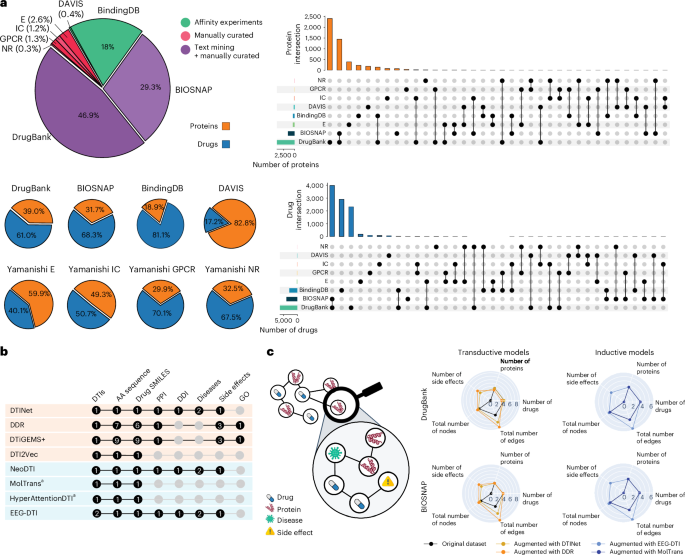
Drug–target interaction (DTI) prediction is a challenging albeit essential task in drug repurposing. Learning on graph models has drawn special attention as they can substantially reduce drug repurposing costs and time commitment. However, many current approaches require high-demand additional information besides DTIs that complicates their evaluation process and usability. Additionally, structural differences in the learning architecture of current models hinder their fair benchmarking. In this work, we first perform an in-depth evaluation of current DTI datasets and prediction models through a robust benchmarking process and show that DTI methods based on transductive models lack generalization and lead to inflated performance when traditionally evaluated, making them unsuitable for drug repurposing. We then propose a biologically driven strategy for negative-edge subsampling and uncovered previously unknown interactions via in vitro validation, missed by traditional subsampling. Finally, we provide a toolbox from all generated resources, crucial for fair benchmarking and robust model design. The authors address the challenge of predicting drug–target interactions, which is crucial for drug repurposing, by introducing a robust benchmarking framework. Using a biologically driven strategy, they uncover previously unknown interactions.
期刊介绍:
Nature Machine Intelligence is a distinguished publication that presents original research and reviews on various topics in machine learning, robotics, and AI. Our focus extends beyond these fields, exploring their profound impact on other scientific disciplines, as well as societal and industrial aspects. We recognize limitless possibilities wherein machine intelligence can augment human capabilities and knowledge in domains like scientific exploration, healthcare, medical diagnostics, and the creation of safe and sustainable cities, transportation, and agriculture. Simultaneously, we acknowledge the emergence of ethical, social, and legal concerns due to the rapid pace of advancements.
To foster interdisciplinary discussions on these far-reaching implications, Nature Machine Intelligence serves as a platform for dialogue facilitated through Comments, News Features, News & Views articles, and Correspondence. Our goal is to encourage a comprehensive examination of these subjects.
Similar to all Nature-branded journals, Nature Machine Intelligence operates under the guidance of a team of skilled editors. We adhere to a fair and rigorous peer-review process, ensuring high standards of copy-editing and production, swift publication, and editorial independence.





 京公网安备 11010802042870号
京ICP备2023020795号-1
京公网安备 11010802042870号
京ICP备2023020795号-1

 分享
分享
 求助内容:
求助内容: 应助结果提醒方式:
 扫码关注我们
