Peijie Xu , Yuhang Yu , Beibei Du , Yongdan Cao , Donghui Sun , Zengchao Ji , Yifei Zhu , Yanyue Jia , Yang Liu , Zhao Cao
{"title":"基于微结构可控高岭土纳米管的锌离子电池用高性能Janus分离器","authors":"Peijie Xu , Yuhang Yu , Beibei Du , Yongdan Cao , Donghui Sun , Zengchao Ji , Yifei Zhu , Yanyue Jia , Yang Liu , Zhao Cao","doi":"10.1016/j.est.2025.115820","DOIUrl":null,"url":null,"abstract":"<div><div>Zinc-ion batteries(ZIBs) are promising as the stationary energy storage owing to their inherent high safety, cost-effective, and environmental-friendly. Nevertheless, the notorious dendrite growth and water-induced side reactions on Zn anode significantly downgrade the long-lasting cycling stability and hinder the industrialization of ZIBs. Herein, a flux-homogenized Zn<sup>2+</sup> transport system based on a Janus separator is constructed. This Janus separator features bacterial cellulose (BC) layer on one side and roughened halloysite nanotubes/bacterial cellulose (RHNTs/BC) layer on the other side. The abundant surface hydroxyl groups, zincophilicity sites, and ionic transmission paths of RHNTs make them ideal for acting as an ion pump to accelerate the transportation of ions, contributing to the immensely improvement of the de-solvation process, zinc deposition, and the growth of Zn dendrites. As a result, the Zn/Zn symmetrical cell with Janus separator can achieve a stable cycle life of over 800 h at 4.40 mA cm<sup>−2</sup>. More impressively, the full cell based on Janus separator enables excellent cycling stability. This study enriches the structurally controllable construction method of HNTs and provides the fundamental theories for the application of HNTs in the field of new high-efficiency mineral energy storage materials.</div></div>","PeriodicalId":15942,"journal":{"name":"Journal of energy storage","volume":"114 ","pages":"Article 115820"},"PeriodicalIF":8.9000,"publicationDate":"2025-04-01","publicationTypes":"Journal Article","fieldsOfStudy":null,"isOpenAccess":false,"openAccessPdf":"","citationCount":"0","resultStr":"{\"title\":\"High performance Janus separator based on microstructurally controllable halloysite nanotubes for zinc-ion batteries\",\"authors\":\"Peijie Xu , Yuhang Yu , Beibei Du , Yongdan Cao , Donghui Sun , Zengchao Ji , Yifei Zhu , Yanyue Jia , Yang Liu , Zhao Cao\",\"doi\":\"10.1016/j.est.2025.115820\",\"DOIUrl\":null,\"url\":null,\"abstract\":\"<div><div>Zinc-ion batteries(ZIBs) are promising as the stationary energy storage owing to their inherent high safety, cost-effective, and environmental-friendly. Nevertheless, the notorious dendrite growth and water-induced side reactions on Zn anode significantly downgrade the long-lasting cycling stability and hinder the industrialization of ZIBs. Herein, a flux-homogenized Zn<sup>2+</sup> transport system based on a Janus separator is constructed. This Janus separator features bacterial cellulose (BC) layer on one side and roughened halloysite nanotubes/bacterial cellulose (RHNTs/BC) layer on the other side. The abundant surface hydroxyl groups, zincophilicity sites, and ionic transmission paths of RHNTs make them ideal for acting as an ion pump to accelerate the transportation of ions, contributing to the immensely improvement of the de-solvation process, zinc deposition, and the growth of Zn dendrites. As a result, the Zn/Zn symmetrical cell with Janus separator can achieve a stable cycle life of over 800 h at 4.40 mA cm<sup>−2</sup>. More impressively, the full cell based on Janus separator enables excellent cycling stability. This study enriches the structurally controllable construction method of HNTs and provides the fundamental theories for the application of HNTs in the field of new high-efficiency mineral energy storage materials.</div></div>\",\"PeriodicalId\":15942,\"journal\":{\"name\":\"Journal of energy storage\",\"volume\":\"114 \",\"pages\":\"Article 115820\"},\"PeriodicalIF\":8.9000,\"publicationDate\":\"2025-04-01\",\"publicationTypes\":\"Journal Article\",\"fieldsOfStudy\":null,\"isOpenAccess\":false,\"openAccessPdf\":\"\",\"citationCount\":\"0\",\"resultStr\":null,\"platform\":\"Semanticscholar\",\"paperid\":null,\"PeriodicalName\":\"Journal of energy storage\",\"FirstCategoryId\":\"5\",\"ListUrlMain\":\"https://www.sciencedirect.com/science/article/pii/S2352152X2500533X\",\"RegionNum\":2,\"RegionCategory\":\"工程技术\",\"ArticlePicture\":[],\"TitleCN\":null,\"AbstractTextCN\":null,\"PMCID\":null,\"EPubDate\":\"2025/2/14 0:00:00\",\"PubModel\":\"Epub\",\"JCR\":\"Q1\",\"JCRName\":\"ENERGY & FUELS\",\"Score\":null,\"Total\":0}","platform":"Semanticscholar","paperid":null,"PeriodicalName":"Journal of energy storage","FirstCategoryId":"5","ListUrlMain":"https://www.sciencedirect.com/science/article/pii/S2352152X2500533X","RegionNum":2,"RegionCategory":"工程技术","ArticlePicture":[],"TitleCN":null,"AbstractTextCN":null,"PMCID":null,"EPubDate":"2025/2/14 0:00:00","PubModel":"Epub","JCR":"Q1","JCRName":"ENERGY & FUELS","Score":null,"Total":0}
引用次数: 0
摘要
锌离子电池具有安全、经济、环保等优点,在固定式储能领域具有广阔的应用前景。然而,锌阳极上严重的枝晶生长和水致副反应严重降低了锌阳极的长期循环稳定性,阻碍了锌阳极的工业化。本文构建了基于Janus分离器的通量均质Zn2+输运体系。Janus分离器的一面是细菌纤维素(BC)层,另一面是粗糙的高岭土纳米管/细菌纤维素(RHNTs/BC)层。RHNTs丰富的表面羟基、亲锌位点和离子传输路径使其成为离子泵加速离子运输的理想选择,有助于极大地改善脱溶剂过程、锌沉积和锌枝的生长。结果表明,采用Janus分离器的Zn/Zn对称电池在4.40 mA cm−2下的稳定循环寿命可达800 h以上。更令人印象深刻的是,基于Janus分离器的全电池能够实现出色的循环稳定性。本研究丰富了纳米碳管结构可控的构建方法,为纳米碳管在新型高效矿物储能材料领域的应用提供了基础理论。
High performance Janus separator based on microstructurally controllable halloysite nanotubes for zinc-ion batteries
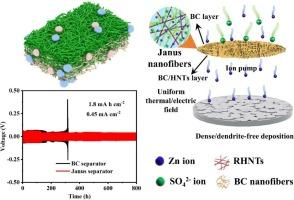
Zinc-ion batteries(ZIBs) are promising as the stationary energy storage owing to their inherent high safety, cost-effective, and environmental-friendly. Nevertheless, the notorious dendrite growth and water-induced side reactions on Zn anode significantly downgrade the long-lasting cycling stability and hinder the industrialization of ZIBs. Herein, a flux-homogenized Zn2+ transport system based on a Janus separator is constructed. This Janus separator features bacterial cellulose (BC) layer on one side and roughened halloysite nanotubes/bacterial cellulose (RHNTs/BC) layer on the other side. The abundant surface hydroxyl groups, zincophilicity sites, and ionic transmission paths of RHNTs make them ideal for acting as an ion pump to accelerate the transportation of ions, contributing to the immensely improvement of the de-solvation process, zinc deposition, and the growth of Zn dendrites. As a result, the Zn/Zn symmetrical cell with Janus separator can achieve a stable cycle life of over 800 h at 4.40 mA cm−2. More impressively, the full cell based on Janus separator enables excellent cycling stability. This study enriches the structurally controllable construction method of HNTs and provides the fundamental theories for the application of HNTs in the field of new high-efficiency mineral energy storage materials.
期刊介绍:
Journal of energy storage focusses on all aspects of energy storage, in particular systems integration, electric grid integration, modelling and analysis, novel energy storage technologies, sizing and management strategies, business models for operation of storage systems and energy storage developments worldwide.




 京公网安备 11010802042870号
京ICP备2023020795号-1
京公网安备 11010802042870号
京ICP备2023020795号-1

 分享
分享
 求助内容:
求助内容: 应助结果提醒方式:
 扫码关注我们
