Prashant U Pandey, Jonathan A Micieli, Stephan Ong Tone, Kenneth T Eng, Peter J Kertes, Jovi C Y Wong
{"title":"真实眼底照片生成,提高疾病自动分类。","authors":"Prashant U Pandey, Jonathan A Micieli, Stephan Ong Tone, Kenneth T Eng, Peter J Kertes, Jovi C Y Wong","doi":"10.1136/bjo-2024-326122","DOIUrl":null,"url":null,"abstract":"<p><strong>Aims: </strong>This study aims to investigate whether denoising diffusion probabilistic models (DDPMs) could generate realistic retinal images, and if they could be used to improve the performance of a deep convolutional neural network (CNN) ensemble for multiple retinal disease classification, which was previously shown to outperform human experts.</p><p><strong>Methods: </strong>We trained DDPMs to generate retinal fundus images representing diabetic retinopathy, age-related macular degeneration, glaucoma or normal eyes. Eight board-certified ophthalmologists evaluated 96 test images to assess the realism of generated images and classified them based on disease labels. Subsequently, between 100 and 1000 generated images were employed to augment training of deep convolutional ensembles for classifying retinal disease. We measured the accuracy of ophthalmologists in correctly identifying real and generated images. We also measured the classification accuracy, F-score and area under the receiver operating curve of a trained CNN in classifying retinal diseases from a test set of 100 fundus images.</p><p><strong>Results: </strong>Ophthalmologists exhibited a mean accuracy of 61.1% (range: 51.0%-68.8%) in differentiating real and generated images. Augmenting the training set with 238 generated images in the smallest class statistically significantly improved the F-score and accuracy by 5.3% and 5.8%, respectively (p<0.01) in a retinal disease classification task, compared with a baseline model trained only with real images.</p><p><strong>Conclusions: </strong>Latent diffusion models generated highly realistic retinal images, as validated by human experts. Adding generated images to the training set improved performance of a CNN ensemble without requiring additional real patient data.</p>","PeriodicalId":9313,"journal":{"name":"British Journal of Ophthalmology","volume":" ","pages":"791-798"},"PeriodicalIF":3.5000,"publicationDate":"2025-06-23","publicationTypes":"Journal Article","fieldsOfStudy":null,"isOpenAccess":false,"openAccessPdf":"https://www.ncbi.nlm.nih.gov/pmc/articles/PMC12229059/pdf/","citationCount":"0","resultStr":"{\"title\":\"Realistic fundus photograph generation for improving automated disease classification.\",\"authors\":\"Prashant U Pandey, Jonathan A Micieli, Stephan Ong Tone, Kenneth T Eng, Peter J Kertes, Jovi C Y Wong\",\"doi\":\"10.1136/bjo-2024-326122\",\"DOIUrl\":null,\"url\":null,\"abstract\":\"<p><strong>Aims: </strong>This study aims to investigate whether denoising diffusion probabilistic models (DDPMs) could generate realistic retinal images, and if they could be used to improve the performance of a deep convolutional neural network (CNN) ensemble for multiple retinal disease classification, which was previously shown to outperform human experts.</p><p><strong>Methods: </strong>We trained DDPMs to generate retinal fundus images representing diabetic retinopathy, age-related macular degeneration, glaucoma or normal eyes. Eight board-certified ophthalmologists evaluated 96 test images to assess the realism of generated images and classified them based on disease labels. Subsequently, between 100 and 1000 generated images were employed to augment training of deep convolutional ensembles for classifying retinal disease. We measured the accuracy of ophthalmologists in correctly identifying real and generated images. We also measured the classification accuracy, F-score and area under the receiver operating curve of a trained CNN in classifying retinal diseases from a test set of 100 fundus images.</p><p><strong>Results: </strong>Ophthalmologists exhibited a mean accuracy of 61.1% (range: 51.0%-68.8%) in differentiating real and generated images. Augmenting the training set with 238 generated images in the smallest class statistically significantly improved the F-score and accuracy by 5.3% and 5.8%, respectively (p<0.01) in a retinal disease classification task, compared with a baseline model trained only with real images.</p><p><strong>Conclusions: </strong>Latent diffusion models generated highly realistic retinal images, as validated by human experts. Adding generated images to the training set improved performance of a CNN ensemble without requiring additional real patient data.</p>\",\"PeriodicalId\":9313,\"journal\":{\"name\":\"British Journal of Ophthalmology\",\"volume\":\" \",\"pages\":\"791-798\"},\"PeriodicalIF\":3.5000,\"publicationDate\":\"2025-06-23\",\"publicationTypes\":\"Journal Article\",\"fieldsOfStudy\":null,\"isOpenAccess\":false,\"openAccessPdf\":\"https://www.ncbi.nlm.nih.gov/pmc/articles/PMC12229059/pdf/\",\"citationCount\":\"0\",\"resultStr\":null,\"platform\":\"Semanticscholar\",\"paperid\":null,\"PeriodicalName\":\"British Journal of Ophthalmology\",\"FirstCategoryId\":\"3\",\"ListUrlMain\":\"https://doi.org/10.1136/bjo-2024-326122\",\"RegionNum\":2,\"RegionCategory\":\"医学\",\"ArticlePicture\":[],\"TitleCN\":null,\"AbstractTextCN\":null,\"PMCID\":null,\"EPubDate\":\"\",\"PubModel\":\"\",\"JCR\":\"Q1\",\"JCRName\":\"OPHTHALMOLOGY\",\"Score\":null,\"Total\":0}","platform":"Semanticscholar","paperid":null,"PeriodicalName":"British Journal of Ophthalmology","FirstCategoryId":"3","ListUrlMain":"https://doi.org/10.1136/bjo-2024-326122","RegionNum":2,"RegionCategory":"医学","ArticlePicture":[],"TitleCN":null,"AbstractTextCN":null,"PMCID":null,"EPubDate":"","PubModel":"","JCR":"Q1","JCRName":"OPHTHALMOLOGY","Score":null,"Total":0}
Realistic fundus photograph generation for improving automated disease classification.
Aims: This study aims to investigate whether denoising diffusion probabilistic models (DDPMs) could generate realistic retinal images, and if they could be used to improve the performance of a deep convolutional neural network (CNN) ensemble for multiple retinal disease classification, which was previously shown to outperform human experts.
Methods: We trained DDPMs to generate retinal fundus images representing diabetic retinopathy, age-related macular degeneration, glaucoma or normal eyes. Eight board-certified ophthalmologists evaluated 96 test images to assess the realism of generated images and classified them based on disease labels. Subsequently, between 100 and 1000 generated images were employed to augment training of deep convolutional ensembles for classifying retinal disease. We measured the accuracy of ophthalmologists in correctly identifying real and generated images. We also measured the classification accuracy, F-score and area under the receiver operating curve of a trained CNN in classifying retinal diseases from a test set of 100 fundus images.
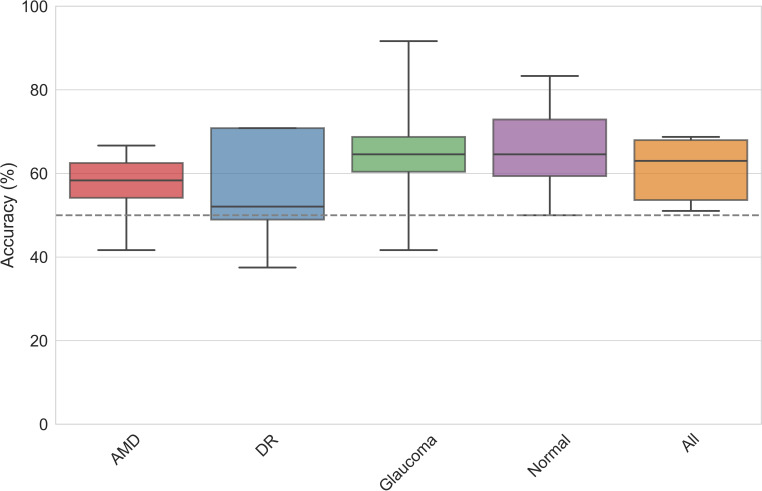
Results: Ophthalmologists exhibited a mean accuracy of 61.1% (range: 51.0%-68.8%) in differentiating real and generated images. Augmenting the training set with 238 generated images in the smallest class statistically significantly improved the F-score and accuracy by 5.3% and 5.8%, respectively (p<0.01) in a retinal disease classification task, compared with a baseline model trained only with real images.
Conclusions: Latent diffusion models generated highly realistic retinal images, as validated by human experts. Adding generated images to the training set improved performance of a CNN ensemble without requiring additional real patient data.
期刊介绍:
The British Journal of Ophthalmology (BJO) is an international peer-reviewed journal for ophthalmologists and visual science specialists. BJO publishes clinical investigations, clinical observations, and clinically relevant laboratory investigations related to ophthalmology. It also provides major reviews and also publishes manuscripts covering regional issues in a global context.






 京公网安备 11010802042870号
京ICP备2023020795号-1
京公网安备 11010802042870号
京ICP备2023020795号-1

 分享
分享
 求助内容:
求助内容: 应助结果提醒方式:
 扫码关注我们
