{"title":"炎症性肠病与性别的因果关系:一项孟德尔随机研究。","authors":"Kaiwen Wang, Yu Lou, Shunjie Tian, Zhihui Tao","doi":"10.3389/fendo.2025.1338701","DOIUrl":null,"url":null,"abstract":"<p><strong>Objective: </strong>The aim of this study was to investigate the bidirectional causal relationship between sex hormones and IBD through a two-sample bidirectional Mendelian randomization (MR) study.</p><p><strong>Methods: </strong>Based on Genome-Wide Association Study (GWAS) pooled data on SHBG, total testosterone, bioavailable testosterone, estradiol, and IBD in a European population, we performed two-sample bidirectional MR analyses using single nucleotide polymorphisms (SNPs) as instrumental variables. We used inverse variance weighting (IVW), weighted median, weighted mode, and MR-Egger to assess bidirectional causality between sex hormones and IBD.</p><p><strong>Results: </strong>There was no causal relationship between sex hormones and IBD in women (<i>P</i> > 0.05), and there was a causal and positive correlation between SHBG and testosterone and IBD in men.The OR for SHBG was 1.22 (95% CI: 1.09-1.37, <i>P</i> = 0.0004), and for testosterone was 1.20 (95% CI: 1.04-1.39, <i>P</i> = 0.0145).IBD did not significantly interact with female sex hormones but resulted in a decrease in SHBG (OR = 1.02, 95% CI: 1.00-1.04, <i>P</i> = 0.0195) and testosterone (OR = 1.01, 95% CI: 1.00 -1.02, <i>P</i> = 0.0200) in men.</p><p><strong>Conclusion: </strong>There is no causal relationship between female sex hormones and IBD, but male SHBG and testosterone are positively correlated with the risk of IBD and IBD promotes elevated levels of SHBG and testosterone in males, suggesting that sex hormones play different roles in IBD patients of different sexes.</p>","PeriodicalId":12447,"journal":{"name":"Frontiers in Endocrinology","volume":"16 ","pages":"1338701"},"PeriodicalIF":4.6000,"publicationDate":"2025-01-29","publicationTypes":"Journal Article","fieldsOfStudy":null,"isOpenAccess":false,"openAccessPdf":"https://www.ncbi.nlm.nih.gov/pmc/articles/PMC11813775/pdf/","citationCount":"0","resultStr":"{\"title\":\"Causal relationship between inflammatory bowel disease and sex: a Mendelian randomization study.\",\"authors\":\"Kaiwen Wang, Yu Lou, Shunjie Tian, Zhihui Tao\",\"doi\":\"10.3389/fendo.2025.1338701\",\"DOIUrl\":null,\"url\":null,\"abstract\":\"<p><strong>Objective: </strong>The aim of this study was to investigate the bidirectional causal relationship between sex hormones and IBD through a two-sample bidirectional Mendelian randomization (MR) study.</p><p><strong>Methods: </strong>Based on Genome-Wide Association Study (GWAS) pooled data on SHBG, total testosterone, bioavailable testosterone, estradiol, and IBD in a European population, we performed two-sample bidirectional MR analyses using single nucleotide polymorphisms (SNPs) as instrumental variables. We used inverse variance weighting (IVW), weighted median, weighted mode, and MR-Egger to assess bidirectional causality between sex hormones and IBD.</p><p><strong>Results: </strong>There was no causal relationship between sex hormones and IBD in women (<i>P</i> > 0.05), and there was a causal and positive correlation between SHBG and testosterone and IBD in men.The OR for SHBG was 1.22 (95% CI: 1.09-1.37, <i>P</i> = 0.0004), and for testosterone was 1.20 (95% CI: 1.04-1.39, <i>P</i> = 0.0145).IBD did not significantly interact with female sex hormones but resulted in a decrease in SHBG (OR = 1.02, 95% CI: 1.00-1.04, <i>P</i> = 0.0195) and testosterone (OR = 1.01, 95% CI: 1.00 -1.02, <i>P</i> = 0.0200) in men.</p><p><strong>Conclusion: </strong>There is no causal relationship between female sex hormones and IBD, but male SHBG and testosterone are positively correlated with the risk of IBD and IBD promotes elevated levels of SHBG and testosterone in males, suggesting that sex hormones play different roles in IBD patients of different sexes.</p>\",\"PeriodicalId\":12447,\"journal\":{\"name\":\"Frontiers in Endocrinology\",\"volume\":\"16 \",\"pages\":\"1338701\"},\"PeriodicalIF\":4.6000,\"publicationDate\":\"2025-01-29\",\"publicationTypes\":\"Journal Article\",\"fieldsOfStudy\":null,\"isOpenAccess\":false,\"openAccessPdf\":\"https://www.ncbi.nlm.nih.gov/pmc/articles/PMC11813775/pdf/\",\"citationCount\":\"0\",\"resultStr\":null,\"platform\":\"Semanticscholar\",\"paperid\":null,\"PeriodicalName\":\"Frontiers in Endocrinology\",\"FirstCategoryId\":\"3\",\"ListUrlMain\":\"https://doi.org/10.3389/fendo.2025.1338701\",\"RegionNum\":2,\"RegionCategory\":\"医学\",\"ArticlePicture\":[],\"TitleCN\":null,\"AbstractTextCN\":null,\"PMCID\":null,\"EPubDate\":\"2025/1/1 0:00:00\",\"PubModel\":\"eCollection\",\"JCR\":\"Q2\",\"JCRName\":\"ENDOCRINOLOGY & METABOLISM\",\"Score\":null,\"Total\":0}","platform":"Semanticscholar","paperid":null,"PeriodicalName":"Frontiers in Endocrinology","FirstCategoryId":"3","ListUrlMain":"https://doi.org/10.3389/fendo.2025.1338701","RegionNum":2,"RegionCategory":"医学","ArticlePicture":[],"TitleCN":null,"AbstractTextCN":null,"PMCID":null,"EPubDate":"2025/1/1 0:00:00","PubModel":"eCollection","JCR":"Q2","JCRName":"ENDOCRINOLOGY & METABOLISM","Score":null,"Total":0}
引用次数: 0
摘要
目的:本研究通过双样本双向孟德尔随机化(MR)研究,探讨性激素与IBD之间的双向因果关系。方法:基于全基因组关联研究(GWAS)汇总了欧洲人群中SHBG、总睾酮、生物可利用睾酮、雌二醇和IBD的数据,我们使用单核苷酸多态性(snp)作为工具变量进行了两样本双向MR分析。我们使用逆方差加权(IVW)、加权中位数、加权模式和MR-Egger来评估性激素与IBD之间的双向因果关系。结果:女性性激素与IBD无因果关系(P < 0.05),男性SHBG、睾酮与IBD有因果正相关。SHBG的OR为1.22 (95% CI: 1.09-1.37, P = 0.0004),睾酮的OR为1.20 (95% CI: 1.04-1.39, P = 0.0145)。IBD与女性性激素没有明显的相互作用,但导致男性SHBG (OR = 1.02, 95% CI: 1.00-1.04, P = 0.0195)和睾酮(OR = 1.01, 95% CI: 1.00 -1.02, P = 0.0200)下降。结论:女性性激素与IBD无因果关系,但男性SHBG和睾酮与IBD发病风险呈正相关,且IBD可促进男性SHBG和睾酮水平升高,提示性激素在不同性别IBD患者中的作用不同。
Causal relationship between inflammatory bowel disease and sex: a Mendelian randomization study.
Objective: The aim of this study was to investigate the bidirectional causal relationship between sex hormones and IBD through a two-sample bidirectional Mendelian randomization (MR) study.
Methods: Based on Genome-Wide Association Study (GWAS) pooled data on SHBG, total testosterone, bioavailable testosterone, estradiol, and IBD in a European population, we performed two-sample bidirectional MR analyses using single nucleotide polymorphisms (SNPs) as instrumental variables. We used inverse variance weighting (IVW), weighted median, weighted mode, and MR-Egger to assess bidirectional causality between sex hormones and IBD.
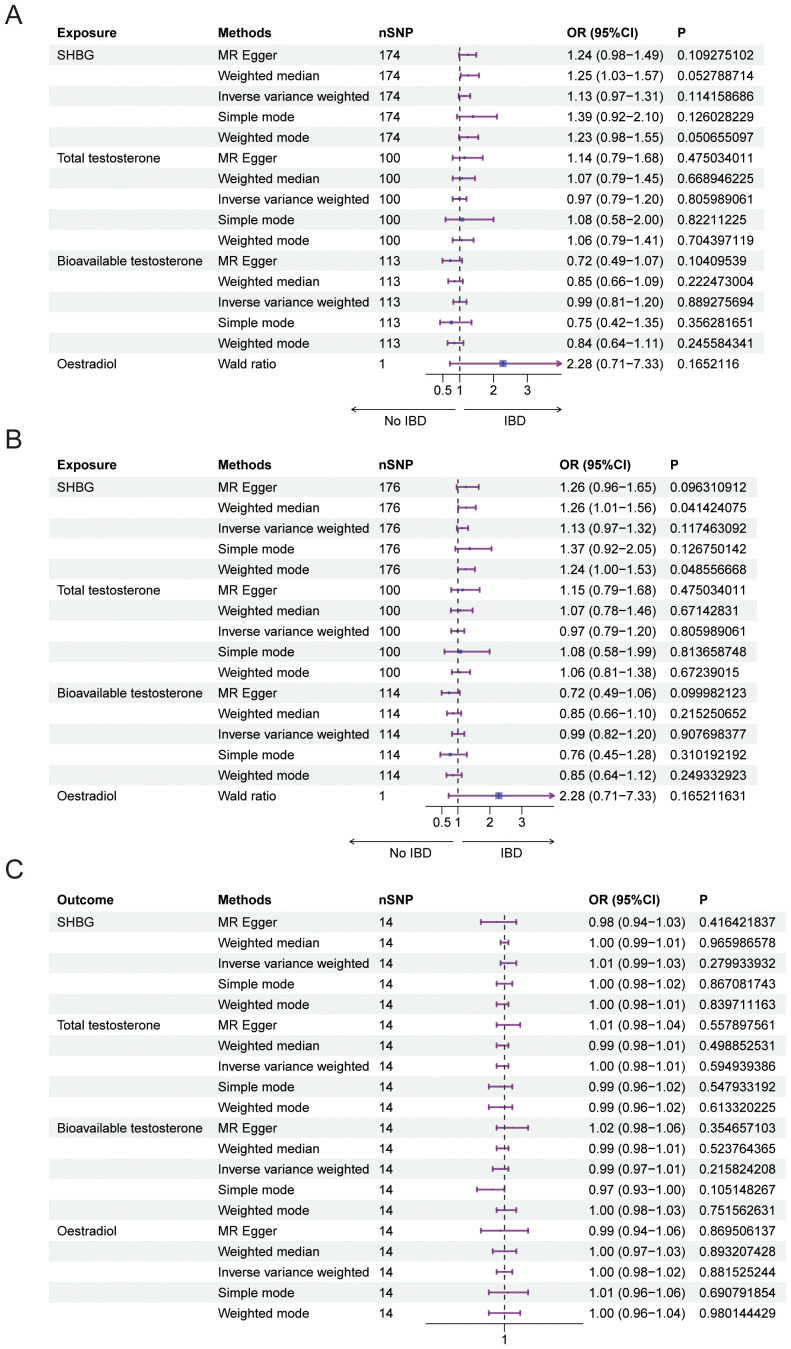
Results: There was no causal relationship between sex hormones and IBD in women (P > 0.05), and there was a causal and positive correlation between SHBG and testosterone and IBD in men.The OR for SHBG was 1.22 (95% CI: 1.09-1.37, P = 0.0004), and for testosterone was 1.20 (95% CI: 1.04-1.39, P = 0.0145).IBD did not significantly interact with female sex hormones but resulted in a decrease in SHBG (OR = 1.02, 95% CI: 1.00-1.04, P = 0.0195) and testosterone (OR = 1.01, 95% CI: 1.00 -1.02, P = 0.0200) in men.
Conclusion: There is no causal relationship between female sex hormones and IBD, but male SHBG and testosterone are positively correlated with the risk of IBD and IBD promotes elevated levels of SHBG and testosterone in males, suggesting that sex hormones play different roles in IBD patients of different sexes.
期刊介绍:
Frontiers in Endocrinology is a field journal of the "Frontiers in" journal series.
In today’s world, endocrinology is becoming increasingly important as it underlies many of the challenges societies face - from obesity and diabetes to reproduction, population control and aging. Endocrinology covers a broad field from basic molecular and cellular communication through to clinical care and some of the most crucial public health issues. The journal, thus, welcomes outstanding contributions in any domain of endocrinology.
Frontiers in Endocrinology publishes articles on the most outstanding discoveries across a wide research spectrum of Endocrinology. The mission of Frontiers in Endocrinology is to bring all relevant Endocrinology areas together on a single platform.





 京公网安备 11010802042870号
京ICP备2023020795号-1
京公网安备 11010802042870号
京ICP备2023020795号-1

 分享
分享
 求助内容:
求助内容: 应助结果提醒方式:
 扫码关注我们
