{"title":"芒果(Mangifera Indica L.)品种Safaid Chonsa抗氧化活性的成熟依赖性变化和非靶向植物化学指纹图谱。","authors":"Aniqa, Abdul Mannan, Zarrin Fatima Rizvi","doi":"10.1017/jns.2025.2","DOIUrl":null,"url":null,"abstract":"<p><p>The ripening-dependent changes in antioxidant activities and phytochemical content of mango (<i>Mangifera indica</i> L.) cultivar Safaid Chonsa at various ripening stages were evaluated. The ripening time period was divided into five stages (RSI-RSV) and the pulp was subjected to proximate analysis, antioxidant potential, and UHPLC/MS-based non-targeted metabolite fingerprinting. Proximate analyses depicted variations in moisture, dry matter, fat, protein, carbohydrate, and energy parameters. Maximum DPPH activity (51%) was observed at stages III, IV, and V while FRSP increased 31% at RS V as compared to stage I. Total antioxidant capacity and total reducing power potential were maximum (295.7 and 345.71 µg AAE/mg extract, respectively at stage V. Total phenolic content increased from 3.57 µg GAE/mg extract to 5.72 µg GAE/mg extract from stage I to RSIII while 19% increase in total flavonoid content was observed at stage V as compared to stage I. UHPLC/MS analysis showed presence of Aconitic acid, methylisocitric acid, 4-O-methyl gallate, beta-glucogallin, xanthenes, sakebiose, Isobergaptene, Fructoselysine 6-phosphate, Citbismine C, and many others at different ripening stages of chonsa mango extracts. The results conclude that during the mango ripening stages, changes in phytochemical composition have positive correlation with antioxidantive potential. These phytochemicals have nutritional and nutraceutical effects on human health therefore ripening stage should be considered for consumption of mango.</p>","PeriodicalId":47536,"journal":{"name":"Journal of Nutritional Science","volume":"14 ","pages":"e16"},"PeriodicalIF":2.3000,"publicationDate":"2025-02-05","publicationTypes":"Journal Article","fieldsOfStudy":null,"isOpenAccess":false,"openAccessPdf":"https://www.ncbi.nlm.nih.gov/pmc/articles/PMC11811868/pdf/","citationCount":"0","resultStr":"{\"title\":\"Ripening-dependent changes in antioxidant activities and un-targeted phytochemical fingerprinting of mango (<i>Mangifera Indica</i> L.) cultivar Safaid Chonsa.\",\"authors\":\"Aniqa, Abdul Mannan, Zarrin Fatima Rizvi\",\"doi\":\"10.1017/jns.2025.2\",\"DOIUrl\":null,\"url\":null,\"abstract\":\"<p><p>The ripening-dependent changes in antioxidant activities and phytochemical content of mango (<i>Mangifera indica</i> L.) cultivar Safaid Chonsa at various ripening stages were evaluated. The ripening time period was divided into five stages (RSI-RSV) and the pulp was subjected to proximate analysis, antioxidant potential, and UHPLC/MS-based non-targeted metabolite fingerprinting. Proximate analyses depicted variations in moisture, dry matter, fat, protein, carbohydrate, and energy parameters. Maximum DPPH activity (51%) was observed at stages III, IV, and V while FRSP increased 31% at RS V as compared to stage I. Total antioxidant capacity and total reducing power potential were maximum (295.7 and 345.71 µg AAE/mg extract, respectively at stage V. Total phenolic content increased from 3.57 µg GAE/mg extract to 5.72 µg GAE/mg extract from stage I to RSIII while 19% increase in total flavonoid content was observed at stage V as compared to stage I. UHPLC/MS analysis showed presence of Aconitic acid, methylisocitric acid, 4-O-methyl gallate, beta-glucogallin, xanthenes, sakebiose, Isobergaptene, Fructoselysine 6-phosphate, Citbismine C, and many others at different ripening stages of chonsa mango extracts. The results conclude that during the mango ripening stages, changes in phytochemical composition have positive correlation with antioxidantive potential. These phytochemicals have nutritional and nutraceutical effects on human health therefore ripening stage should be considered for consumption of mango.</p>\",\"PeriodicalId\":47536,\"journal\":{\"name\":\"Journal of Nutritional Science\",\"volume\":\"14 \",\"pages\":\"e16\"},\"PeriodicalIF\":2.3000,\"publicationDate\":\"2025-02-05\",\"publicationTypes\":\"Journal Article\",\"fieldsOfStudy\":null,\"isOpenAccess\":false,\"openAccessPdf\":\"https://www.ncbi.nlm.nih.gov/pmc/articles/PMC11811868/pdf/\",\"citationCount\":\"0\",\"resultStr\":null,\"platform\":\"Semanticscholar\",\"paperid\":null,\"PeriodicalName\":\"Journal of Nutritional Science\",\"FirstCategoryId\":\"1085\",\"ListUrlMain\":\"https://doi.org/10.1017/jns.2025.2\",\"RegionNum\":0,\"RegionCategory\":null,\"ArticlePicture\":[],\"TitleCN\":null,\"AbstractTextCN\":null,\"PMCID\":null,\"EPubDate\":\"2025/1/1 0:00:00\",\"PubModel\":\"eCollection\",\"JCR\":\"Q3\",\"JCRName\":\"NUTRITION & DIETETICS\",\"Score\":null,\"Total\":0}","platform":"Semanticscholar","paperid":null,"PeriodicalName":"Journal of Nutritional Science","FirstCategoryId":"1085","ListUrlMain":"https://doi.org/10.1017/jns.2025.2","RegionNum":0,"RegionCategory":null,"ArticlePicture":[],"TitleCN":null,"AbstractTextCN":null,"PMCID":null,"EPubDate":"2025/1/1 0:00:00","PubModel":"eCollection","JCR":"Q3","JCRName":"NUTRITION & DIETETICS","Score":null,"Total":0}
引用次数: 0
摘要
研究了芒果(Mangifera indica L.)品种Safaid Chonsa在不同成熟期抗氧化活性和植物化学成分的成熟依赖性变化。将成熟时间分为5个阶段(RSI-RSV),并对果肉进行近似分析、抗氧化潜力和UHPLC/MS-based非靶向代谢物指纹图谱。近似分析描述了水分、干物质、脂肪、蛋白质、碳水化合物和能量参数的变化。第三阶段、第四阶段和第五阶段的DPPH活性最高(51%),而FRSP在第五阶段与第一阶段相比增加了31%。总抗氧化能力和总还原力潜力最大(295.7和345.71µg AAE/mg提取物)。总酚含量从第一期的3.57µg GAE/mg增加到第二期的5.72µg GAE/mg,而总黄酮含量在第一期的19%,UHPLC/MS分析显示,在不同的成熟阶段,chonsa芒果提取物中存在着附子酸、甲基异柠檬酸、4- o -没食子酸甲酯、-葡高糖苷、黄原烯、白藜芦醇、异叔丁烯、6-磷酸果糖赖氨酸、柠檬酸C和许多其他物质。结果表明,在芒果成熟阶段,植物化学成分的变化与抗氧化能力呈正相关。这些植物化学物质对人体健康具有营养和营养作用,因此芒果的食用应考虑成熟阶段。
Ripening-dependent changes in antioxidant activities and un-targeted phytochemical fingerprinting of mango (Mangifera Indica L.) cultivar Safaid Chonsa.
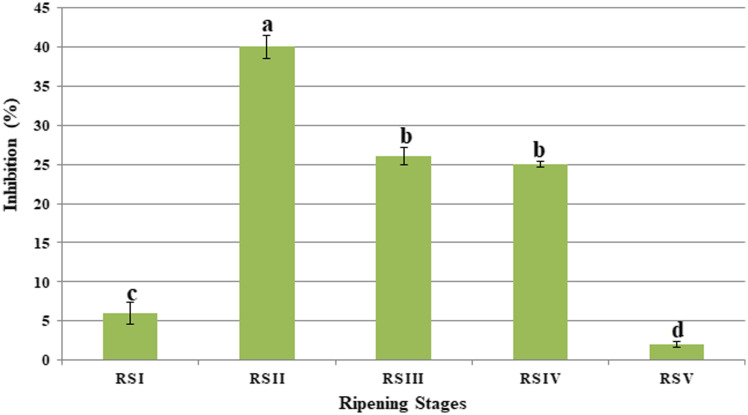
The ripening-dependent changes in antioxidant activities and phytochemical content of mango (Mangifera indica L.) cultivar Safaid Chonsa at various ripening stages were evaluated. The ripening time period was divided into five stages (RSI-RSV) and the pulp was subjected to proximate analysis, antioxidant potential, and UHPLC/MS-based non-targeted metabolite fingerprinting. Proximate analyses depicted variations in moisture, dry matter, fat, protein, carbohydrate, and energy parameters. Maximum DPPH activity (51%) was observed at stages III, IV, and V while FRSP increased 31% at RS V as compared to stage I. Total antioxidant capacity and total reducing power potential were maximum (295.7 and 345.71 µg AAE/mg extract, respectively at stage V. Total phenolic content increased from 3.57 µg GAE/mg extract to 5.72 µg GAE/mg extract from stage I to RSIII while 19% increase in total flavonoid content was observed at stage V as compared to stage I. UHPLC/MS analysis showed presence of Aconitic acid, methylisocitric acid, 4-O-methyl gallate, beta-glucogallin, xanthenes, sakebiose, Isobergaptene, Fructoselysine 6-phosphate, Citbismine C, and many others at different ripening stages of chonsa mango extracts. The results conclude that during the mango ripening stages, changes in phytochemical composition have positive correlation with antioxidantive potential. These phytochemicals have nutritional and nutraceutical effects on human health therefore ripening stage should be considered for consumption of mango.
期刊介绍:
Journal of Nutritional Science is an international, peer-reviewed, online only, open access journal that welcomes high-quality research articles in all aspects of nutrition. The underlying aim of all work should be, as far as possible, to develop nutritional concepts. JNS encompasses the full spectrum of nutritional science including public health nutrition, epidemiology, dietary surveys, nutritional requirements, metabolic studies, body composition, energetics, appetite, obesity, ageing, endocrinology, immunology, neuroscience, microbiology, genetics, molecular and cellular biology and nutrigenomics. JNS welcomes Primary Research Papers, Brief Reports, Review Articles, Systematic Reviews, Workshop Reports, Letters to the Editor and Obituaries.







 京公网安备 11010802042870号
京ICP备2023020795号-1
京公网安备 11010802042870号
京ICP备2023020795号-1

 分享
分享
 求助内容:
求助内容: 应助结果提醒方式:
 扫码关注我们
