Yuanbo Zhou, Mengfan Wang, Lifang Zhang, Najun Li, Tao Qian, Chenglin Yan, Jianmei Lu
{"title":"强电荷极化第四纪中熵合金金属烯在二氧化碳和硝酸盐高选择性电合成尿素中的应用。","authors":"Yuanbo Zhou, Mengfan Wang, Lifang Zhang, Najun Li, Tao Qian, Chenglin Yan, Jianmei Lu","doi":"10.1021/acsnano.4c17546","DOIUrl":null,"url":null,"abstract":"<p><p>Electrochemical urea synthesis via the coreduction of CO<sub>2</sub> and NO<sub>3</sub><sup>-</sup> is a sustainable alternative to the traditional Bosch-Meiser process. However, the sluggish reaction kinetics usually result in a low efficiency. Herein, we designed a kind of quaternary PdCuCoZn medium-entropy alloy (MEA) metallene for highly selective urea electrosynthesis. The random occupation of Cu, Co, and Zn with lower electronegativity in the face-centered cubic lattice of Pd-based metallene enables abundant electron donation from transition metals to adjacent Pd atoms, leading to the formation of charge-polarized Pd<sup>δ-</sup>-Cu/Co/Zn<sup>δ+</sup> sites. Considering that the pivotal C- and N-intermediates, namely, *CO and *NH<sub>2</sub>, are electrophilic and nucleophilic, respectively, such strong charge polarization would greatly benefit their respective formation and stabilization. The stable adsorption with *CO bonded to electron-rich Pd-based sites and *NH<sub>2</sub> bonded to electron-deficient Cu/Co/Zn-based sites is demonstrated by the combination of in situ characterizations and theoretical calculations. The proof-of-concept PdCuCoZn MEA metallene achieves a maximum urea yield rate of 1840 μg h<sup>-1</sup> mg<sup>-1</sup> and a high Faradaic efficiency of 70.2%, surpassing most of the reported state-of-the-arts. Our strategy proposed in this work is believed to enlighten the design of an effective catalyst used for multistep reactions.</p>","PeriodicalId":21,"journal":{"name":"ACS Nano","volume":" ","pages":"7273-7282"},"PeriodicalIF":17.3000,"publicationDate":"2025-02-25","publicationTypes":"Journal Article","fieldsOfStudy":null,"isOpenAccess":false,"openAccessPdf":"","citationCount":"0","resultStr":"{\"title\":\"Quaternary Medium-Entropy Alloy Metallene with Strong Charge Polarization for Highly Selective Urea Electrosynthesis from Carbon Dioxide and Nitrate.\",\"authors\":\"Yuanbo Zhou, Mengfan Wang, Lifang Zhang, Najun Li, Tao Qian, Chenglin Yan, Jianmei Lu\",\"doi\":\"10.1021/acsnano.4c17546\",\"DOIUrl\":null,\"url\":null,\"abstract\":\"<p><p>Electrochemical urea synthesis via the coreduction of CO<sub>2</sub> and NO<sub>3</sub><sup>-</sup> is a sustainable alternative to the traditional Bosch-Meiser process. However, the sluggish reaction kinetics usually result in a low efficiency. Herein, we designed a kind of quaternary PdCuCoZn medium-entropy alloy (MEA) metallene for highly selective urea electrosynthesis. The random occupation of Cu, Co, and Zn with lower electronegativity in the face-centered cubic lattice of Pd-based metallene enables abundant electron donation from transition metals to adjacent Pd atoms, leading to the formation of charge-polarized Pd<sup>δ-</sup>-Cu/Co/Zn<sup>δ+</sup> sites. Considering that the pivotal C- and N-intermediates, namely, *CO and *NH<sub>2</sub>, are electrophilic and nucleophilic, respectively, such strong charge polarization would greatly benefit their respective formation and stabilization. The stable adsorption with *CO bonded to electron-rich Pd-based sites and *NH<sub>2</sub> bonded to electron-deficient Cu/Co/Zn-based sites is demonstrated by the combination of in situ characterizations and theoretical calculations. The proof-of-concept PdCuCoZn MEA metallene achieves a maximum urea yield rate of 1840 μg h<sup>-1</sup> mg<sup>-1</sup> and a high Faradaic efficiency of 70.2%, surpassing most of the reported state-of-the-arts. Our strategy proposed in this work is believed to enlighten the design of an effective catalyst used for multistep reactions.</p>\",\"PeriodicalId\":21,\"journal\":{\"name\":\"ACS Nano\",\"volume\":\" \",\"pages\":\"7273-7282\"},\"PeriodicalIF\":17.3000,\"publicationDate\":\"2025-02-25\",\"publicationTypes\":\"Journal Article\",\"fieldsOfStudy\":null,\"isOpenAccess\":false,\"openAccessPdf\":\"\",\"citationCount\":\"0\",\"resultStr\":null,\"platform\":\"Semanticscholar\",\"paperid\":null,\"PeriodicalName\":\"ACS Nano\",\"FirstCategoryId\":\"88\",\"ListUrlMain\":\"https://doi.org/10.1021/acsnano.4c17546\",\"RegionNum\":1,\"RegionCategory\":\"材料科学\",\"ArticlePicture\":[],\"TitleCN\":null,\"AbstractTextCN\":null,\"PMCID\":null,\"EPubDate\":\"2025/2/14 0:00:00\",\"PubModel\":\"Epub\",\"JCR\":\"Q1\",\"JCRName\":\"CHEMISTRY, MULTIDISCIPLINARY\",\"Score\":null,\"Total\":0}","platform":"Semanticscholar","paperid":null,"PeriodicalName":"ACS Nano","FirstCategoryId":"88","ListUrlMain":"https://doi.org/10.1021/acsnano.4c17546","RegionNum":1,"RegionCategory":"材料科学","ArticlePicture":[],"TitleCN":null,"AbstractTextCN":null,"PMCID":null,"EPubDate":"2025/2/14 0:00:00","PubModel":"Epub","JCR":"Q1","JCRName":"CHEMISTRY, MULTIDISCIPLINARY","Score":null,"Total":0}
引用次数: 0
摘要
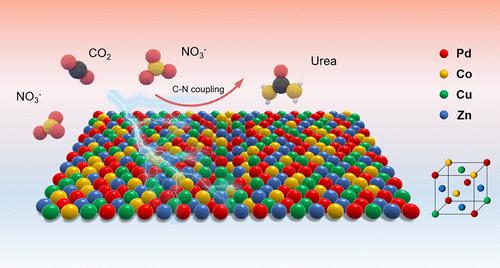
通过CO2和NO3-的共还原,电化学合成尿素是传统Bosch-Meiser工艺的可持续替代方案。然而,反应动力学缓慢往往导致效率低下。本文设计了一种用于高选择性尿素电合成的四元PdCuCoZn中熵合金(MEA)金属烯。在Pd基金属烯的面心立方晶格中,电负性较低的Cu、Co和Zn随机占据,使得过渡金属向邻近的Pd原子提供了丰富的电子,从而形成了电荷极化的Pdδ—Cu/Co/Znδ+位。考虑到关键的C-和n -中间体,即*CO和*NH2分别是亲电性和亲核性,这种强电荷极化将极大地有利于它们各自的形成和稳定。通过原位表征和理论计算相结合,证明了*CO键合富电子的pd基位点和*NH2键合缺电子的Cu/ CO / zn基位点的稳定吸附。PdCuCoZn MEA金属烯的概念验证尿素产率最高可达1840 μg -1 mg-1,法拉第效率高达70.2%,超过了目前报道的大多数最新技术。我们在这项工作中提出的策略被认为对设计用于多步反应的有效催化剂有启发。
Quaternary Medium-Entropy Alloy Metallene with Strong Charge Polarization for Highly Selective Urea Electrosynthesis from Carbon Dioxide and Nitrate.
Electrochemical urea synthesis via the coreduction of CO2 and NO3- is a sustainable alternative to the traditional Bosch-Meiser process. However, the sluggish reaction kinetics usually result in a low efficiency. Herein, we designed a kind of quaternary PdCuCoZn medium-entropy alloy (MEA) metallene for highly selective urea electrosynthesis. The random occupation of Cu, Co, and Zn with lower electronegativity in the face-centered cubic lattice of Pd-based metallene enables abundant electron donation from transition metals to adjacent Pd atoms, leading to the formation of charge-polarized Pdδ--Cu/Co/Znδ+ sites. Considering that the pivotal C- and N-intermediates, namely, *CO and *NH2, are electrophilic and nucleophilic, respectively, such strong charge polarization would greatly benefit their respective formation and stabilization. The stable adsorption with *CO bonded to electron-rich Pd-based sites and *NH2 bonded to electron-deficient Cu/Co/Zn-based sites is demonstrated by the combination of in situ characterizations and theoretical calculations. The proof-of-concept PdCuCoZn MEA metallene achieves a maximum urea yield rate of 1840 μg h-1 mg-1 and a high Faradaic efficiency of 70.2%, surpassing most of the reported state-of-the-arts. Our strategy proposed in this work is believed to enlighten the design of an effective catalyst used for multistep reactions.
期刊介绍:
ACS Nano, published monthly, serves as an international forum for comprehensive articles on nanoscience and nanotechnology research at the intersections of chemistry, biology, materials science, physics, and engineering. The journal fosters communication among scientists in these communities, facilitating collaboration, new research opportunities, and advancements through discoveries. ACS Nano covers synthesis, assembly, characterization, theory, and simulation of nanostructures, nanobiotechnology, nanofabrication, methods and tools for nanoscience and nanotechnology, and self- and directed-assembly. Alongside original research articles, it offers thorough reviews, perspectives on cutting-edge research, and discussions envisioning the future of nanoscience and nanotechnology.




 京公网安备 11010802042870号
京ICP备2023020795号-1
京公网安备 11010802042870号
京ICP备2023020795号-1

 分享
分享
 求助内容:
求助内容: 应助结果提醒方式:
 扫码关注我们
