Songwei Wang, Günter Hoch, Sven Hopf, Ansgar Kahmen
{"title":"温带树种叶片最小水导的遗传变异和表型可塑性。","authors":"Songwei Wang, Günter Hoch, Sven Hopf, Ansgar Kahmen","doi":"10.1111/pce.15432","DOIUrl":null,"url":null,"abstract":"<div>\n \n <p>The survival time of trees under drought is intimately linked to leaf minimum water conductance on the leaf surface (<i>g</i><sub>min</sub>), which determines the residual water loss of trees after maximum stomatal closure. Considerable interspecies variation of <i>g</i><sub>min</sub> in trees has been documented, but intraspecific variation resulting from genetic variation (<i>G</i>) and phenotypic plasticity (<i>E</i>) remains unclear. We measured the temperature response (<i>T</i>) of <i>g</i><sub>min</sub> in different provenances of four temperate tree species growing in three common gardens differing in water availability and assessed <i>G</i>, <i>E</i> and <i>G × E</i> of <i>g</i><sub>min</sub> and <i>T</i>. Additionally, we explored how leaf cuticular and stomatal traits are related to the intraspecific variation of <i>g</i><sub>min</sub>. For all species, our results showed strong <i>T</i>, low <i>G</i> and high <i>E</i> for <i>g</i><sub>min</sub>. Interestingly, <i>E</i> was more pronounced in deciduous angiosperm trees than in evergreen conifers. Surprisingly, there was significant <i>E × T</i> in some species. Contrary to our expectation, we found no significant effect of leaf stomatal and cuticular traits on <i>g</i><sub>min</sub>. Our study suggests that <i>E</i> is the most potent driver of intraspecies variation of <i>g</i><sub>min</sub>, possibly contributing to the acclimation of deciduous trees to a future hotter and dryer climate.</p></div>","PeriodicalId":222,"journal":{"name":"Plant, Cell & Environment","volume":"48 6","pages":"4312-4326"},"PeriodicalIF":6.3000,"publicationDate":"2025-02-13","publicationTypes":"Journal Article","fieldsOfStudy":null,"isOpenAccess":false,"openAccessPdf":"","citationCount":"0","resultStr":"{\"title\":\"Genetic Variation and Phenotypic Plasticity of Leaf Minimum Water Conductance in Temperate Tree Species\",\"authors\":\"Songwei Wang, Günter Hoch, Sven Hopf, Ansgar Kahmen\",\"doi\":\"10.1111/pce.15432\",\"DOIUrl\":null,\"url\":null,\"abstract\":\"<div>\\n \\n <p>The survival time of trees under drought is intimately linked to leaf minimum water conductance on the leaf surface (<i>g</i><sub>min</sub>), which determines the residual water loss of trees after maximum stomatal closure. Considerable interspecies variation of <i>g</i><sub>min</sub> in trees has been documented, but intraspecific variation resulting from genetic variation (<i>G</i>) and phenotypic plasticity (<i>E</i>) remains unclear. We measured the temperature response (<i>T</i>) of <i>g</i><sub>min</sub> in different provenances of four temperate tree species growing in three common gardens differing in water availability and assessed <i>G</i>, <i>E</i> and <i>G × E</i> of <i>g</i><sub>min</sub> and <i>T</i>. Additionally, we explored how leaf cuticular and stomatal traits are related to the intraspecific variation of <i>g</i><sub>min</sub>. For all species, our results showed strong <i>T</i>, low <i>G</i> and high <i>E</i> for <i>g</i><sub>min</sub>. Interestingly, <i>E</i> was more pronounced in deciduous angiosperm trees than in evergreen conifers. Surprisingly, there was significant <i>E × T</i> in some species. Contrary to our expectation, we found no significant effect of leaf stomatal and cuticular traits on <i>g</i><sub>min</sub>. Our study suggests that <i>E</i> is the most potent driver of intraspecies variation of <i>g</i><sub>min</sub>, possibly contributing to the acclimation of deciduous trees to a future hotter and dryer climate.</p></div>\",\"PeriodicalId\":222,\"journal\":{\"name\":\"Plant, Cell & Environment\",\"volume\":\"48 6\",\"pages\":\"4312-4326\"},\"PeriodicalIF\":6.3000,\"publicationDate\":\"2025-02-13\",\"publicationTypes\":\"Journal Article\",\"fieldsOfStudy\":null,\"isOpenAccess\":false,\"openAccessPdf\":\"\",\"citationCount\":\"0\",\"resultStr\":null,\"platform\":\"Semanticscholar\",\"paperid\":null,\"PeriodicalName\":\"Plant, Cell & Environment\",\"FirstCategoryId\":\"2\",\"ListUrlMain\":\"https://onlinelibrary.wiley.com/doi/10.1111/pce.15432\",\"RegionNum\":1,\"RegionCategory\":\"生物学\",\"ArticlePicture\":[],\"TitleCN\":null,\"AbstractTextCN\":null,\"PMCID\":null,\"EPubDate\":\"\",\"PubModel\":\"\",\"JCR\":\"Q1\",\"JCRName\":\"PLANT SCIENCES\",\"Score\":null,\"Total\":0}","platform":"Semanticscholar","paperid":null,"PeriodicalName":"Plant, Cell & Environment","FirstCategoryId":"2","ListUrlMain":"https://onlinelibrary.wiley.com/doi/10.1111/pce.15432","RegionNum":1,"RegionCategory":"生物学","ArticlePicture":[],"TitleCN":null,"AbstractTextCN":null,"PMCID":null,"EPubDate":"","PubModel":"","JCR":"Q1","JCRName":"PLANT SCIENCES","Score":null,"Total":0}
Genetic Variation and Phenotypic Plasticity of Leaf Minimum Water Conductance in Temperate Tree Species
The survival time of trees under drought is intimately linked to leaf minimum water conductance on the leaf surface (gmin), which determines the residual water loss of trees after maximum stomatal closure. Considerable interspecies variation of gmin in trees has been documented, but intraspecific variation resulting from genetic variation (G) and phenotypic plasticity (E) remains unclear. We measured the temperature response (T) of gmin in different provenances of four temperate tree species growing in three common gardens differing in water availability and assessed G, E and G × E of gmin and T. Additionally, we explored how leaf cuticular and stomatal traits are related to the intraspecific variation of gmin. For all species, our results showed strong T, low G and high E for gmin. Interestingly, E was more pronounced in deciduous angiosperm trees than in evergreen conifers. Surprisingly, there was significant E × T in some species. Contrary to our expectation, we found no significant effect of leaf stomatal and cuticular traits on gmin. Our study suggests that E is the most potent driver of intraspecies variation of gmin, possibly contributing to the acclimation of deciduous trees to a future hotter and dryer climate.
期刊介绍:
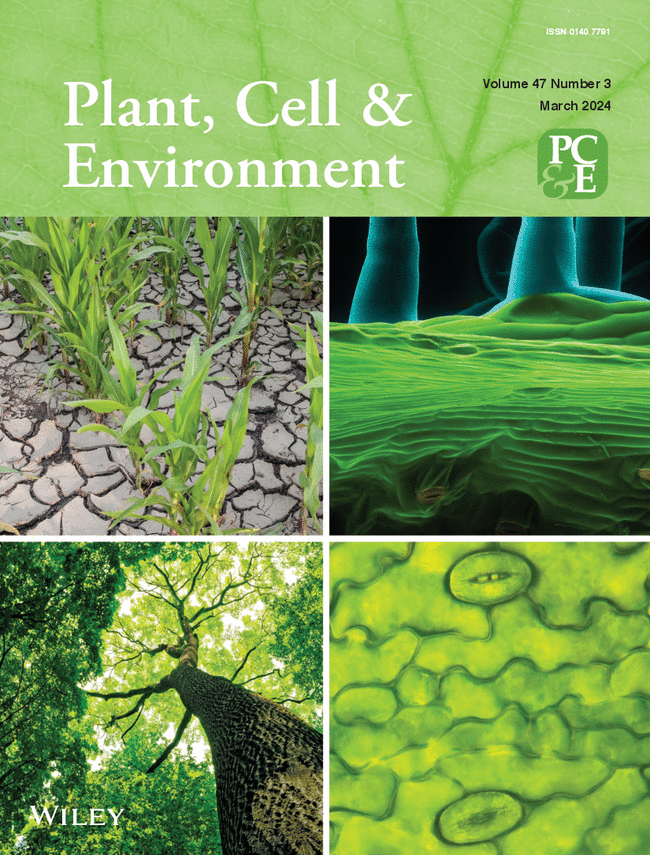
Plant, Cell & Environment is a premier plant science journal, offering valuable insights into plant responses to their environment. Committed to publishing high-quality theoretical and experimental research, the journal covers a broad spectrum of factors, spanning from molecular to community levels. Researchers exploring various aspects of plant biology, physiology, and ecology contribute to the journal's comprehensive understanding of plant-environment interactions.




 京公网安备 11010802042870号
京ICP备2023020795号-1
京公网安备 11010802042870号
京ICP备2023020795号-1

 分享
分享
 求助内容:
求助内容: 应助结果提醒方式:
 扫码关注我们
