{"title":"库布其沙漠不同边锁林配置对土壤C、N、P生态计量特征的差异响应","authors":"Xue Chen, Hejun Zuo, Min Yan, Haibing Wang, Cheng Xi, Yinchao Chai","doi":"10.3389/fpls.2025.1520024","DOIUrl":null,"url":null,"abstract":"<p><p>As a vital component of the desert ecological protection system, the edge-locked forests of the Kubuqi Desert play a crucial role in mitigating wind erosion, stabilizing sand, maintaining soil and water, and restricting desert expansion. In this paper, six types of standard protection forests in the Kubuqi Desert, namely <i>Salix psammophila</i> (SL), <i>Elaeagnus angustifolia</i> (SZ), <i>Salix matsudana</i> (HL), <i>Corethrodendron fruticosum+Salix psammophila</i> (YC + SL), <i>Caragana korshinskii + Populus simonii</i> (XYY + NT), and <i>Elaeagnus angustifolia + Salix matsudana</i> (SZ + HL), were investigated. Notably, the vertical differentiation patterns of soil carbon (C), nitrogen (N), phosphorus (P), and ecological stoichiometric ratios, as well as soil particle size features within the 0-100-cm soil layer under protection forests with different allocation modes, were systematically and comprehensively analyzed. The study's findings showed that: (1) Among the six configuration types, SZ, NT + XYY, and SL exhibited higher soil SOC and TN concentrations. Both soil SOC and TN content decreased with increasing soil depth, whereas soil TP content displayed no considerable variation among different stand types or soil depths. (2) Based on the N/P threshold hypothesis, N was the limiting nutrient element for the growth of edge-locked forests in the region. (3) The understory soils of different configurations of edge-locked forests mainly comprised sand. The silt and clay contents of SL and NT + XYY were substantially higher than those of the other four configurations. The vertical distribution patterns of particle size and parameter characteristics had variations. (4) Soil C, N, P, and stoichiometric characteristics are affected by vegetation type, soil depth, and soil texture. In conclusion, SZ and SL can be used as the dominant tree species in the edge-locked forests of the Kubuqi Desert, and the NT + XYY mixed forest configuration pattern displays the most apparent soil improvement effect. This study's findings offer a scientific reference and foundation for restoring vegetation and enhancing the ecological environment in desert regions. In addition, they provide a theoretical foundation for establishing and managing edge-locked forests.</p>","PeriodicalId":12632,"journal":{"name":"Frontiers in Plant Science","volume":"16 ","pages":"1520024"},"PeriodicalIF":5.9000,"publicationDate":"2025-01-30","publicationTypes":"Journal Article","fieldsOfStudy":null,"isOpenAccess":false,"openAccessPdf":"https://www.ncbi.nlm.nih.gov/pmc/articles/PMC11821981/pdf/","citationCount":"0","resultStr":"{\"title\":\"Differential responses of soil C, N, and P ecological stoichiometric characteristics to different configurations of edge-locked forests in the Kubuqi Desert.\",\"authors\":\"Xue Chen, Hejun Zuo, Min Yan, Haibing Wang, Cheng Xi, Yinchao Chai\",\"doi\":\"10.3389/fpls.2025.1520024\",\"DOIUrl\":null,\"url\":null,\"abstract\":\"<p><p>As a vital component of the desert ecological protection system, the edge-locked forests of the Kubuqi Desert play a crucial role in mitigating wind erosion, stabilizing sand, maintaining soil and water, and restricting desert expansion. In this paper, six types of standard protection forests in the Kubuqi Desert, namely <i>Salix psammophila</i> (SL), <i>Elaeagnus angustifolia</i> (SZ), <i>Salix matsudana</i> (HL), <i>Corethrodendron fruticosum+Salix psammophila</i> (YC + SL), <i>Caragana korshinskii + Populus simonii</i> (XYY + NT), and <i>Elaeagnus angustifolia + Salix matsudana</i> (SZ + HL), were investigated. Notably, the vertical differentiation patterns of soil carbon (C), nitrogen (N), phosphorus (P), and ecological stoichiometric ratios, as well as soil particle size features within the 0-100-cm soil layer under protection forests with different allocation modes, were systematically and comprehensively analyzed. The study's findings showed that: (1) Among the six configuration types, SZ, NT + XYY, and SL exhibited higher soil SOC and TN concentrations. Both soil SOC and TN content decreased with increasing soil depth, whereas soil TP content displayed no considerable variation among different stand types or soil depths. (2) Based on the N/P threshold hypothesis, N was the limiting nutrient element for the growth of edge-locked forests in the region. (3) The understory soils of different configurations of edge-locked forests mainly comprised sand. The silt and clay contents of SL and NT + XYY were substantially higher than those of the other four configurations. The vertical distribution patterns of particle size and parameter characteristics had variations. (4) Soil C, N, P, and stoichiometric characteristics are affected by vegetation type, soil depth, and soil texture. In conclusion, SZ and SL can be used as the dominant tree species in the edge-locked forests of the Kubuqi Desert, and the NT + XYY mixed forest configuration pattern displays the most apparent soil improvement effect. This study's findings offer a scientific reference and foundation for restoring vegetation and enhancing the ecological environment in desert regions. In addition, they provide a theoretical foundation for establishing and managing edge-locked forests.</p>\",\"PeriodicalId\":12632,\"journal\":{\"name\":\"Frontiers in Plant Science\",\"volume\":\"16 \",\"pages\":\"1520024\"},\"PeriodicalIF\":5.9000,\"publicationDate\":\"2025-01-30\",\"publicationTypes\":\"Journal Article\",\"fieldsOfStudy\":null,\"isOpenAccess\":false,\"openAccessPdf\":\"https://www.ncbi.nlm.nih.gov/pmc/articles/PMC11821981/pdf/\",\"citationCount\":\"0\",\"resultStr\":null,\"platform\":\"Semanticscholar\",\"paperid\":null,\"PeriodicalName\":\"Frontiers in Plant Science\",\"FirstCategoryId\":\"99\",\"ListUrlMain\":\"https://doi.org/10.3389/fpls.2025.1520024\",\"RegionNum\":2,\"RegionCategory\":\"生物学\",\"ArticlePicture\":[],\"TitleCN\":null,\"AbstractTextCN\":null,\"PMCID\":null,\"EPubDate\":\"2025/1/1 0:00:00\",\"PubModel\":\"eCollection\",\"JCR\":\"Q1\",\"JCRName\":\"PLANT SCIENCES\",\"Score\":null,\"Total\":0}","platform":"Semanticscholar","paperid":null,"PeriodicalName":"Frontiers in Plant Science","FirstCategoryId":"99","ListUrlMain":"https://doi.org/10.3389/fpls.2025.1520024","RegionNum":2,"RegionCategory":"生物学","ArticlePicture":[],"TitleCN":null,"AbstractTextCN":null,"PMCID":null,"EPubDate":"2025/1/1 0:00:00","PubModel":"eCollection","JCR":"Q1","JCRName":"PLANT SCIENCES","Score":null,"Total":0}
Differential responses of soil C, N, and P ecological stoichiometric characteristics to different configurations of edge-locked forests in the Kubuqi Desert.
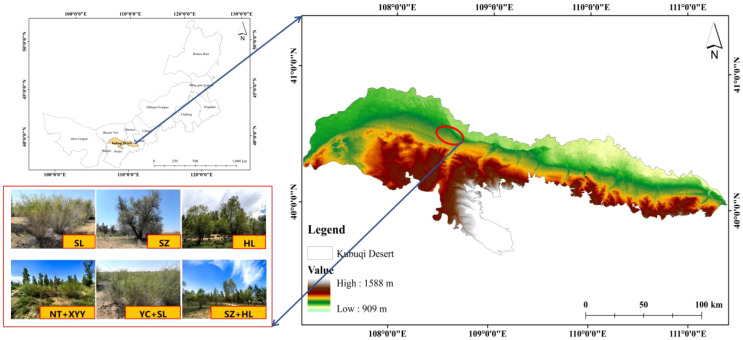
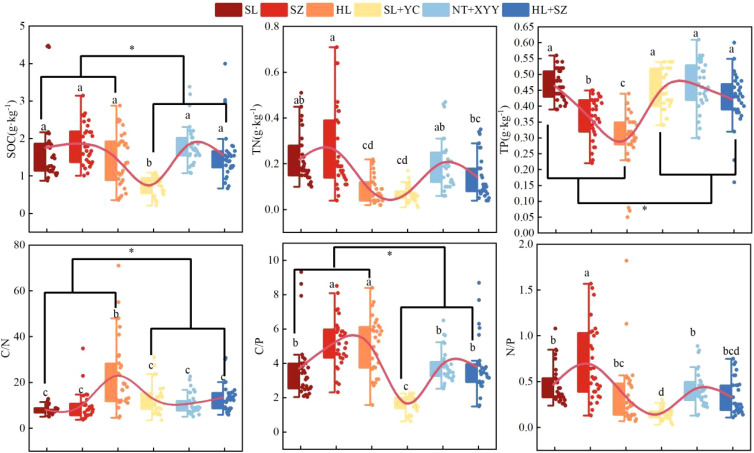
As a vital component of the desert ecological protection system, the edge-locked forests of the Kubuqi Desert play a crucial role in mitigating wind erosion, stabilizing sand, maintaining soil and water, and restricting desert expansion. In this paper, six types of standard protection forests in the Kubuqi Desert, namely Salix psammophila (SL), Elaeagnus angustifolia (SZ), Salix matsudana (HL), Corethrodendron fruticosum+Salix psammophila (YC + SL), Caragana korshinskii + Populus simonii (XYY + NT), and Elaeagnus angustifolia + Salix matsudana (SZ + HL), were investigated. Notably, the vertical differentiation patterns of soil carbon (C), nitrogen (N), phosphorus (P), and ecological stoichiometric ratios, as well as soil particle size features within the 0-100-cm soil layer under protection forests with different allocation modes, were systematically and comprehensively analyzed. The study's findings showed that: (1) Among the six configuration types, SZ, NT + XYY, and SL exhibited higher soil SOC and TN concentrations. Both soil SOC and TN content decreased with increasing soil depth, whereas soil TP content displayed no considerable variation among different stand types or soil depths. (2) Based on the N/P threshold hypothesis, N was the limiting nutrient element for the growth of edge-locked forests in the region. (3) The understory soils of different configurations of edge-locked forests mainly comprised sand. The silt and clay contents of SL and NT + XYY were substantially higher than those of the other four configurations. The vertical distribution patterns of particle size and parameter characteristics had variations. (4) Soil C, N, P, and stoichiometric characteristics are affected by vegetation type, soil depth, and soil texture. In conclusion, SZ and SL can be used as the dominant tree species in the edge-locked forests of the Kubuqi Desert, and the NT + XYY mixed forest configuration pattern displays the most apparent soil improvement effect. This study's findings offer a scientific reference and foundation for restoring vegetation and enhancing the ecological environment in desert regions. In addition, they provide a theoretical foundation for establishing and managing edge-locked forests.
期刊介绍:
In an ever changing world, plant science is of the utmost importance for securing the future well-being of humankind. Plants provide oxygen, food, feed, fibers, and building materials. In addition, they are a diverse source of industrial and pharmaceutical chemicals. Plants are centrally important to the health of ecosystems, and their understanding is critical for learning how to manage and maintain a sustainable biosphere. Plant science is extremely interdisciplinary, reaching from agricultural science to paleobotany, and molecular physiology to ecology. It uses the latest developments in computer science, optics, molecular biology and genomics to address challenges in model systems, agricultural crops, and ecosystems. Plant science research inquires into the form, function, development, diversity, reproduction, evolution and uses of both higher and lower plants and their interactions with other organisms throughout the biosphere. Frontiers in Plant Science welcomes outstanding contributions in any field of plant science from basic to applied research, from organismal to molecular studies, from single plant analysis to studies of populations and whole ecosystems, and from molecular to biophysical to computational approaches.
Frontiers in Plant Science publishes articles on the most outstanding discoveries across a wide research spectrum of Plant Science. The mission of Frontiers in Plant Science is to bring all relevant Plant Science areas together on a single platform.





 京公网安备 11010802042870号
京ICP备2023020795号-1
京公网安备 11010802042870号
京ICP备2023020795号-1

 分享
分享
 求助内容:
求助内容: 应助结果提醒方式:
 扫码关注我们
