Trần Thiết Sơn, Phạm Thị Việt Dung, Phan Tuấn Nghĩa, Tạ Thị Hồng Thuý, Phạm Kiến Nhật, Hoàng Tuấn Anh
{"title":"股前外侧嵌合皮瓣修复复杂鼻缺损。","authors":"Trần Thiết Sơn, Phạm Thị Việt Dung, Phan Tuấn Nghĩa, Tạ Thị Hồng Thuý, Phạm Kiến Nhật, Hoàng Tuấn Anh","doi":"10.1097/GOX.0000000000006546","DOIUrl":null,"url":null,"abstract":"<p><p>Total nasal defects, including adjacent soft tissue damage, present a challenge for plastic surgeons, and in this case, free flaps should be an alternative when local flaps are limited. However, the importance of donor site morbidity must be taken into account for free flaps. Due to flap bulkiness, the anterolateral thigh (ALT) free flaps are less commonly used to restore nasal structures. Our case used a thinned ALT flap to reconstruct the entire nasal defect and part of the upper lip due to the resection of poorly differentiated squamous cell carcinoma. Two ALT flaps were harvested to reconstruct a 10 × 6 cm defect spanning the entire nose and part of the upper lip. Both skin paddles were thinned to a minimum of 4 mm thickness. A costal cartilage graft was used to create a framework for structural support. The donor site was closed with local flaps and skin grafts. No complications were noted during follow-ups. After 24 months, the patient had an excellent nasal contour that matched her skin tone and had no airway obstruction. The thinned ALT chimeric flap can be ideal for large defects composed of multiple anatomical units, even in the facial region. Its advantages are that it is thin, flexible, and well vascularized and can provide favorable aesthetic results with minimal donor site morbidity.</p>","PeriodicalId":20149,"journal":{"name":"Plastic and Reconstructive Surgery Global Open","volume":"13 2","pages":"e6546"},"PeriodicalIF":1.8000,"publicationDate":"2025-02-12","publicationTypes":"Journal Article","fieldsOfStudy":null,"isOpenAccess":false,"openAccessPdf":"https://www.ncbi.nlm.nih.gov/pmc/articles/PMC11822336/pdf/","citationCount":"0","resultStr":"{\"title\":\"Reconstruction of Complex Nasal Defect With Anterolateral Thigh Chimeric Flap.\",\"authors\":\"Trần Thiết Sơn, Phạm Thị Việt Dung, Phan Tuấn Nghĩa, Tạ Thị Hồng Thuý, Phạm Kiến Nhật, Hoàng Tuấn Anh\",\"doi\":\"10.1097/GOX.0000000000006546\",\"DOIUrl\":null,\"url\":null,\"abstract\":\"<p><p>Total nasal defects, including adjacent soft tissue damage, present a challenge for plastic surgeons, and in this case, free flaps should be an alternative when local flaps are limited. However, the importance of donor site morbidity must be taken into account for free flaps. Due to flap bulkiness, the anterolateral thigh (ALT) free flaps are less commonly used to restore nasal structures. Our case used a thinned ALT flap to reconstruct the entire nasal defect and part of the upper lip due to the resection of poorly differentiated squamous cell carcinoma. Two ALT flaps were harvested to reconstruct a 10 × 6 cm defect spanning the entire nose and part of the upper lip. Both skin paddles were thinned to a minimum of 4 mm thickness. A costal cartilage graft was used to create a framework for structural support. The donor site was closed with local flaps and skin grafts. No complications were noted during follow-ups. After 24 months, the patient had an excellent nasal contour that matched her skin tone and had no airway obstruction. The thinned ALT chimeric flap can be ideal for large defects composed of multiple anatomical units, even in the facial region. Its advantages are that it is thin, flexible, and well vascularized and can provide favorable aesthetic results with minimal donor site morbidity.</p>\",\"PeriodicalId\":20149,\"journal\":{\"name\":\"Plastic and Reconstructive Surgery Global Open\",\"volume\":\"13 2\",\"pages\":\"e6546\"},\"PeriodicalIF\":1.8000,\"publicationDate\":\"2025-02-12\",\"publicationTypes\":\"Journal Article\",\"fieldsOfStudy\":null,\"isOpenAccess\":false,\"openAccessPdf\":\"https://www.ncbi.nlm.nih.gov/pmc/articles/PMC11822336/pdf/\",\"citationCount\":\"0\",\"resultStr\":null,\"platform\":\"Semanticscholar\",\"paperid\":null,\"PeriodicalName\":\"Plastic and Reconstructive Surgery Global Open\",\"FirstCategoryId\":\"1085\",\"ListUrlMain\":\"https://doi.org/10.1097/GOX.0000000000006546\",\"RegionNum\":0,\"RegionCategory\":null,\"ArticlePicture\":[],\"TitleCN\":null,\"AbstractTextCN\":null,\"PMCID\":null,\"EPubDate\":\"2025/2/1 0:00:00\",\"PubModel\":\"eCollection\",\"JCR\":\"Q3\",\"JCRName\":\"SURGERY\",\"Score\":null,\"Total\":0}","platform":"Semanticscholar","paperid":null,"PeriodicalName":"Plastic and Reconstructive Surgery Global Open","FirstCategoryId":"1085","ListUrlMain":"https://doi.org/10.1097/GOX.0000000000006546","RegionNum":0,"RegionCategory":null,"ArticlePicture":[],"TitleCN":null,"AbstractTextCN":null,"PMCID":null,"EPubDate":"2025/2/1 0:00:00","PubModel":"eCollection","JCR":"Q3","JCRName":"SURGERY","Score":null,"Total":0}
Reconstruction of Complex Nasal Defect With Anterolateral Thigh Chimeric Flap.
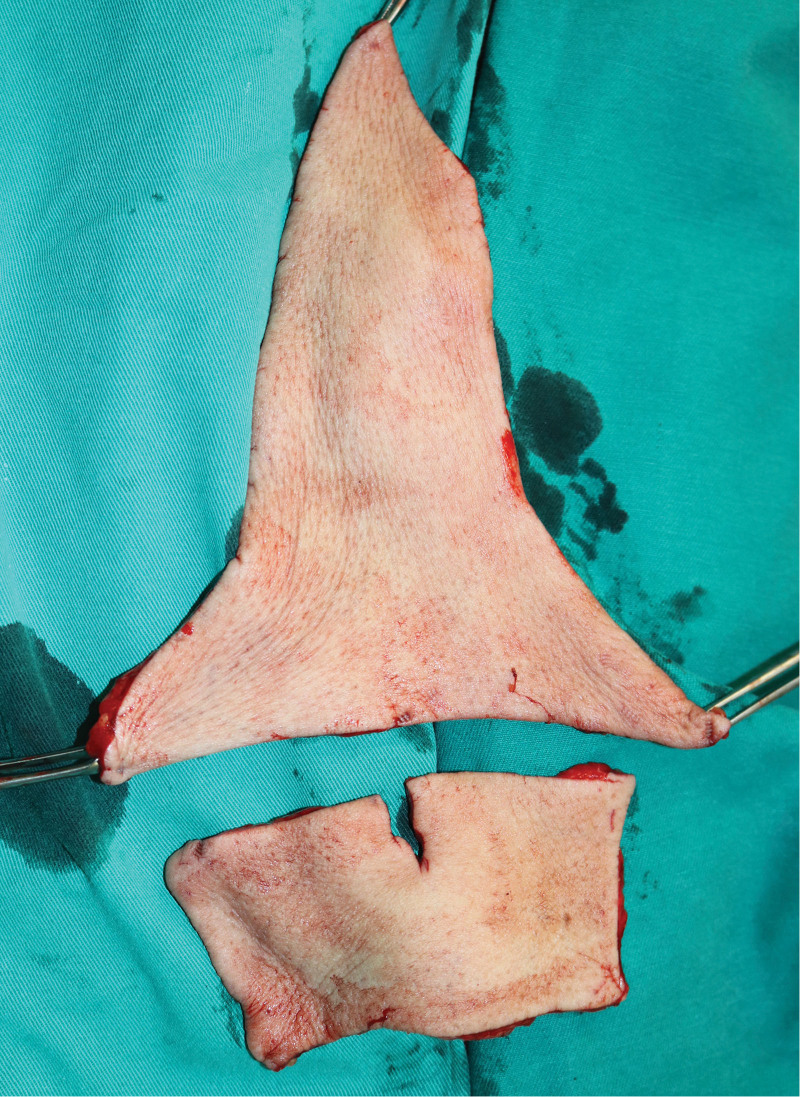
Total nasal defects, including adjacent soft tissue damage, present a challenge for plastic surgeons, and in this case, free flaps should be an alternative when local flaps are limited. However, the importance of donor site morbidity must be taken into account for free flaps. Due to flap bulkiness, the anterolateral thigh (ALT) free flaps are less commonly used to restore nasal structures. Our case used a thinned ALT flap to reconstruct the entire nasal defect and part of the upper lip due to the resection of poorly differentiated squamous cell carcinoma. Two ALT flaps were harvested to reconstruct a 10 × 6 cm defect spanning the entire nose and part of the upper lip. Both skin paddles were thinned to a minimum of 4 mm thickness. A costal cartilage graft was used to create a framework for structural support. The donor site was closed with local flaps and skin grafts. No complications were noted during follow-ups. After 24 months, the patient had an excellent nasal contour that matched her skin tone and had no airway obstruction. The thinned ALT chimeric flap can be ideal for large defects composed of multiple anatomical units, even in the facial region. Its advantages are that it is thin, flexible, and well vascularized and can provide favorable aesthetic results with minimal donor site morbidity.
期刊介绍:
Plastic and Reconstructive Surgery—Global Open is an open access, peer reviewed, international journal focusing on global plastic and reconstructive surgery.Plastic and Reconstructive Surgery—Global Open publishes on all areas of plastic and reconstructive surgery, including basic science/experimental studies pertinent to the field and also clinical articles on such topics as: breast reconstruction, head and neck surgery, pediatric and craniofacial surgery, hand and microsurgery, wound healing, and cosmetic and aesthetic surgery. Clinical studies, experimental articles, ideas and innovations, and techniques and case reports are all welcome article types. Manuscript submission is open to all surgeons, researchers, and other health care providers world-wide who wish to communicate their research results on topics related to plastic and reconstructive surgery. Furthermore, Plastic and Reconstructive Surgery—Global Open, a complimentary journal to Plastic and Reconstructive Surgery, provides an open access venue for the publication of those research studies sponsored by private and public funding agencies that require open access publication of study results. Its mission is to disseminate high quality, peer reviewed research in plastic and reconstructive surgery to the widest possible global audience, through an open access platform. As an open access journal, Plastic and Reconstructive Surgery—Global Open offers its content for free to any viewer. Authors of articles retain their copyright to the materials published. Additionally, Plastic and Reconstructive Surgery—Global Open provides rapid review and publication of accepted papers.






 京公网安备 11010802042870号
京ICP备2023020795号-1
京公网安备 11010802042870号
京ICP备2023020795号-1

 分享
分享

 求助内容:
求助内容: 应助结果提醒方式:
 扫码关注我们
