Ahmed Al Harraq, Philip J Brahana, Bhuvnesh Bharti
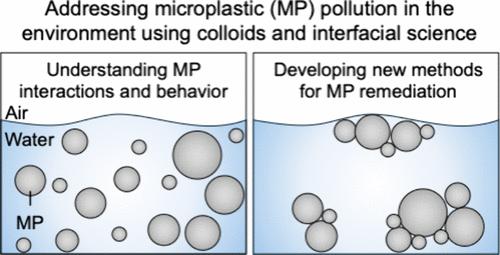
{"title":"胶体和界面科学:理解微塑料和制定修复策略。","authors":"Ahmed Al Harraq, Philip J Brahana, Bhuvnesh Bharti","doi":"10.1021/acs.langmuir.4c03856","DOIUrl":null,"url":null,"abstract":"<p><p>Microplastics (MPs) originate from industrial production of <1 mm polymeric particles and from the progressive breakdown of larger plastic debris. Their environmental behavior is governed by their interfacial properties, which dominate due to their small size. This Perspective highlights the complex surface chemistry of MPs under environmental stressors and discusses how physical attributes like shape and roughness could influence their fate. We further identify wastewater treatment plants (WWTPs) as critical hotspots for MP accumulation, where the MPs are inadvertently transferred to sewage sludge and reintroduced into the environment. We emphasize the potential of colloid and interfacial science not only to improve our fundamental understanding of MPs but also to advance mitigation strategies in hotspots such as WWTPs.</p>","PeriodicalId":50,"journal":{"name":"Langmuir","volume":" ","pages":"4412-4421"},"PeriodicalIF":4.4000,"publicationDate":"2025-02-25","publicationTypes":"Journal Article","fieldsOfStudy":null,"isOpenAccess":false,"openAccessPdf":"https://www.ncbi.nlm.nih.gov/pmc/articles/PMC11866930/pdf/","citationCount":"0","resultStr":"{\"title\":\"Colloid and Interface Science for Understanding Microplastics and Developing Remediation Strategies.\",\"authors\":\"Ahmed Al Harraq, Philip J Brahana, Bhuvnesh Bharti\",\"doi\":\"10.1021/acs.langmuir.4c03856\",\"DOIUrl\":null,\"url\":null,\"abstract\":\"<p><p>Microplastics (MPs) originate from industrial production of <1 mm polymeric particles and from the progressive breakdown of larger plastic debris. Their environmental behavior is governed by their interfacial properties, which dominate due to their small size. This Perspective highlights the complex surface chemistry of MPs under environmental stressors and discusses how physical attributes like shape and roughness could influence their fate. We further identify wastewater treatment plants (WWTPs) as critical hotspots for MP accumulation, where the MPs are inadvertently transferred to sewage sludge and reintroduced into the environment. We emphasize the potential of colloid and interfacial science not only to improve our fundamental understanding of MPs but also to advance mitigation strategies in hotspots such as WWTPs.</p>\",\"PeriodicalId\":50,\"journal\":{\"name\":\"Langmuir\",\"volume\":\" \",\"pages\":\"4412-4421\"},\"PeriodicalIF\":4.4000,\"publicationDate\":\"2025-02-25\",\"publicationTypes\":\"Journal Article\",\"fieldsOfStudy\":null,\"isOpenAccess\":false,\"openAccessPdf\":\"https://www.ncbi.nlm.nih.gov/pmc/articles/PMC11866930/pdf/\",\"citationCount\":\"0\",\"resultStr\":null,\"platform\":\"Semanticscholar\",\"paperid\":null,\"PeriodicalName\":\"Langmuir\",\"FirstCategoryId\":\"92\",\"ListUrlMain\":\"https://doi.org/10.1021/acs.langmuir.4c03856\",\"RegionNum\":2,\"RegionCategory\":\"化学\",\"ArticlePicture\":[],\"TitleCN\":null,\"AbstractTextCN\":null,\"PMCID\":null,\"EPubDate\":\"2025/2/14 0:00:00\",\"PubModel\":\"Epub\",\"JCR\":\"Q2\",\"JCRName\":\"CHEMISTRY, MULTIDISCIPLINARY\",\"Score\":null,\"Total\":0}","platform":"Semanticscholar","paperid":null,"PeriodicalName":"Langmuir","FirstCategoryId":"92","ListUrlMain":"https://doi.org/10.1021/acs.langmuir.4c03856","RegionNum":2,"RegionCategory":"化学","ArticlePicture":[],"TitleCN":null,"AbstractTextCN":null,"PMCID":null,"EPubDate":"2025/2/14 0:00:00","PubModel":"Epub","JCR":"Q2","JCRName":"CHEMISTRY, MULTIDISCIPLINARY","Score":null,"Total":0}
Colloid and Interface Science for Understanding Microplastics and Developing Remediation Strategies.
Microplastics (MPs) originate from industrial production of <1 mm polymeric particles and from the progressive breakdown of larger plastic debris. Their environmental behavior is governed by their interfacial properties, which dominate due to their small size. This Perspective highlights the complex surface chemistry of MPs under environmental stressors and discusses how physical attributes like shape and roughness could influence their fate. We further identify wastewater treatment plants (WWTPs) as critical hotspots for MP accumulation, where the MPs are inadvertently transferred to sewage sludge and reintroduced into the environment. We emphasize the potential of colloid and interfacial science not only to improve our fundamental understanding of MPs but also to advance mitigation strategies in hotspots such as WWTPs.
期刊介绍:
Langmuir is an interdisciplinary journal publishing articles in the following subject categories:
Colloids: surfactants and self-assembly, dispersions, emulsions, foams
Interfaces: adsorption, reactions, films, forces
Biological Interfaces: biocolloids, biomolecular and biomimetic materials
Materials: nano- and mesostructured materials, polymers, gels, liquid crystals
Electrochemistry: interfacial charge transfer, charge transport, electrocatalysis, electrokinetic phenomena, bioelectrochemistry
Devices and Applications: sensors, fluidics, patterning, catalysis, photonic crystals
However, when high-impact, original work is submitted that does not fit within the above categories, decisions to accept or decline such papers will be based on one criteria: What Would Irving Do?
Langmuir ranks #2 in citations out of 136 journals in the category of Physical Chemistry with 113,157 total citations. The journal received an Impact Factor of 4.384*.
This journal is also indexed in the categories of Materials Science (ranked #1) and Multidisciplinary Chemistry (ranked #5).




 京公网安备 11010802042870号
京ICP备2023020795号-1
京公网安备 11010802042870号
京ICP备2023020795号-1

 分享
分享
 求助内容:
求助内容: 应助结果提醒方式:
 扫码关注我们
