{"title":"TaANK-TPR1通过调控NLR蛋白TaRPP13L1的基因表达和蛋白活性增强小麦对条锈病的抗性","authors":"Shuangyuan Guo, Feng Zhang, Xiaoya Du, Xinmei Zhang, Xueling Huang, Zelong Li, Yanqin Zhang, Pengfei Gan, Huankun Li, Min Li, Xinyue Wang, Chunlei Tang, Xiaojie Wang, Zhensheng Kang, Xinmei Zhang","doi":"10.1016/j.devcel.2025.01.017","DOIUrl":null,"url":null,"abstract":"Nucleotide-binding site, leucine-rich repeat (NLR) proteins activate a robust immune response on recognition of pathogen invasion. However, the function and regulatory mechanisms of NLRs during <em>Puccinia striiformis</em> f. sp. <em>tritici</em> (<em>Pst</em>) infection in wheat remain elusive. Here, we identify an ankyrin (ANK) repeat and tetratricopeptide repeat (TPR)-containing protein, TaANK-TPR1, which plays a positive role in the regulation of wheat resistance against <em>Pst</em> and the immune response of NLR. TaANK-TPR1 targets the NLR protein TaRPP13L1 (Recognition of <em>Peronospora</em> <em>Parasitica</em> 13-like 1) to facilitate its homodimerization and cell death to enhance the resistance of wheat against <em>Pst</em>. Meanwhile, TaANK-TPR1 binds to the TGACGT motif (methyl jasmonate-responsive element) of the <em>TaRPP13L1</em> promoter and activates <em>TaRPP13L1</em> transcription. Both <em>TaANK-TPR1</em> and <em>TaRPP13L1</em> respond to jasmonic acid (JA) signaling via the TGACGT element. Importantly, overexpressing <em>TaRPP13L1</em> confers robust rust resistance without impacting important agronomic traits in the field. These findings identify a regulatory mechanism of NLR protein and provide targets for improving crop disease resistance.","PeriodicalId":11157,"journal":{"name":"Developmental cell","volume":"61 1","pages":""},"PeriodicalIF":9.2000,"publicationDate":"2025-02-14","publicationTypes":"Journal Article","fieldsOfStudy":null,"isOpenAccess":false,"openAccessPdf":"","citationCount":"0","resultStr":"{\"title\":\"TaANK-TPR1 enhances wheat resistance against stripe rust via controlling gene expression and protein activity of NLR protein TaRPP13L1\",\"authors\":\"Shuangyuan Guo, Feng Zhang, Xiaoya Du, Xinmei Zhang, Xueling Huang, Zelong Li, Yanqin Zhang, Pengfei Gan, Huankun Li, Min Li, Xinyue Wang, Chunlei Tang, Xiaojie Wang, Zhensheng Kang, Xinmei Zhang\",\"doi\":\"10.1016/j.devcel.2025.01.017\",\"DOIUrl\":null,\"url\":null,\"abstract\":\"Nucleotide-binding site, leucine-rich repeat (NLR) proteins activate a robust immune response on recognition of pathogen invasion. However, the function and regulatory mechanisms of NLRs during <em>Puccinia striiformis</em> f. sp. <em>tritici</em> (<em>Pst</em>) infection in wheat remain elusive. Here, we identify an ankyrin (ANK) repeat and tetratricopeptide repeat (TPR)-containing protein, TaANK-TPR1, which plays a positive role in the regulation of wheat resistance against <em>Pst</em> and the immune response of NLR. TaANK-TPR1 targets the NLR protein TaRPP13L1 (Recognition of <em>Peronospora</em> <em>Parasitica</em> 13-like 1) to facilitate its homodimerization and cell death to enhance the resistance of wheat against <em>Pst</em>. Meanwhile, TaANK-TPR1 binds to the TGACGT motif (methyl jasmonate-responsive element) of the <em>TaRPP13L1</em> promoter and activates <em>TaRPP13L1</em> transcription. Both <em>TaANK-TPR1</em> and <em>TaRPP13L1</em> respond to jasmonic acid (JA) signaling via the TGACGT element. Importantly, overexpressing <em>TaRPP13L1</em> confers robust rust resistance without impacting important agronomic traits in the field. These findings identify a regulatory mechanism of NLR protein and provide targets for improving crop disease resistance.\",\"PeriodicalId\":11157,\"journal\":{\"name\":\"Developmental cell\",\"volume\":\"61 1\",\"pages\":\"\"},\"PeriodicalIF\":9.2000,\"publicationDate\":\"2025-02-14\",\"publicationTypes\":\"Journal Article\",\"fieldsOfStudy\":null,\"isOpenAccess\":false,\"openAccessPdf\":\"\",\"citationCount\":\"0\",\"resultStr\":null,\"platform\":\"Semanticscholar\",\"paperid\":null,\"PeriodicalName\":\"Developmental cell\",\"FirstCategoryId\":\"99\",\"ListUrlMain\":\"https://doi.org/10.1016/j.devcel.2025.01.017\",\"RegionNum\":1,\"RegionCategory\":\"生物学\",\"ArticlePicture\":[],\"TitleCN\":null,\"AbstractTextCN\":null,\"PMCID\":null,\"EPubDate\":\"\",\"PubModel\":\"\",\"JCR\":\"Q1\",\"JCRName\":\"CELL BIOLOGY\",\"Score\":null,\"Total\":0}","platform":"Semanticscholar","paperid":null,"PeriodicalName":"Developmental cell","FirstCategoryId":"99","ListUrlMain":"https://doi.org/10.1016/j.devcel.2025.01.017","RegionNum":1,"RegionCategory":"生物学","ArticlePicture":[],"TitleCN":null,"AbstractTextCN":null,"PMCID":null,"EPubDate":"","PubModel":"","JCR":"Q1","JCRName":"CELL BIOLOGY","Score":null,"Total":0}
TaANK-TPR1 enhances wheat resistance against stripe rust via controlling gene expression and protein activity of NLR protein TaRPP13L1
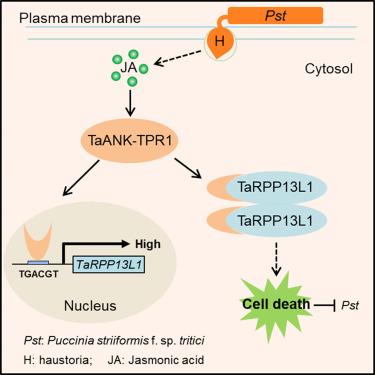
Nucleotide-binding site, leucine-rich repeat (NLR) proteins activate a robust immune response on recognition of pathogen invasion. However, the function and regulatory mechanisms of NLRs during Puccinia striiformis f. sp. tritici (Pst) infection in wheat remain elusive. Here, we identify an ankyrin (ANK) repeat and tetratricopeptide repeat (TPR)-containing protein, TaANK-TPR1, which plays a positive role in the regulation of wheat resistance against Pst and the immune response of NLR. TaANK-TPR1 targets the NLR protein TaRPP13L1 (Recognition of PeronosporaParasitica 13-like 1) to facilitate its homodimerization and cell death to enhance the resistance of wheat against Pst. Meanwhile, TaANK-TPR1 binds to the TGACGT motif (methyl jasmonate-responsive element) of the TaRPP13L1 promoter and activates TaRPP13L1 transcription. Both TaANK-TPR1 and TaRPP13L1 respond to jasmonic acid (JA) signaling via the TGACGT element. Importantly, overexpressing TaRPP13L1 confers robust rust resistance without impacting important agronomic traits in the field. These findings identify a regulatory mechanism of NLR protein and provide targets for improving crop disease resistance.
期刊介绍:
Developmental Cell, established in 2001, is a comprehensive journal that explores a wide range of topics in cell and developmental biology. Our publication encompasses work across various disciplines within biology, with a particular emphasis on investigating the intersections between cell biology, developmental biology, and other related fields. Our primary objective is to present research conducted through a cell biological perspective, addressing the essential mechanisms governing cell function, cellular interactions, and responses to the environment. Moreover, we focus on understanding the collective behavior of cells, culminating in the formation of tissues, organs, and whole organisms, while also investigating the consequences of any malfunctions in these intricate processes.




 京公网安备 11010802042870号
京ICP备2023020795号-1
京公网安备 11010802042870号
京ICP备2023020795号-1

 分享
分享
 求助内容:
求助内容: 应助结果提醒方式:
 扫码关注我们
