{"title":"钴硅配位诱导的过氧单硫酸盐非自由基活化对实际废水中有机污染物的降解","authors":"Shizong Wang, Jianlong Wang","doi":"10.1002/smll.202500434","DOIUrl":null,"url":null,"abstract":"<p>Nonradical-driven degradation pathways have emerged as a promising solution for the removal of emerging organic pollutants in complex water matrices. How to construct nonradical systems remains a challenge. In this study, a novel silicon carbide (SiC)-supported cobalt single-atom catalyst (Co/SiC) is developed to induce nonradicals activation of peroxymonosulfate toward the degradation of sulfamethoxazole (SMX). The normalized degradation rate of SMX reaches 16.425 L·min<sup>−1</sup>·g<sup>−1</sup>·m<span>m</span><sup>−1</sup>, significantly outperforming most reported single-atom catalysts. Surface-bound reactive species dominate the SMX degradation process, followed by high-valent cobalt oxo. Experimental and characterization results demonstrate that the unique Co-Si coordination structure facilitated electron transfer, and lowered the energy barrier for the formation of surface-bound reactive species, thereby exhibiting superior resistance to inorganic ions. In a seven-day continuous column experiment, SMX, atrazine, and bisphenol A are completely removed from actual secondary effluent, confirming the stability and effectiveness of the catalyst in real wastewater systems. Moreover, the acute toxicity of treated secondary effluent almost disappears. These results highlight the potential of Co-Si coordination in driving electron transfer for the generation of nonradicals, offering a promising approach to addressing the challenges of the removal of emerging organic pollutants from the complex wastewater.</p>","PeriodicalId":228,"journal":{"name":"Small","volume":"21 12","pages":""},"PeriodicalIF":12.1000,"publicationDate":"2025-02-16","publicationTypes":"Journal Article","fieldsOfStudy":null,"isOpenAccess":false,"openAccessPdf":"","citationCount":"0","resultStr":"{\"title\":\"Cobalt-Silicon Coordination-Induced Nonradical Activation of Peroxymonosulfate for Enhancing the Degradation of Organic Pollutants in Real Wastewater\",\"authors\":\"Shizong Wang, Jianlong Wang\",\"doi\":\"10.1002/smll.202500434\",\"DOIUrl\":null,\"url\":null,\"abstract\":\"<p>Nonradical-driven degradation pathways have emerged as a promising solution for the removal of emerging organic pollutants in complex water matrices. How to construct nonradical systems remains a challenge. In this study, a novel silicon carbide (SiC)-supported cobalt single-atom catalyst (Co/SiC) is developed to induce nonradicals activation of peroxymonosulfate toward the degradation of sulfamethoxazole (SMX). The normalized degradation rate of SMX reaches 16.425 L·min<sup>−1</sup>·g<sup>−1</sup>·m<span>m</span><sup>−1</sup>, significantly outperforming most reported single-atom catalysts. Surface-bound reactive species dominate the SMX degradation process, followed by high-valent cobalt oxo. Experimental and characterization results demonstrate that the unique Co-Si coordination structure facilitated electron transfer, and lowered the energy barrier for the formation of surface-bound reactive species, thereby exhibiting superior resistance to inorganic ions. In a seven-day continuous column experiment, SMX, atrazine, and bisphenol A are completely removed from actual secondary effluent, confirming the stability and effectiveness of the catalyst in real wastewater systems. Moreover, the acute toxicity of treated secondary effluent almost disappears. These results highlight the potential of Co-Si coordination in driving electron transfer for the generation of nonradicals, offering a promising approach to addressing the challenges of the removal of emerging organic pollutants from the complex wastewater.</p>\",\"PeriodicalId\":228,\"journal\":{\"name\":\"Small\",\"volume\":\"21 12\",\"pages\":\"\"},\"PeriodicalIF\":12.1000,\"publicationDate\":\"2025-02-16\",\"publicationTypes\":\"Journal Article\",\"fieldsOfStudy\":null,\"isOpenAccess\":false,\"openAccessPdf\":\"\",\"citationCount\":\"0\",\"resultStr\":null,\"platform\":\"Semanticscholar\",\"paperid\":null,\"PeriodicalName\":\"Small\",\"FirstCategoryId\":\"88\",\"ListUrlMain\":\"https://onlinelibrary.wiley.com/doi/10.1002/smll.202500434\",\"RegionNum\":2,\"RegionCategory\":\"材料科学\",\"ArticlePicture\":[],\"TitleCN\":null,\"AbstractTextCN\":null,\"PMCID\":null,\"EPubDate\":\"\",\"PubModel\":\"\",\"JCR\":\"Q1\",\"JCRName\":\"CHEMISTRY, MULTIDISCIPLINARY\",\"Score\":null,\"Total\":0}","platform":"Semanticscholar","paperid":null,"PeriodicalName":"Small","FirstCategoryId":"88","ListUrlMain":"https://onlinelibrary.wiley.com/doi/10.1002/smll.202500434","RegionNum":2,"RegionCategory":"材料科学","ArticlePicture":[],"TitleCN":null,"AbstractTextCN":null,"PMCID":null,"EPubDate":"","PubModel":"","JCR":"Q1","JCRName":"CHEMISTRY, MULTIDISCIPLINARY","Score":null,"Total":0}
Cobalt-Silicon Coordination-Induced Nonradical Activation of Peroxymonosulfate for Enhancing the Degradation of Organic Pollutants in Real Wastewater
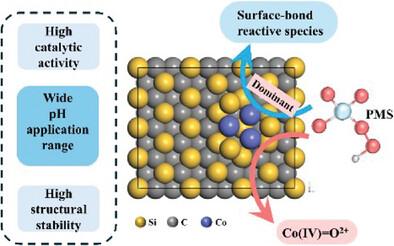
Nonradical-driven degradation pathways have emerged as a promising solution for the removal of emerging organic pollutants in complex water matrices. How to construct nonradical systems remains a challenge. In this study, a novel silicon carbide (SiC)-supported cobalt single-atom catalyst (Co/SiC) is developed to induce nonradicals activation of peroxymonosulfate toward the degradation of sulfamethoxazole (SMX). The normalized degradation rate of SMX reaches 16.425 L·min−1·g−1·mm−1, significantly outperforming most reported single-atom catalysts. Surface-bound reactive species dominate the SMX degradation process, followed by high-valent cobalt oxo. Experimental and characterization results demonstrate that the unique Co-Si coordination structure facilitated electron transfer, and lowered the energy barrier for the formation of surface-bound reactive species, thereby exhibiting superior resistance to inorganic ions. In a seven-day continuous column experiment, SMX, atrazine, and bisphenol A are completely removed from actual secondary effluent, confirming the stability and effectiveness of the catalyst in real wastewater systems. Moreover, the acute toxicity of treated secondary effluent almost disappears. These results highlight the potential of Co-Si coordination in driving electron transfer for the generation of nonradicals, offering a promising approach to addressing the challenges of the removal of emerging organic pollutants from the complex wastewater.
期刊介绍:
Small serves as an exceptional platform for both experimental and theoretical studies in fundamental and applied interdisciplinary research at the nano- and microscale. The journal offers a compelling mix of peer-reviewed Research Articles, Reviews, Perspectives, and Comments.
With a remarkable 2022 Journal Impact Factor of 13.3 (Journal Citation Reports from Clarivate Analytics, 2023), Small remains among the top multidisciplinary journals, covering a wide range of topics at the interface of materials science, chemistry, physics, engineering, medicine, and biology.
Small's readership includes biochemists, biologists, biomedical scientists, chemists, engineers, information technologists, materials scientists, physicists, and theoreticians alike.




 京公网安备 11010802042870号
京ICP备2023020795号-1
京公网安备 11010802042870号
京ICP备2023020795号-1

 分享
分享
 求助内容:
求助内容: 应助结果提醒方式:
 扫码关注我们
