Heng Luo , Zixiong Ruan , Touwen Fan , Yuanyuan Zhang , Te Hu , HongGe Yan
{"title":"BCC (TiZrHf)1-xMx (M=Nb, Mo, Ta)中熵合金的平面缺陷和热力学第一性原理研究","authors":"Heng Luo , Zixiong Ruan , Touwen Fan , Yuanyuan Zhang , Te Hu , HongGe Yan","doi":"10.1016/j.matchemphys.2025.130498","DOIUrl":null,"url":null,"abstract":"<div><div>The newly developed BCC TiZrHf based multi-principal element alloys (MPEAs) can simultaneously guarantee high strength and good ductility. However, until now, the theoretical research on their stacking faults (SFs) and twins associated with the dislocation in plastic deformation have scarcely been studied due to their large computation amount and complexity, and thus the underlying mechanisms are still mysterious. In this work, we have investigated the effects of three types of substitution elements, namely, Nb, Mo and Ta, on the SF energy (SFE) curves of (110) plane of TiZrHf based medium entropy alloys (MEAs) along [001]ˎ [110] and [111] directions, twinning faults on (112) plane, based on the first-principles (FP) calculations in conjunction with the special quasi-random structures (SQS) method. With the increase of Nb, Ta and Mo concentrations, the unstable SFE <em>γ</em><sub>us</sub> along [001], [110] and [111] directions show a wavier increasing trend, and the effect of Mo is more pronounced. The boundary energy of the twins TS<sub>1</sub>, TS<sub>2</sub> and TS<sub>3</sub> also show the wavier increasing tendency, and they are all larger than that of pure TiZrHf alloy. We have conducted an in-depth investigation into the thermodynamic properties of TiZrHf-based alloys doped with Nb, Ta, and Mo, owing to their exceptional high-temperature performance.</div></div>","PeriodicalId":18227,"journal":{"name":"Materials Chemistry and Physics","volume":"335 ","pages":"Article 130498"},"PeriodicalIF":4.7000,"publicationDate":"2025-04-15","publicationTypes":"Journal Article","fieldsOfStudy":null,"isOpenAccess":false,"openAccessPdf":"","citationCount":"0","resultStr":"{\"title\":\"First-principles investigation of plane faults and thermodynamics in BCC (TiZrHf)1-xMx (M=Nb, Mo, Ta) medium entropy alloys\",\"authors\":\"Heng Luo , Zixiong Ruan , Touwen Fan , Yuanyuan Zhang , Te Hu , HongGe Yan\",\"doi\":\"10.1016/j.matchemphys.2025.130498\",\"DOIUrl\":null,\"url\":null,\"abstract\":\"<div><div>The newly developed BCC TiZrHf based multi-principal element alloys (MPEAs) can simultaneously guarantee high strength and good ductility. However, until now, the theoretical research on their stacking faults (SFs) and twins associated with the dislocation in plastic deformation have scarcely been studied due to their large computation amount and complexity, and thus the underlying mechanisms are still mysterious. In this work, we have investigated the effects of three types of substitution elements, namely, Nb, Mo and Ta, on the SF energy (SFE) curves of (110) plane of TiZrHf based medium entropy alloys (MEAs) along [001]ˎ [110] and [111] directions, twinning faults on (112) plane, based on the first-principles (FP) calculations in conjunction with the special quasi-random structures (SQS) method. With the increase of Nb, Ta and Mo concentrations, the unstable SFE <em>γ</em><sub>us</sub> along [001], [110] and [111] directions show a wavier increasing trend, and the effect of Mo is more pronounced. The boundary energy of the twins TS<sub>1</sub>, TS<sub>2</sub> and TS<sub>3</sub> also show the wavier increasing tendency, and they are all larger than that of pure TiZrHf alloy. We have conducted an in-depth investigation into the thermodynamic properties of TiZrHf-based alloys doped with Nb, Ta, and Mo, owing to their exceptional high-temperature performance.</div></div>\",\"PeriodicalId\":18227,\"journal\":{\"name\":\"Materials Chemistry and Physics\",\"volume\":\"335 \",\"pages\":\"Article 130498\"},\"PeriodicalIF\":4.7000,\"publicationDate\":\"2025-04-15\",\"publicationTypes\":\"Journal Article\",\"fieldsOfStudy\":null,\"isOpenAccess\":false,\"openAccessPdf\":\"\",\"citationCount\":\"0\",\"resultStr\":null,\"platform\":\"Semanticscholar\",\"paperid\":null,\"PeriodicalName\":\"Materials Chemistry and Physics\",\"FirstCategoryId\":\"88\",\"ListUrlMain\":\"https://www.sciencedirect.com/science/article/pii/S0254058425001440\",\"RegionNum\":3,\"RegionCategory\":\"材料科学\",\"ArticlePicture\":[],\"TitleCN\":null,\"AbstractTextCN\":null,\"PMCID\":null,\"EPubDate\":\"2025/2/7 0:00:00\",\"PubModel\":\"Epub\",\"JCR\":\"Q2\",\"JCRName\":\"MATERIALS SCIENCE, MULTIDISCIPLINARY\",\"Score\":null,\"Total\":0}","platform":"Semanticscholar","paperid":null,"PeriodicalName":"Materials Chemistry and Physics","FirstCategoryId":"88","ListUrlMain":"https://www.sciencedirect.com/science/article/pii/S0254058425001440","RegionNum":3,"RegionCategory":"材料科学","ArticlePicture":[],"TitleCN":null,"AbstractTextCN":null,"PMCID":null,"EPubDate":"2025/2/7 0:00:00","PubModel":"Epub","JCR":"Q2","JCRName":"MATERIALS SCIENCE, MULTIDISCIPLINARY","Score":null,"Total":0}
First-principles investigation of plane faults and thermodynamics in BCC (TiZrHf)1-xMx (M=Nb, Mo, Ta) medium entropy alloys
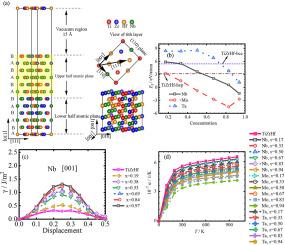
The newly developed BCC TiZrHf based multi-principal element alloys (MPEAs) can simultaneously guarantee high strength and good ductility. However, until now, the theoretical research on their stacking faults (SFs) and twins associated with the dislocation in plastic deformation have scarcely been studied due to their large computation amount and complexity, and thus the underlying mechanisms are still mysterious. In this work, we have investigated the effects of three types of substitution elements, namely, Nb, Mo and Ta, on the SF energy (SFE) curves of (110) plane of TiZrHf based medium entropy alloys (MEAs) along [001]ˎ [110] and [111] directions, twinning faults on (112) plane, based on the first-principles (FP) calculations in conjunction with the special quasi-random structures (SQS) method. With the increase of Nb, Ta and Mo concentrations, the unstable SFE γus along [001], [110] and [111] directions show a wavier increasing trend, and the effect of Mo is more pronounced. The boundary energy of the twins TS1, TS2 and TS3 also show the wavier increasing tendency, and they are all larger than that of pure TiZrHf alloy. We have conducted an in-depth investigation into the thermodynamic properties of TiZrHf-based alloys doped with Nb, Ta, and Mo, owing to their exceptional high-temperature performance.
期刊介绍:
Materials Chemistry and Physics is devoted to short communications, full-length research papers and feature articles on interrelationships among structure, properties, processing and performance of materials. The Editors welcome manuscripts on thin films, surface and interface science, materials degradation and reliability, metallurgy, semiconductors and optoelectronic materials, fine ceramics, magnetics, superconductors, specialty polymers, nano-materials and composite materials.




 京公网安备 11010802042870号
京ICP备2023020795号-1
京公网安备 11010802042870号
京ICP备2023020795号-1

 分享
分享
 求助内容:
求助内容: 应助结果提醒方式:
 扫码关注我们
