G.D. Bueno , I.V. Alves , M.G. Mello , L.S. Silva , R. Caram , A. Cremasco
{"title":"微观组织对Ti-10Mo-3Sn合金腐蚀行为及TiO2纳米结构层生长的影响","authors":"G.D. Bueno , I.V. Alves , M.G. Mello , L.S. Silva , R. Caram , A. Cremasco","doi":"10.1016/j.matchemphys.2025.130529","DOIUrl":null,"url":null,"abstract":"<div><div>β-metastable titanium alloys have received special attention in prosthesis manufacturing due to their good mechanical behavior and superior biocompatibility. Nonetheless, the addition of self-organized titanium (IV) oxide (TiO<sub>2</sub>) on the component surface has been needed to improve its bioactivity and osseointegration. In this investigation, the effect of the substrate microstructure on corrosion behavior and TiO<sub>2</sub> nanotube formation was studied in the β-metastable Ti–10Mo–3Sn (% wt.) alloy. Self-organized TiO<sub>2</sub> was prepared by anodization of Ti–10Mo–3Sn (% wt.) alloy after solution heat treatment at 1000 °C and aging treatments at 500 °C and 600 °C. Changes in surface nanotopography were verified as a function of the substrate microstructure and the electrolyte composition. The presence of finer precipitation leads to a thicker layer of TiO<sub>2</sub> nanotubes and an increase in their diameters was observed at higher aging temperatures.</div></div>","PeriodicalId":18227,"journal":{"name":"Materials Chemistry and Physics","volume":"335 ","pages":"Article 130529"},"PeriodicalIF":5.2000,"publicationDate":"2025-04-15","publicationTypes":"Journal Article","fieldsOfStudy":null,"isOpenAccess":false,"openAccessPdf":"","citationCount":"0","resultStr":"{\"title\":\"Microstructural influence on corrosion behavior and the TiO2 nanostructured layer growth in the Ti–10Mo–3Sn alloy\",\"authors\":\"G.D. Bueno , I.V. Alves , M.G. Mello , L.S. Silva , R. Caram , A. Cremasco\",\"doi\":\"10.1016/j.matchemphys.2025.130529\",\"DOIUrl\":null,\"url\":null,\"abstract\":\"<div><div>β-metastable titanium alloys have received special attention in prosthesis manufacturing due to their good mechanical behavior and superior biocompatibility. Nonetheless, the addition of self-organized titanium (IV) oxide (TiO<sub>2</sub>) on the component surface has been needed to improve its bioactivity and osseointegration. In this investigation, the effect of the substrate microstructure on corrosion behavior and TiO<sub>2</sub> nanotube formation was studied in the β-metastable Ti–10Mo–3Sn (% wt.) alloy. Self-organized TiO<sub>2</sub> was prepared by anodization of Ti–10Mo–3Sn (% wt.) alloy after solution heat treatment at 1000 °C and aging treatments at 500 °C and 600 °C. Changes in surface nanotopography were verified as a function of the substrate microstructure and the electrolyte composition. The presence of finer precipitation leads to a thicker layer of TiO<sub>2</sub> nanotubes and an increase in their diameters was observed at higher aging temperatures.</div></div>\",\"PeriodicalId\":18227,\"journal\":{\"name\":\"Materials Chemistry and Physics\",\"volume\":\"335 \",\"pages\":\"Article 130529\"},\"PeriodicalIF\":5.2000,\"publicationDate\":\"2025-04-15\",\"publicationTypes\":\"Journal Article\",\"fieldsOfStudy\":null,\"isOpenAccess\":false,\"openAccessPdf\":\"\",\"citationCount\":\"0\",\"resultStr\":null,\"platform\":\"Semanticscholar\",\"paperid\":null,\"PeriodicalName\":\"Materials Chemistry and Physics\",\"FirstCategoryId\":\"88\",\"ListUrlMain\":\"https://www.sciencedirect.com/science/article/pii/S0254058425001750\",\"RegionNum\":3,\"RegionCategory\":\"材料科学\",\"ArticlePicture\":[],\"TitleCN\":null,\"AbstractTextCN\":null,\"PMCID\":null,\"EPubDate\":\"2025/2/10 0:00:00\",\"PubModel\":\"Epub\",\"JCR\":\"Q2\",\"JCRName\":\"MATERIALS SCIENCE, MULTIDISCIPLINARY\",\"Score\":null,\"Total\":0}","platform":"Semanticscholar","paperid":null,"PeriodicalName":"Materials Chemistry and Physics","FirstCategoryId":"88","ListUrlMain":"https://www.sciencedirect.com/science/article/pii/S0254058425001750","RegionNum":3,"RegionCategory":"材料科学","ArticlePicture":[],"TitleCN":null,"AbstractTextCN":null,"PMCID":null,"EPubDate":"2025/2/10 0:00:00","PubModel":"Epub","JCR":"Q2","JCRName":"MATERIALS SCIENCE, MULTIDISCIPLINARY","Score":null,"Total":0}
Microstructural influence on corrosion behavior and the TiO2 nanostructured layer growth in the Ti–10Mo–3Sn alloy
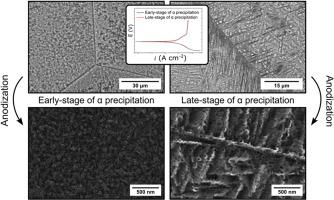
β-metastable titanium alloys have received special attention in prosthesis manufacturing due to their good mechanical behavior and superior biocompatibility. Nonetheless, the addition of self-organized titanium (IV) oxide (TiO2) on the component surface has been needed to improve its bioactivity and osseointegration. In this investigation, the effect of the substrate microstructure on corrosion behavior and TiO2 nanotube formation was studied in the β-metastable Ti–10Mo–3Sn (% wt.) alloy. Self-organized TiO2 was prepared by anodization of Ti–10Mo–3Sn (% wt.) alloy after solution heat treatment at 1000 °C and aging treatments at 500 °C and 600 °C. Changes in surface nanotopography were verified as a function of the substrate microstructure and the electrolyte composition. The presence of finer precipitation leads to a thicker layer of TiO2 nanotubes and an increase in their diameters was observed at higher aging temperatures.
期刊介绍:
Materials Chemistry and Physics is devoted to short communications, full-length research papers and feature articles on interrelationships among structure, properties, processing and performance of materials. The Editors welcome manuscripts on thin films, surface and interface science, materials degradation and reliability, metallurgy, semiconductors and optoelectronic materials, fine ceramics, magnetics, superconductors, specialty polymers, nano-materials and composite materials.




 京公网安备 11010802042870号
京ICP备2023020795号-1
京公网安备 11010802042870号
京ICP备2023020795号-1

 分享
分享
 求助内容:
求助内容: 应助结果提醒方式:
 扫码关注我们
