Lei Sun , Kailin Feng , Dean Bai, Yiyan Yu, Wei-Ting Shen, Jiayuan Alex Zhang, Ronnie H. Fang, Weiwei Gao, Liangfang Zhang
{"title":"用于广谱药物解毒的肝内质网衍生纳米片","authors":"Lei Sun , Kailin Feng , Dean Bai, Yiyan Yu, Wei-Ting Shen, Jiayuan Alex Zhang, Ronnie H. Fang, Weiwei Gao, Liangfang Zhang","doi":"10.1016/j.biomaterials.2025.123188","DOIUrl":null,"url":null,"abstract":"<div><div>Drug overdose is a pressing global public health challenge, with current detoxification treatments often lacking the broad-spectrum efficacy needed for emergency applications. Inspired by the unique advantages of cell membrane-derived nanodiscs (CNDs), including their compact size, rapid distribution, and preservation of native cell membrane functions, we developed endoplasmic reticulum (ER)-derived nanodiscs (ER-NDs) from the ER membranes of mouse hepatic cells for broad-spectrum drug detoxification. ER-NDs retain natural cytochrome P450 (CYP) enzymes, enabling effective detoxification of three model drugs: bupropion, haloperidol, and propranolol. Cell-based assays demonstrated ER-NDs' ability to mitigate drug-induced cytotoxicity, reduce oxidative stress, and restore antioxidant defenses. In mouse models of drug intoxication, ER-ND treatment significantly improved survival rates and alleviated drug-induced oxidative damage. Importantly, ER-NDs showed no evidence of acute toxicity <em>in vivo</em>. These findings underscore the potential of ER-NDs as a versatile platform for broad-spectrum drug detoxification and as a promising tool for managing drug intoxication in emergency and clinical settings.</div></div>","PeriodicalId":254,"journal":{"name":"Biomaterials","volume":"318 ","pages":"Article 123188"},"PeriodicalIF":12.9000,"publicationDate":"2025-07-01","publicationTypes":"Journal Article","fieldsOfStudy":null,"isOpenAccess":false,"openAccessPdf":"","citationCount":"0","resultStr":"{\"title\":\"Hepatic endoplasmic reticulum-derived nanodiscs for broad-spectrum drug detoxification\",\"authors\":\"Lei Sun , Kailin Feng , Dean Bai, Yiyan Yu, Wei-Ting Shen, Jiayuan Alex Zhang, Ronnie H. Fang, Weiwei Gao, Liangfang Zhang\",\"doi\":\"10.1016/j.biomaterials.2025.123188\",\"DOIUrl\":null,\"url\":null,\"abstract\":\"<div><div>Drug overdose is a pressing global public health challenge, with current detoxification treatments often lacking the broad-spectrum efficacy needed for emergency applications. Inspired by the unique advantages of cell membrane-derived nanodiscs (CNDs), including their compact size, rapid distribution, and preservation of native cell membrane functions, we developed endoplasmic reticulum (ER)-derived nanodiscs (ER-NDs) from the ER membranes of mouse hepatic cells for broad-spectrum drug detoxification. ER-NDs retain natural cytochrome P450 (CYP) enzymes, enabling effective detoxification of three model drugs: bupropion, haloperidol, and propranolol. Cell-based assays demonstrated ER-NDs' ability to mitigate drug-induced cytotoxicity, reduce oxidative stress, and restore antioxidant defenses. In mouse models of drug intoxication, ER-ND treatment significantly improved survival rates and alleviated drug-induced oxidative damage. Importantly, ER-NDs showed no evidence of acute toxicity <em>in vivo</em>. These findings underscore the potential of ER-NDs as a versatile platform for broad-spectrum drug detoxification and as a promising tool for managing drug intoxication in emergency and clinical settings.</div></div>\",\"PeriodicalId\":254,\"journal\":{\"name\":\"Biomaterials\",\"volume\":\"318 \",\"pages\":\"Article 123188\"},\"PeriodicalIF\":12.9000,\"publicationDate\":\"2025-07-01\",\"publicationTypes\":\"Journal Article\",\"fieldsOfStudy\":null,\"isOpenAccess\":false,\"openAccessPdf\":\"\",\"citationCount\":\"0\",\"resultStr\":null,\"platform\":\"Semanticscholar\",\"paperid\":null,\"PeriodicalName\":\"Biomaterials\",\"FirstCategoryId\":\"5\",\"ListUrlMain\":\"https://www.sciencedirect.com/science/article/pii/S0142961225001073\",\"RegionNum\":1,\"RegionCategory\":\"医学\",\"ArticlePicture\":[],\"TitleCN\":null,\"AbstractTextCN\":null,\"PMCID\":null,\"EPubDate\":\"2025/2/12 0:00:00\",\"PubModel\":\"Epub\",\"JCR\":\"Q1\",\"JCRName\":\"ENGINEERING, BIOMEDICAL\",\"Score\":null,\"Total\":0}","platform":"Semanticscholar","paperid":null,"PeriodicalName":"Biomaterials","FirstCategoryId":"5","ListUrlMain":"https://www.sciencedirect.com/science/article/pii/S0142961225001073","RegionNum":1,"RegionCategory":"医学","ArticlePicture":[],"TitleCN":null,"AbstractTextCN":null,"PMCID":null,"EPubDate":"2025/2/12 0:00:00","PubModel":"Epub","JCR":"Q1","JCRName":"ENGINEERING, BIOMEDICAL","Score":null,"Total":0}
Hepatic endoplasmic reticulum-derived nanodiscs for broad-spectrum drug detoxification
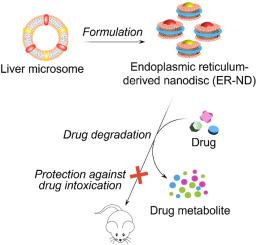
Drug overdose is a pressing global public health challenge, with current detoxification treatments often lacking the broad-spectrum efficacy needed for emergency applications. Inspired by the unique advantages of cell membrane-derived nanodiscs (CNDs), including their compact size, rapid distribution, and preservation of native cell membrane functions, we developed endoplasmic reticulum (ER)-derived nanodiscs (ER-NDs) from the ER membranes of mouse hepatic cells for broad-spectrum drug detoxification. ER-NDs retain natural cytochrome P450 (CYP) enzymes, enabling effective detoxification of three model drugs: bupropion, haloperidol, and propranolol. Cell-based assays demonstrated ER-NDs' ability to mitigate drug-induced cytotoxicity, reduce oxidative stress, and restore antioxidant defenses. In mouse models of drug intoxication, ER-ND treatment significantly improved survival rates and alleviated drug-induced oxidative damage. Importantly, ER-NDs showed no evidence of acute toxicity in vivo. These findings underscore the potential of ER-NDs as a versatile platform for broad-spectrum drug detoxification and as a promising tool for managing drug intoxication in emergency and clinical settings.
期刊介绍:
Biomaterials is an international journal covering the science and clinical application of biomaterials. A biomaterial is now defined as a substance that has been engineered to take a form which, alone or as part of a complex system, is used to direct, by control of interactions with components of living systems, the course of any therapeutic or diagnostic procedure. It is the aim of the journal to provide a peer-reviewed forum for the publication of original papers and authoritative review and opinion papers dealing with the most important issues facing the use of biomaterials in clinical practice. The scope of the journal covers the wide range of physical, biological and chemical sciences that underpin the design of biomaterials and the clinical disciplines in which they are used. These sciences include polymer synthesis and characterization, drug and gene vector design, the biology of the host response, immunology and toxicology and self assembly at the nanoscale. Clinical applications include the therapies of medical technology and regenerative medicine in all clinical disciplines, and diagnostic systems that reply on innovative contrast and sensing agents. The journal is relevant to areas such as cancer diagnosis and therapy, implantable devices, drug delivery systems, gene vectors, bionanotechnology and tissue engineering.




 京公网安备 11010802042870号
京ICP备2023020795号-1
京公网安备 11010802042870号
京ICP备2023020795号-1

 分享
分享
 求助内容:
求助内容: 应助结果提醒方式:
 扫码关注我们
