{"title":"部分结晶Co3(HITP)2修饰的硅阳极赋予硅空气电池在高温下的长放电时间","authors":"Fengjun Deng, Ze Liu, Yuhang Zhang, Kaiyong Feng, Xiaochen Zhang, Yingjian Yu","doi":"10.1016/j.compositesb.2025.112270","DOIUrl":null,"url":null,"abstract":"<div><div>In recent years, silicon has garnered attention as an anode material for air batteries due to its high energy density. However, a major challenge lies in the self-corrosion of the silicon anode during discharge, leading to inefficient silicon consumption. In this study, electronic conductive metal-organic frameworks, including partially crystalline Co<sub>3</sub>(HITP)<sub>2</sub>-1 and crystalline Co<sub>3</sub>(HITP)<sub>2</sub>-2 powders, were synthesized using a hydrothermal method to ameliorate anodes for silicon-air batteries for the first time. Notably, the Si@Co<sub>3</sub>(HITP)<sub>2</sub>-1 composite anode demonstrated the longest discharge duration of 476 h at 150 μA, outperforming all other samples. Both experimental results and theoretical calculations indicate that Co<sub>3</sub>(HITP)<sub>2</sub> reduces the composite anode's adsorption capacity for H₂O and SiO<sub>2</sub>, enhancing its self-corrosion reactions and passivation resistance. Compared with pristine silicon, the Si@Co<sub>3</sub>(HITP)<sub>2</sub>-1 composite anode extended the discharge time by approximately 18 h even at 50 °C. This pioneering research highlights the potential of an electronic conductive metal-organic framework in enhancing anode stability and extending battery life.</div></div>","PeriodicalId":10660,"journal":{"name":"Composites Part B: Engineering","volume":"296 ","pages":"Article 112270"},"PeriodicalIF":14.2000,"publicationDate":"2025-05-01","publicationTypes":"Journal Article","fieldsOfStudy":null,"isOpenAccess":false,"openAccessPdf":"","citationCount":"0","resultStr":"{\"title\":\"Partially crystalline Co3(HITP)2 modified Si anode endowing Si-air batteries with long discharge duration at high temperatures\",\"authors\":\"Fengjun Deng, Ze Liu, Yuhang Zhang, Kaiyong Feng, Xiaochen Zhang, Yingjian Yu\",\"doi\":\"10.1016/j.compositesb.2025.112270\",\"DOIUrl\":null,\"url\":null,\"abstract\":\"<div><div>In recent years, silicon has garnered attention as an anode material for air batteries due to its high energy density. However, a major challenge lies in the self-corrosion of the silicon anode during discharge, leading to inefficient silicon consumption. In this study, electronic conductive metal-organic frameworks, including partially crystalline Co<sub>3</sub>(HITP)<sub>2</sub>-1 and crystalline Co<sub>3</sub>(HITP)<sub>2</sub>-2 powders, were synthesized using a hydrothermal method to ameliorate anodes for silicon-air batteries for the first time. Notably, the Si@Co<sub>3</sub>(HITP)<sub>2</sub>-1 composite anode demonstrated the longest discharge duration of 476 h at 150 μA, outperforming all other samples. Both experimental results and theoretical calculations indicate that Co<sub>3</sub>(HITP)<sub>2</sub> reduces the composite anode's adsorption capacity for H₂O and SiO<sub>2</sub>, enhancing its self-corrosion reactions and passivation resistance. Compared with pristine silicon, the Si@Co<sub>3</sub>(HITP)<sub>2</sub>-1 composite anode extended the discharge time by approximately 18 h even at 50 °C. This pioneering research highlights the potential of an electronic conductive metal-organic framework in enhancing anode stability and extending battery life.</div></div>\",\"PeriodicalId\":10660,\"journal\":{\"name\":\"Composites Part B: Engineering\",\"volume\":\"296 \",\"pages\":\"Article 112270\"},\"PeriodicalIF\":14.2000,\"publicationDate\":\"2025-05-01\",\"publicationTypes\":\"Journal Article\",\"fieldsOfStudy\":null,\"isOpenAccess\":false,\"openAccessPdf\":\"\",\"citationCount\":\"0\",\"resultStr\":null,\"platform\":\"Semanticscholar\",\"paperid\":null,\"PeriodicalName\":\"Composites Part B: Engineering\",\"FirstCategoryId\":\"5\",\"ListUrlMain\":\"https://www.sciencedirect.com/science/article/pii/S135983682500160X\",\"RegionNum\":1,\"RegionCategory\":\"材料科学\",\"ArticlePicture\":[],\"TitleCN\":null,\"AbstractTextCN\":null,\"PMCID\":null,\"EPubDate\":\"2025/2/11 0:00:00\",\"PubModel\":\"Epub\",\"JCR\":\"Q1\",\"JCRName\":\"ENGINEERING, MULTIDISCIPLINARY\",\"Score\":null,\"Total\":0}","platform":"Semanticscholar","paperid":null,"PeriodicalName":"Composites Part B: Engineering","FirstCategoryId":"5","ListUrlMain":"https://www.sciencedirect.com/science/article/pii/S135983682500160X","RegionNum":1,"RegionCategory":"材料科学","ArticlePicture":[],"TitleCN":null,"AbstractTextCN":null,"PMCID":null,"EPubDate":"2025/2/11 0:00:00","PubModel":"Epub","JCR":"Q1","JCRName":"ENGINEERING, MULTIDISCIPLINARY","Score":null,"Total":0}
Partially crystalline Co3(HITP)2 modified Si anode endowing Si-air batteries with long discharge duration at high temperatures
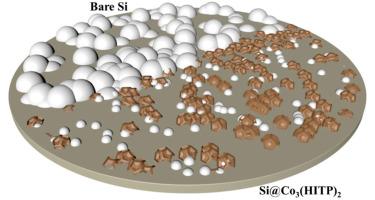
In recent years, silicon has garnered attention as an anode material for air batteries due to its high energy density. However, a major challenge lies in the self-corrosion of the silicon anode during discharge, leading to inefficient silicon consumption. In this study, electronic conductive metal-organic frameworks, including partially crystalline Co3(HITP)2-1 and crystalline Co3(HITP)2-2 powders, were synthesized using a hydrothermal method to ameliorate anodes for silicon-air batteries for the first time. Notably, the Si@Co3(HITP)2-1 composite anode demonstrated the longest discharge duration of 476 h at 150 μA, outperforming all other samples. Both experimental results and theoretical calculations indicate that Co3(HITP)2 reduces the composite anode's adsorption capacity for H₂O and SiO2, enhancing its self-corrosion reactions and passivation resistance. Compared with pristine silicon, the Si@Co3(HITP)2-1 composite anode extended the discharge time by approximately 18 h even at 50 °C. This pioneering research highlights the potential of an electronic conductive metal-organic framework in enhancing anode stability and extending battery life.
期刊介绍:
Composites Part B: Engineering is a journal that publishes impactful research of high quality on composite materials. This research is supported by fundamental mechanics and materials science and engineering approaches. The targeted research can cover a wide range of length scales, ranging from nano to micro and meso, and even to the full product and structure level. The journal specifically focuses on engineering applications that involve high performance composites. These applications can range from low volume and high cost to high volume and low cost composite development.
The main goal of the journal is to provide a platform for the prompt publication of original and high quality research. The emphasis is on design, development, modeling, validation, and manufacturing of engineering details and concepts. The journal welcomes both basic research papers and proposals for review articles. Authors are encouraged to address challenges across various application areas. These areas include, but are not limited to, aerospace, automotive, and other surface transportation. The journal also covers energy-related applications, with a focus on renewable energy. Other application areas include infrastructure, off-shore and maritime projects, health care technology, and recreational products.




 京公网安备 11010802042870号
京ICP备2023020795号-1
京公网安备 11010802042870号
京ICP备2023020795号-1

 分享
分享
 求助内容:
求助内容: 应助结果提醒方式:
 扫码关注我们
