{"title":"水相有机磷助界面聚合增强聚酰胺纳滤膜的渗透性","authors":"Tunga Kuhana Arsene , Zihao Zhai , Junyong Zhu , Miaomiao Tian , Yatao Zhang","doi":"10.1016/j.desal.2025.118685","DOIUrl":null,"url":null,"abstract":"<div><div>Nanofiltration membranes' performance hinges on their ion sieving and water permeability, which are affected by the crosslinking degree, uniformity, thickness, and microstructure of the active layer. Additive control offers a promising approach for optimizing membrane properties. This study presents a novel approach to improve water permeance of nanofiltration membranes by introducing organophosphorus end-capping reagents ((2-aminoethyl) triphenyphosphonium bromide (ATPB), (3-aminopropyl) triphenylphosphonium bromide (ATPPB), and 2-(diphenyphosphino) ethylamine (DPPE)) as <em>co</em>-reactive additives in the aqueous phase during interfacial polymerization. These reagents influenced the amine monomer's diffusion behavior, leading to a more homogeneous and potentially thinner polyamide (PA) layer, as demonstrated by molecular dynamics (MD) simulations. By regulating this process, we effectively modified pore characteristics, charge density distribution, and structural properties of the PA layer, all through a straightforward one-step method. The ATPB-0.015 membrane emerged as the optimal choice due to its excellent performance, characterized by a nodular buried structure, a water permeance of 16.3 L m<sup>−2</sup> h<sup>−1</sup> bar<sup>−1</sup>, and a high Na<sub>2</sub>SO<sub>4</sub> rejection (98.5 %). In addition, the amide and phosphorus units on the ATPB-0.015 membrane surface facilitated the removal of 97.48 % of <em>Escherichia coli</em> through hydrogen bonding and electrostatic interaction, enhancing its anti-bacterial property. Anti-fouling tests employing bovine serum albumin (BSA) and humic acid (HA) as foulants revealed that the ATPB-0.015 membrane demonstrated a faster recovery ratio than the control membrane, primarily attributed to its enhanced surface hydrophilicity. This study demonstrates a facile method for designing nanofiltration membranes with controlled structure and functional performance characteristics.</div></div>","PeriodicalId":299,"journal":{"name":"Desalination","volume":"603 ","pages":"Article 118685"},"PeriodicalIF":9.8000,"publicationDate":"2025-05-15","publicationTypes":"Journal Article","fieldsOfStudy":null,"isOpenAccess":false,"openAccessPdf":"","citationCount":"0","resultStr":"{\"title\":\"Enhancing permeability of polyamide nanofiltration membranes via aqueous organophosphorus co-reactant assisted interfacial polymerization\",\"authors\":\"Tunga Kuhana Arsene , Zihao Zhai , Junyong Zhu , Miaomiao Tian , Yatao Zhang\",\"doi\":\"10.1016/j.desal.2025.118685\",\"DOIUrl\":null,\"url\":null,\"abstract\":\"<div><div>Nanofiltration membranes' performance hinges on their ion sieving and water permeability, which are affected by the crosslinking degree, uniformity, thickness, and microstructure of the active layer. Additive control offers a promising approach for optimizing membrane properties. This study presents a novel approach to improve water permeance of nanofiltration membranes by introducing organophosphorus end-capping reagents ((2-aminoethyl) triphenyphosphonium bromide (ATPB), (3-aminopropyl) triphenylphosphonium bromide (ATPPB), and 2-(diphenyphosphino) ethylamine (DPPE)) as <em>co</em>-reactive additives in the aqueous phase during interfacial polymerization. These reagents influenced the amine monomer's diffusion behavior, leading to a more homogeneous and potentially thinner polyamide (PA) layer, as demonstrated by molecular dynamics (MD) simulations. By regulating this process, we effectively modified pore characteristics, charge density distribution, and structural properties of the PA layer, all through a straightforward one-step method. The ATPB-0.015 membrane emerged as the optimal choice due to its excellent performance, characterized by a nodular buried structure, a water permeance of 16.3 L m<sup>−2</sup> h<sup>−1</sup> bar<sup>−1</sup>, and a high Na<sub>2</sub>SO<sub>4</sub> rejection (98.5 %). In addition, the amide and phosphorus units on the ATPB-0.015 membrane surface facilitated the removal of 97.48 % of <em>Escherichia coli</em> through hydrogen bonding and electrostatic interaction, enhancing its anti-bacterial property. Anti-fouling tests employing bovine serum albumin (BSA) and humic acid (HA) as foulants revealed that the ATPB-0.015 membrane demonstrated a faster recovery ratio than the control membrane, primarily attributed to its enhanced surface hydrophilicity. This study demonstrates a facile method for designing nanofiltration membranes with controlled structure and functional performance characteristics.</div></div>\",\"PeriodicalId\":299,\"journal\":{\"name\":\"Desalination\",\"volume\":\"603 \",\"pages\":\"Article 118685\"},\"PeriodicalIF\":9.8000,\"publicationDate\":\"2025-05-15\",\"publicationTypes\":\"Journal Article\",\"fieldsOfStudy\":null,\"isOpenAccess\":false,\"openAccessPdf\":\"\",\"citationCount\":\"0\",\"resultStr\":null,\"platform\":\"Semanticscholar\",\"paperid\":null,\"PeriodicalName\":\"Desalination\",\"FirstCategoryId\":\"5\",\"ListUrlMain\":\"https://www.sciencedirect.com/science/article/pii/S0011916425001602\",\"RegionNum\":1,\"RegionCategory\":\"工程技术\",\"ArticlePicture\":[],\"TitleCN\":null,\"AbstractTextCN\":null,\"PMCID\":null,\"EPubDate\":\"2025/2/14 0:00:00\",\"PubModel\":\"Epub\",\"JCR\":\"Q1\",\"JCRName\":\"ENGINEERING, CHEMICAL\",\"Score\":null,\"Total\":0}","platform":"Semanticscholar","paperid":null,"PeriodicalName":"Desalination","FirstCategoryId":"5","ListUrlMain":"https://www.sciencedirect.com/science/article/pii/S0011916425001602","RegionNum":1,"RegionCategory":"工程技术","ArticlePicture":[],"TitleCN":null,"AbstractTextCN":null,"PMCID":null,"EPubDate":"2025/2/14 0:00:00","PubModel":"Epub","JCR":"Q1","JCRName":"ENGINEERING, CHEMICAL","Score":null,"Total":0}
引用次数: 0
摘要
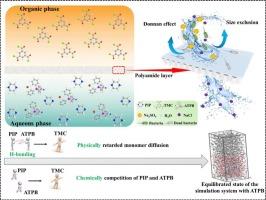
纳滤膜的性能取决于其离子筛分能力和透水性,而这又受活性层的交联度、均匀性、厚度和微观结构的影响。添加剂控制为优化膜性能提供了一种很有前途的方法。本研究提出了一种通过引入有机磷封端试剂((2-氨基乙基)三苯溴化磷(ATPB)、(3-氨基丙基)三苯溴化磷(ATPPB)和2-(二苯膦)乙胺(DPPE))作为界面聚合水相共反应添加剂来提高纳滤膜透水性的新方法。这些试剂影响了胺单体的扩散行为,导致更均匀和更薄的聚酰胺(PA)层,正如分子动力学(MD)模拟所证明的那样。通过调节这一过程,我们通过简单的一步方法有效地改变了PA层的孔隙特征、电荷密度分布和结构特性。ATPB-0.015膜由于其优异的性能而成为最佳选择,其特点是结核状埋地结构,透水率为16.3 L m−2 h−1 bar−1,Na2SO4截留率高达98.5%。此外,ATPB-0.015膜表面的酰胺和磷单元通过氢键和静电相互作用,促进了97.48%的大肠杆菌的去除率,增强了其抗菌性能。用牛血清白蛋白(BSA)和腐植酸(HA)作为污染物进行的防污试验表明,ATPB-0.015膜的回收率比对照膜快,这主要是由于其表面亲水性增强。本研究展示了一种设计具有可控结构和功能性能特征的纳滤膜的简便方法。
Enhancing permeability of polyamide nanofiltration membranes via aqueous organophosphorus co-reactant assisted interfacial polymerization
Nanofiltration membranes' performance hinges on their ion sieving and water permeability, which are affected by the crosslinking degree, uniformity, thickness, and microstructure of the active layer. Additive control offers a promising approach for optimizing membrane properties. This study presents a novel approach to improve water permeance of nanofiltration membranes by introducing organophosphorus end-capping reagents ((2-aminoethyl) triphenyphosphonium bromide (ATPB), (3-aminopropyl) triphenylphosphonium bromide (ATPPB), and 2-(diphenyphosphino) ethylamine (DPPE)) as co-reactive additives in the aqueous phase during interfacial polymerization. These reagents influenced the amine monomer's diffusion behavior, leading to a more homogeneous and potentially thinner polyamide (PA) layer, as demonstrated by molecular dynamics (MD) simulations. By regulating this process, we effectively modified pore characteristics, charge density distribution, and structural properties of the PA layer, all through a straightforward one-step method. The ATPB-0.015 membrane emerged as the optimal choice due to its excellent performance, characterized by a nodular buried structure, a water permeance of 16.3 L m−2 h−1 bar−1, and a high Na2SO4 rejection (98.5 %). In addition, the amide and phosphorus units on the ATPB-0.015 membrane surface facilitated the removal of 97.48 % of Escherichia coli through hydrogen bonding and electrostatic interaction, enhancing its anti-bacterial property. Anti-fouling tests employing bovine serum albumin (BSA) and humic acid (HA) as foulants revealed that the ATPB-0.015 membrane demonstrated a faster recovery ratio than the control membrane, primarily attributed to its enhanced surface hydrophilicity. This study demonstrates a facile method for designing nanofiltration membranes with controlled structure and functional performance characteristics.
期刊介绍:
Desalination is a scholarly journal that focuses on the field of desalination materials, processes, and associated technologies. It encompasses a wide range of disciplines and aims to publish exceptional papers in this area.
The journal invites submissions that explicitly revolve around water desalting and its applications to various sources such as seawater, groundwater, and wastewater. It particularly encourages research on diverse desalination methods including thermal, membrane, sorption, and hybrid processes.
By providing a platform for innovative studies, Desalination aims to advance the understanding and development of desalination technologies, promoting sustainable solutions for water scarcity challenges.




 京公网安备 11010802042870号
京ICP备2023020795号-1
京公网安备 11010802042870号
京ICP备2023020795号-1

 分享
分享
 求助内容:
求助内容: 应助结果提醒方式:
 扫码关注我们
