{"title":"林芝子实体中生物活性物质的序贯绿色提取、鉴定及包封","authors":"Tita Foophow , Sittiruk Roytrakul , Vilai Rungsardthong , Weerachon Phoohinkong","doi":"10.1016/j.rechem.2025.102112","DOIUrl":null,"url":null,"abstract":"<div><div><em>Phellinus linteus</em>, a traditional medicinal mushroom, is highly valued for its health benefits. The commercially available fruiting body of <em>Phellinus linteus</em> (PL) was extracted and characterized to elucidate its potential nutritional bioactivity. A sequential extraction method was employed, starting with conventional ethanol extraction (PL-E), followed by mechanical ball-mill assisted ethanol extraction (PL-B) or supercritical CO<sub>2</sub> cosolvent (PL-C), resulting in the identification of 19, 9, and 10 tentative compounds, respectively. The extracts comprised non-polar compounds, including triterpenoids and sterols in PL-E, and polyphenols and long-chain fatty acids in PL-B and PL-C. Hispidin and hispolon were found exclusively in PL-E. The PL-E demonstrated anticancer potential against MCF-7 cells, while the PL-C showed the highest activity against MCF-7 and HT-29 cells, suggesting that this high bioactivity fraction may be a promising candidate for anticancer studies. The PL-E, which exhibited high yield and bioactivity with various bioactive compounds, underwent complexation encapsulation with β-cyclodextrin. This study also proposes a potential green method to enhance these compounds' bioactivity value and bioaccessibility, supporting their development for food, nutraceutical, and pharmacological applications.</div></div>","PeriodicalId":420,"journal":{"name":"Results in Chemistry","volume":"14 ","pages":"Article 102112"},"PeriodicalIF":5.8000,"publicationDate":"2025-03-01","publicationTypes":"Journal Article","fieldsOfStudy":null,"isOpenAccess":false,"openAccessPdf":"","citationCount":"0","resultStr":"{\"title\":\"Sequential green extraction, identification, and encapsulation of bioactive compound from Phellinus linteus fruiting body\",\"authors\":\"Tita Foophow , Sittiruk Roytrakul , Vilai Rungsardthong , Weerachon Phoohinkong\",\"doi\":\"10.1016/j.rechem.2025.102112\",\"DOIUrl\":null,\"url\":null,\"abstract\":\"<div><div><em>Phellinus linteus</em>, a traditional medicinal mushroom, is highly valued for its health benefits. The commercially available fruiting body of <em>Phellinus linteus</em> (PL) was extracted and characterized to elucidate its potential nutritional bioactivity. A sequential extraction method was employed, starting with conventional ethanol extraction (PL-E), followed by mechanical ball-mill assisted ethanol extraction (PL-B) or supercritical CO<sub>2</sub> cosolvent (PL-C), resulting in the identification of 19, 9, and 10 tentative compounds, respectively. The extracts comprised non-polar compounds, including triterpenoids and sterols in PL-E, and polyphenols and long-chain fatty acids in PL-B and PL-C. Hispidin and hispolon were found exclusively in PL-E. The PL-E demonstrated anticancer potential against MCF-7 cells, while the PL-C showed the highest activity against MCF-7 and HT-29 cells, suggesting that this high bioactivity fraction may be a promising candidate for anticancer studies. The PL-E, which exhibited high yield and bioactivity with various bioactive compounds, underwent complexation encapsulation with β-cyclodextrin. This study also proposes a potential green method to enhance these compounds' bioactivity value and bioaccessibility, supporting their development for food, nutraceutical, and pharmacological applications.</div></div>\",\"PeriodicalId\":420,\"journal\":{\"name\":\"Results in Chemistry\",\"volume\":\"14 \",\"pages\":\"Article 102112\"},\"PeriodicalIF\":5.8000,\"publicationDate\":\"2025-03-01\",\"publicationTypes\":\"Journal Article\",\"fieldsOfStudy\":null,\"isOpenAccess\":false,\"openAccessPdf\":\"\",\"citationCount\":\"0\",\"resultStr\":null,\"platform\":\"Semanticscholar\",\"paperid\":null,\"PeriodicalName\":\"Results in Chemistry\",\"FirstCategoryId\":\"1085\",\"ListUrlMain\":\"https://www.sciencedirect.com/science/article/pii/S2211715625000955\",\"RegionNum\":0,\"RegionCategory\":null,\"ArticlePicture\":[],\"TitleCN\":null,\"AbstractTextCN\":null,\"PMCID\":null,\"EPubDate\":\"2025/2/9 0:00:00\",\"PubModel\":\"Epub\",\"JCR\":\"Q2\",\"JCRName\":\"CHEMISTRY, MULTIDISCIPLINARY\",\"Score\":null,\"Total\":0}","platform":"Semanticscholar","paperid":null,"PeriodicalName":"Results in Chemistry","FirstCategoryId":"1085","ListUrlMain":"https://www.sciencedirect.com/science/article/pii/S2211715625000955","RegionNum":0,"RegionCategory":null,"ArticlePicture":[],"TitleCN":null,"AbstractTextCN":null,"PMCID":null,"EPubDate":"2025/2/9 0:00:00","PubModel":"Epub","JCR":"Q2","JCRName":"CHEMISTRY, MULTIDISCIPLINARY","Score":null,"Total":0}
Sequential green extraction, identification, and encapsulation of bioactive compound from Phellinus linteus fruiting body
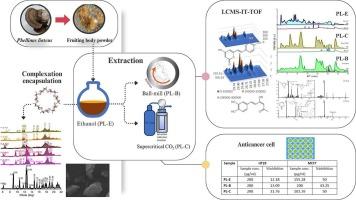
Phellinus linteus, a traditional medicinal mushroom, is highly valued for its health benefits. The commercially available fruiting body of Phellinus linteus (PL) was extracted and characterized to elucidate its potential nutritional bioactivity. A sequential extraction method was employed, starting with conventional ethanol extraction (PL-E), followed by mechanical ball-mill assisted ethanol extraction (PL-B) or supercritical CO2 cosolvent (PL-C), resulting in the identification of 19, 9, and 10 tentative compounds, respectively. The extracts comprised non-polar compounds, including triterpenoids and sterols in PL-E, and polyphenols and long-chain fatty acids in PL-B and PL-C. Hispidin and hispolon were found exclusively in PL-E. The PL-E demonstrated anticancer potential against MCF-7 cells, while the PL-C showed the highest activity against MCF-7 and HT-29 cells, suggesting that this high bioactivity fraction may be a promising candidate for anticancer studies. The PL-E, which exhibited high yield and bioactivity with various bioactive compounds, underwent complexation encapsulation with β-cyclodextrin. This study also proposes a potential green method to enhance these compounds' bioactivity value and bioaccessibility, supporting their development for food, nutraceutical, and pharmacological applications.





 京公网安备 11010802042870号
京ICP备2023020795号-1
京公网安备 11010802042870号
京ICP备2023020795号-1

 分享
分享
 求助内容:
求助内容: 应助结果提醒方式:
 扫码关注我们
