{"title":"水凝胶在污水处理中的研究进展","authors":"Amruta Pattnaik, Prabir Ghosh, Anil Kumar Poonia","doi":"10.1016/j.molliq.2025.127120","DOIUrl":null,"url":null,"abstract":"<div><div>Hydrogels, three-dimensional networks of polymers with excellent water retention properties, have emerged as adaptable wastewater treatment materials. This mini-review discusses current advances in hydrogel technology. These<!--> <!-->possess a large surface area, porosity, and functional diversity that enable them to efficiently absorb and eliminate contaminants through a variety of physical and chemical interactions. Hydrogel synthesis innovations, such as free radical polymerisation, ionic gelation, and interpenetrating polymer networks (IPNs), have resulted in the production of hydrogels that are strong, long-lasting, and selective for certain pollutants. The integration of antibacterial agents, surface functionalisation, and the development of composite hydrogels with materials<!--> <!-->has considerably increased their efficiency. This review also looks at the regenerative and reusable properties of hydrogels, emphasizing their cost-effectiveness and sustainability. By reviewing these achievements, this article aims to provide a thorough knowledge of hydrogel-based technologies and their potential to revolutionize wastewater treatment, providing effective and environmentally friendly solutions for environmental cleanup.</div></div>","PeriodicalId":371,"journal":{"name":"Journal of Molecular Liquids","volume":"424 ","pages":"Article 127120"},"PeriodicalIF":5.2000,"publicationDate":"2025-04-15","publicationTypes":"Journal Article","fieldsOfStudy":null,"isOpenAccess":false,"openAccessPdf":"","citationCount":"0","resultStr":"{\"title\":\"An overview on advancements in hydrogels for effective wastewater treatment\",\"authors\":\"Amruta Pattnaik, Prabir Ghosh, Anil Kumar Poonia\",\"doi\":\"10.1016/j.molliq.2025.127120\",\"DOIUrl\":null,\"url\":null,\"abstract\":\"<div><div>Hydrogels, three-dimensional networks of polymers with excellent water retention properties, have emerged as adaptable wastewater treatment materials. This mini-review discusses current advances in hydrogel technology. These<!--> <!-->possess a large surface area, porosity, and functional diversity that enable them to efficiently absorb and eliminate contaminants through a variety of physical and chemical interactions. Hydrogel synthesis innovations, such as free radical polymerisation, ionic gelation, and interpenetrating polymer networks (IPNs), have resulted in the production of hydrogels that are strong, long-lasting, and selective for certain pollutants. The integration of antibacterial agents, surface functionalisation, and the development of composite hydrogels with materials<!--> <!-->has considerably increased their efficiency. This review also looks at the regenerative and reusable properties of hydrogels, emphasizing their cost-effectiveness and sustainability. By reviewing these achievements, this article aims to provide a thorough knowledge of hydrogel-based technologies and their potential to revolutionize wastewater treatment, providing effective and environmentally friendly solutions for environmental cleanup.</div></div>\",\"PeriodicalId\":371,\"journal\":{\"name\":\"Journal of Molecular Liquids\",\"volume\":\"424 \",\"pages\":\"Article 127120\"},\"PeriodicalIF\":5.2000,\"publicationDate\":\"2025-04-15\",\"publicationTypes\":\"Journal Article\",\"fieldsOfStudy\":null,\"isOpenAccess\":false,\"openAccessPdf\":\"\",\"citationCount\":\"0\",\"resultStr\":null,\"platform\":\"Semanticscholar\",\"paperid\":null,\"PeriodicalName\":\"Journal of Molecular Liquids\",\"FirstCategoryId\":\"92\",\"ListUrlMain\":\"https://www.sciencedirect.com/science/article/pii/S0167732225002867\",\"RegionNum\":2,\"RegionCategory\":\"化学\",\"ArticlePicture\":[],\"TitleCN\":null,\"AbstractTextCN\":null,\"PMCID\":null,\"EPubDate\":\"2025/2/10 0:00:00\",\"PubModel\":\"Epub\",\"JCR\":\"Q2\",\"JCRName\":\"CHEMISTRY, PHYSICAL\",\"Score\":null,\"Total\":0}","platform":"Semanticscholar","paperid":null,"PeriodicalName":"Journal of Molecular Liquids","FirstCategoryId":"92","ListUrlMain":"https://www.sciencedirect.com/science/article/pii/S0167732225002867","RegionNum":2,"RegionCategory":"化学","ArticlePicture":[],"TitleCN":null,"AbstractTextCN":null,"PMCID":null,"EPubDate":"2025/2/10 0:00:00","PubModel":"Epub","JCR":"Q2","JCRName":"CHEMISTRY, PHYSICAL","Score":null,"Total":0}
An overview on advancements in hydrogels for effective wastewater treatment
Hydrogels, three-dimensional networks of polymers with excellent water retention properties, have emerged as adaptable wastewater treatment materials. This mini-review discusses current advances in hydrogel technology. These possess a large surface area, porosity, and functional diversity that enable them to efficiently absorb and eliminate contaminants through a variety of physical and chemical interactions. Hydrogel synthesis innovations, such as free radical polymerisation, ionic gelation, and interpenetrating polymer networks (IPNs), have resulted in the production of hydrogels that are strong, long-lasting, and selective for certain pollutants. The integration of antibacterial agents, surface functionalisation, and the development of composite hydrogels with materials has considerably increased their efficiency. This review also looks at the regenerative and reusable properties of hydrogels, emphasizing their cost-effectiveness and sustainability. By reviewing these achievements, this article aims to provide a thorough knowledge of hydrogel-based technologies and their potential to revolutionize wastewater treatment, providing effective and environmentally friendly solutions for environmental cleanup.
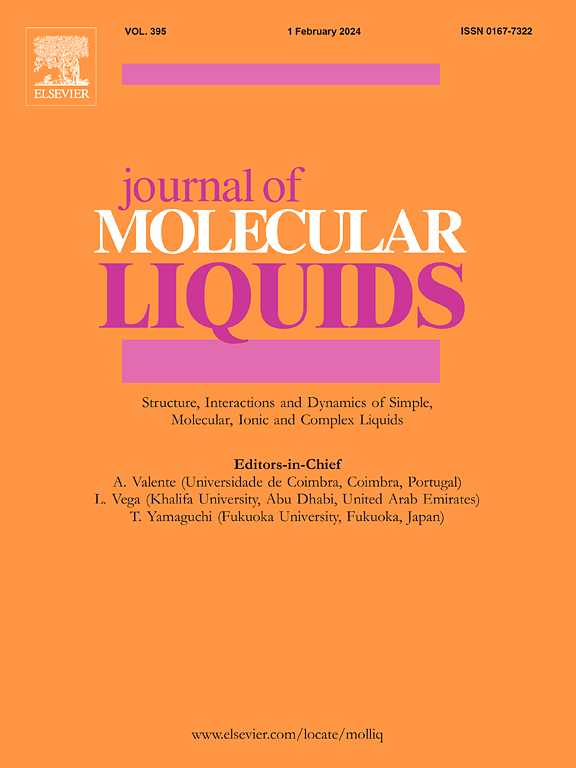
期刊介绍:
The journal includes papers in the following areas:
– Simple organic liquids and mixtures
– Ionic liquids
– Surfactant solutions (including micelles and vesicles) and liquid interfaces
– Colloidal solutions and nanoparticles
– Thermotropic and lyotropic liquid crystals
– Ferrofluids
– Water, aqueous solutions and other hydrogen-bonded liquids
– Lubricants, polymer solutions and melts
– Molten metals and salts
– Phase transitions and critical phenomena in liquids and confined fluids
– Self assembly in complex liquids.– Biomolecules in solution
The emphasis is on the molecular (or microscopic) understanding of particular liquids or liquid systems, especially concerning structure, dynamics and intermolecular forces. The experimental techniques used may include:
– Conventional spectroscopy (mid-IR and far-IR, Raman, NMR, etc.)
– Non-linear optics and time resolved spectroscopy (psec, fsec, asec, ISRS, etc.)
– Light scattering (Rayleigh, Brillouin, PCS, etc.)
– Dielectric relaxation
– X-ray and neutron scattering and diffraction.
Experimental studies, computer simulations (MD or MC) and analytical theory will be considered for publication; papers just reporting experimental results that do not contribute to the understanding of the fundamentals of molecular and ionic liquids will not be accepted. Only papers of a non-routine nature and advancing the field will be considered for publication.




 京公网安备 11010802042870号
京ICP备2023020795号-1
京公网安备 11010802042870号
京ICP备2023020795号-1

 分享
分享
 求助内容:
求助内容: 应助结果提醒方式:
 扫码关注我们
