Evan S. Dellon , David A. Katzka , Vincent A. Mukkada , Margaret H. Collins , Gary W. Falk , Camilla A. Richmond , Brian Terreri , Manoj Thakur , Mena Boules , Bridgett Goodwin , Ikuo Hirano
{"title":"布地奈德口服混悬液治疗嗜酸性粒细胞性食管炎的长期安全性和有效性:一项为期4年的3期开放标签研究","authors":"Evan S. Dellon , David A. Katzka , Vincent A. Mukkada , Margaret H. Collins , Gary W. Falk , Camilla A. Richmond , Brian Terreri , Manoj Thakur , Mena Boules , Bridgett Goodwin , Ikuo Hirano","doi":"10.1016/j.cgh.2024.12.024","DOIUrl":null,"url":null,"abstract":"<div><h3>Background & Aims</h3><div>We investigated the long-term safety and efficacy of budesonide oral suspension (BOS) in eosinophilic esophagitis (EoE).</div></div><div><h3>Methods</h3><div>This study (SHP621-303) was a 4-year, phase 3, open-label study in patients with EoE who completed up to 52 weeks of BOS therapy in 2 preceding phase 3 studies. On the basis of treatment assignments in previous studies, patients were assigned to BOS–BOS or placebo–BOS groups. All patients received BOS 2.0 mg twice daily; dose reductions to once daily and interruptions were permitted. The safety and tolerability of BOS were primarily investigated, with exploratory efficacy endpoints also examined.</div></div><div><h3>Results</h3><div>Overall, 131 patients were included. BOS was well-tolerated, with no unexpected safety signals observed. Treatment-emergent adverse events (TEAEs) occurred in 76.3% of patients; most were mild/moderate in severity and unrelated to study drug. The most frequently reported BOS-related TEAEs included abnormal adrenocorticotropic hormone stimulation test results (8.4%, 11/131; number of events [m] = 12) and adrenal insufficiency (2.3%, 3/131; m = 3). Esophageal candidiasis occurred in 3.1% of patients (4/131). The aforementioned TEAEs resolved in most patients. At month 48 of treatment, 50.0% and 58.3% of patients achieved/maintained a histologic response (≤6 and <15 eosinophils per high-power field, respectively). The initial reduction (−3.6) in total EoE Endoscopic Reference Score from baseline to the first visit was maintained until month 48.</div></div><div><h3>Conclusions</h3><div>Long-term treatment with BOS was well-tolerated. Despite dosing changes/interruptions, approximately half of patients achieved/maintained a histologic response; initial improvements in endoscopic outcomes were maintained over 48 months. <span><span>ClinicalTrials.gov</span><svg><path></path></svg></span> number: NCT03245840.</div></div>","PeriodicalId":10347,"journal":{"name":"Clinical Gastroenterology and Hepatology","volume":"23 12","pages":"Pages 2155-2166.e5"},"PeriodicalIF":16.2000,"publicationDate":"2025-11-01","publicationTypes":"Journal Article","fieldsOfStudy":null,"isOpenAccess":false,"openAccessPdf":"","citationCount":"0","resultStr":"{\"title\":\"Long-term Safety and Efficacy of Budesonide Oral Suspension for Eosinophilic Esophagitis: A 4-Year, Phase 3, Open-Label Study\",\"authors\":\"Evan S. Dellon , David A. Katzka , Vincent A. Mukkada , Margaret H. Collins , Gary W. Falk , Camilla A. Richmond , Brian Terreri , Manoj Thakur , Mena Boules , Bridgett Goodwin , Ikuo Hirano\",\"doi\":\"10.1016/j.cgh.2024.12.024\",\"DOIUrl\":null,\"url\":null,\"abstract\":\"<div><h3>Background & Aims</h3><div>We investigated the long-term safety and efficacy of budesonide oral suspension (BOS) in eosinophilic esophagitis (EoE).</div></div><div><h3>Methods</h3><div>This study (SHP621-303) was a 4-year, phase 3, open-label study in patients with EoE who completed up to 52 weeks of BOS therapy in 2 preceding phase 3 studies. On the basis of treatment assignments in previous studies, patients were assigned to BOS–BOS or placebo–BOS groups. All patients received BOS 2.0 mg twice daily; dose reductions to once daily and interruptions were permitted. The safety and tolerability of BOS were primarily investigated, with exploratory efficacy endpoints also examined.</div></div><div><h3>Results</h3><div>Overall, 131 patients were included. BOS was well-tolerated, with no unexpected safety signals observed. Treatment-emergent adverse events (TEAEs) occurred in 76.3% of patients; most were mild/moderate in severity and unrelated to study drug. The most frequently reported BOS-related TEAEs included abnormal adrenocorticotropic hormone stimulation test results (8.4%, 11/131; number of events [m] = 12) and adrenal insufficiency (2.3%, 3/131; m = 3). Esophageal candidiasis occurred in 3.1% of patients (4/131). The aforementioned TEAEs resolved in most patients. At month 48 of treatment, 50.0% and 58.3% of patients achieved/maintained a histologic response (≤6 and <15 eosinophils per high-power field, respectively). The initial reduction (−3.6) in total EoE Endoscopic Reference Score from baseline to the first visit was maintained until month 48.</div></div><div><h3>Conclusions</h3><div>Long-term treatment with BOS was well-tolerated. Despite dosing changes/interruptions, approximately half of patients achieved/maintained a histologic response; initial improvements in endoscopic outcomes were maintained over 48 months. <span><span>ClinicalTrials.gov</span><svg><path></path></svg></span> number: NCT03245840.</div></div>\",\"PeriodicalId\":10347,\"journal\":{\"name\":\"Clinical Gastroenterology and Hepatology\",\"volume\":\"23 12\",\"pages\":\"Pages 2155-2166.e5\"},\"PeriodicalIF\":16.2000,\"publicationDate\":\"2025-11-01\",\"publicationTypes\":\"Journal Article\",\"fieldsOfStudy\":null,\"isOpenAccess\":false,\"openAccessPdf\":\"\",\"citationCount\":\"0\",\"resultStr\":null,\"platform\":\"Semanticscholar\",\"paperid\":null,\"PeriodicalName\":\"Clinical Gastroenterology and Hepatology\",\"FirstCategoryId\":\"3\",\"ListUrlMain\":\"https://www.sciencedirect.com/science/article/pii/S1542356525001181\",\"RegionNum\":1,\"RegionCategory\":\"医学\",\"ArticlePicture\":[],\"TitleCN\":null,\"AbstractTextCN\":null,\"PMCID\":null,\"EPubDate\":\"2025/2/13 0:00:00\",\"PubModel\":\"Epub\",\"JCR\":\"Q1\",\"JCRName\":\"GASTROENTEROLOGY & HEPATOLOGY\",\"Score\":null,\"Total\":0}","platform":"Semanticscholar","paperid":null,"PeriodicalName":"Clinical Gastroenterology and Hepatology","FirstCategoryId":"3","ListUrlMain":"https://www.sciencedirect.com/science/article/pii/S1542356525001181","RegionNum":1,"RegionCategory":"医学","ArticlePicture":[],"TitleCN":null,"AbstractTextCN":null,"PMCID":null,"EPubDate":"2025/2/13 0:00:00","PubModel":"Epub","JCR":"Q1","JCRName":"GASTROENTEROLOGY & HEPATOLOGY","Score":null,"Total":0}
Long-term Safety and Efficacy of Budesonide Oral Suspension for Eosinophilic Esophagitis: A 4-Year, Phase 3, Open-Label Study
Background & Aims
We investigated the long-term safety and efficacy of budesonide oral suspension (BOS) in eosinophilic esophagitis (EoE).
Methods
This study (SHP621-303) was a 4-year, phase 3, open-label study in patients with EoE who completed up to 52 weeks of BOS therapy in 2 preceding phase 3 studies. On the basis of treatment assignments in previous studies, patients were assigned to BOS–BOS or placebo–BOS groups. All patients received BOS 2.0 mg twice daily; dose reductions to once daily and interruptions were permitted. The safety and tolerability of BOS were primarily investigated, with exploratory efficacy endpoints also examined.
Results
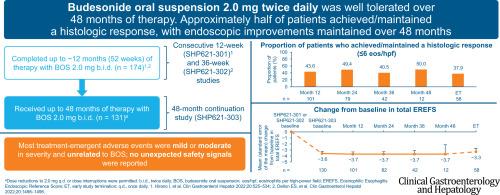
Overall, 131 patients were included. BOS was well-tolerated, with no unexpected safety signals observed. Treatment-emergent adverse events (TEAEs) occurred in 76.3% of patients; most were mild/moderate in severity and unrelated to study drug. The most frequently reported BOS-related TEAEs included abnormal adrenocorticotropic hormone stimulation test results (8.4%, 11/131; number of events [m] = 12) and adrenal insufficiency (2.3%, 3/131; m = 3). Esophageal candidiasis occurred in 3.1% of patients (4/131). The aforementioned TEAEs resolved in most patients. At month 48 of treatment, 50.0% and 58.3% of patients achieved/maintained a histologic response (≤6 and <15 eosinophils per high-power field, respectively). The initial reduction (−3.6) in total EoE Endoscopic Reference Score from baseline to the first visit was maintained until month 48.
Conclusions
Long-term treatment with BOS was well-tolerated. Despite dosing changes/interruptions, approximately half of patients achieved/maintained a histologic response; initial improvements in endoscopic outcomes were maintained over 48 months. ClinicalTrials.gov number: NCT03245840.
期刊介绍:
Clinical Gastroenterology and Hepatology (CGH) is dedicated to offering readers a comprehensive exploration of themes in clinical gastroenterology and hepatology. Encompassing diagnostic, endoscopic, interventional, and therapeutic advances, the journal covers areas such as cancer, inflammatory diseases, functional gastrointestinal disorders, nutrition, absorption, and secretion.
As a peer-reviewed publication, CGH features original articles and scholarly reviews, ensuring immediate relevance to the practice of gastroenterology and hepatology. Beyond peer-reviewed content, the journal includes invited key reviews and articles on endoscopy/practice-based technology, health-care policy, and practice management. Multimedia elements, including images, video abstracts, and podcasts, enhance the reader's experience. CGH remains actively engaged with its audience through updates and commentary shared via platforms such as Facebook and Twitter.




 京公网安备 11010802042870号
京ICP备2023020795号-1
京公网安备 11010802042870号
京ICP备2023020795号-1

 分享
分享
 求助内容:
求助内容: 应助结果提醒方式:
 扫码关注我们
