Gülsemin Çiçek, Fatma Öz Bağcı, Tahsin Murad Aktan, Selçuk Duman
{"title":"量子超光技术在干细胞光生物调节中的应用:一项体外实验研究。","authors":"Gülsemin Çiçek, Fatma Öz Bağcı, Tahsin Murad Aktan, Selçuk Duman","doi":"10.1007/s10103-025-04358-2","DOIUrl":null,"url":null,"abstract":"<p><p>Human umbilical cord matrix Wharton's jelly mesenchymal stem cells (WJ-MSCs) are commonly utilized in regenerative medicine due to their therapeutic benefits. However, the microenvironmental stress present in patients with hyperglycemia can significantly reduce mesenchymal stem cell (MSC) viability under high-glucose conditions in the body, ultimately reducing their therapeutic effectiveness. Enhancing the survival rate of MSCs following cell transplantation remains a crucial challenge. This study investigates whether Quantum Hyperlight (QHL) can counteract the detrimental effects of high glucose (HG), thereby improving MSC survival, proliferation, and mitochondrial function. We aimed to evaluate the effect of QHL on cellular viability, proliferation, and mitochondrial activity in WJ-MSCs exposed to HG. MSCs were cultured in a medium containing normal glucose (NG) (1 g/L) and HG (4.5 g/L). MSCs in the HG medium were exposed to QHL for 90 s or 180 s with an energy density of 2.4 Joules/cm<sup>2</sup>/minute and an average power density of 40 mW/cm<sup>2</sup>. Then, proliferating cell nuclear antigen (PCNA), MTT assays, and Mitotracker Green staining were performed to evaluate cell viability and proliferation. The viability of MSCs was significantly increased in the QHL-treated groups (84% in QHL-90 s and 86% in QHL-180 s) compared to the untreated HG group (65%, p < 0.001). PCNA expression in QHL-90 s and QHL-180 s groups showed significant increases (p < 0.001) compared to the untreated HG group. MitoTracker staining intensity was significantly higher in the QHL-treated groups compared to the untreated HG group (p < 0.001). The HG environment reduced viability, proliferation, and mitochondrial staining. In the context of the NG environment, MSCs exhibited notable differences. However, the viability, proliferation, and mitochondrial staining rates of MSCs were significantly higher in the HG conditions when treated with QHL compared to the group that did not receive QHL. This study introduces QHL as a novel approach to enhance the therapeutic potential of WJ-MSCs under HG conditions, demonstrating its ability to improve cellular viability, proliferation, and mitochondrial activity. This study highlights its potential as a pretreatment to improve clinical outcomes in regenerative medicine.</p>","PeriodicalId":17978,"journal":{"name":"Lasers in Medical Science","volume":"40 1","pages":"96"},"PeriodicalIF":2.4000,"publicationDate":"2025-02-15","publicationTypes":"Journal Article","fieldsOfStudy":null,"isOpenAccess":false,"openAccessPdf":"https://www.ncbi.nlm.nih.gov/pmc/articles/PMC11829900/pdf/","citationCount":"0","resultStr":"{\"title\":\"Use of quantum hyperlight technology in photobiomodulation on stem cells: an experimental in vitro study.\",\"authors\":\"Gülsemin Çiçek, Fatma Öz Bağcı, Tahsin Murad Aktan, Selçuk Duman\",\"doi\":\"10.1007/s10103-025-04358-2\",\"DOIUrl\":null,\"url\":null,\"abstract\":\"<p><p>Human umbilical cord matrix Wharton's jelly mesenchymal stem cells (WJ-MSCs) are commonly utilized in regenerative medicine due to their therapeutic benefits. However, the microenvironmental stress present in patients with hyperglycemia can significantly reduce mesenchymal stem cell (MSC) viability under high-glucose conditions in the body, ultimately reducing their therapeutic effectiveness. Enhancing the survival rate of MSCs following cell transplantation remains a crucial challenge. This study investigates whether Quantum Hyperlight (QHL) can counteract the detrimental effects of high glucose (HG), thereby improving MSC survival, proliferation, and mitochondrial function. We aimed to evaluate the effect of QHL on cellular viability, proliferation, and mitochondrial activity in WJ-MSCs exposed to HG. MSCs were cultured in a medium containing normal glucose (NG) (1 g/L) and HG (4.5 g/L). MSCs in the HG medium were exposed to QHL for 90 s or 180 s with an energy density of 2.4 Joules/cm<sup>2</sup>/minute and an average power density of 40 mW/cm<sup>2</sup>. Then, proliferating cell nuclear antigen (PCNA), MTT assays, and Mitotracker Green staining were performed to evaluate cell viability and proliferation. The viability of MSCs was significantly increased in the QHL-treated groups (84% in QHL-90 s and 86% in QHL-180 s) compared to the untreated HG group (65%, p < 0.001). PCNA expression in QHL-90 s and QHL-180 s groups showed significant increases (p < 0.001) compared to the untreated HG group. MitoTracker staining intensity was significantly higher in the QHL-treated groups compared to the untreated HG group (p < 0.001). The HG environment reduced viability, proliferation, and mitochondrial staining. In the context of the NG environment, MSCs exhibited notable differences. However, the viability, proliferation, and mitochondrial staining rates of MSCs were significantly higher in the HG conditions when treated with QHL compared to the group that did not receive QHL. This study introduces QHL as a novel approach to enhance the therapeutic potential of WJ-MSCs under HG conditions, demonstrating its ability to improve cellular viability, proliferation, and mitochondrial activity. This study highlights its potential as a pretreatment to improve clinical outcomes in regenerative medicine.</p>\",\"PeriodicalId\":17978,\"journal\":{\"name\":\"Lasers in Medical Science\",\"volume\":\"40 1\",\"pages\":\"96\"},\"PeriodicalIF\":2.4000,\"publicationDate\":\"2025-02-15\",\"publicationTypes\":\"Journal Article\",\"fieldsOfStudy\":null,\"isOpenAccess\":false,\"openAccessPdf\":\"https://www.ncbi.nlm.nih.gov/pmc/articles/PMC11829900/pdf/\",\"citationCount\":\"0\",\"resultStr\":null,\"platform\":\"Semanticscholar\",\"paperid\":null,\"PeriodicalName\":\"Lasers in Medical Science\",\"FirstCategoryId\":\"5\",\"ListUrlMain\":\"https://doi.org/10.1007/s10103-025-04358-2\",\"RegionNum\":4,\"RegionCategory\":\"医学\",\"ArticlePicture\":[],\"TitleCN\":null,\"AbstractTextCN\":null,\"PMCID\":null,\"EPubDate\":\"\",\"PubModel\":\"\",\"JCR\":\"Q3\",\"JCRName\":\"ENGINEERING, BIOMEDICAL\",\"Score\":null,\"Total\":0}","platform":"Semanticscholar","paperid":null,"PeriodicalName":"Lasers in Medical Science","FirstCategoryId":"5","ListUrlMain":"https://doi.org/10.1007/s10103-025-04358-2","RegionNum":4,"RegionCategory":"医学","ArticlePicture":[],"TitleCN":null,"AbstractTextCN":null,"PMCID":null,"EPubDate":"","PubModel":"","JCR":"Q3","JCRName":"ENGINEERING, BIOMEDICAL","Score":null,"Total":0}
Use of quantum hyperlight technology in photobiomodulation on stem cells: an experimental in vitro study.
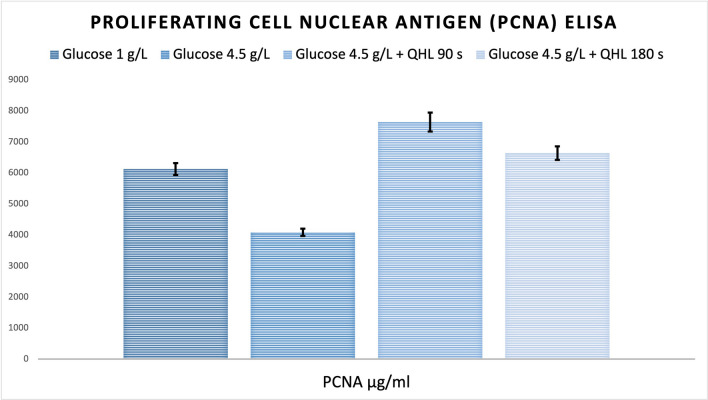
Human umbilical cord matrix Wharton's jelly mesenchymal stem cells (WJ-MSCs) are commonly utilized in regenerative medicine due to their therapeutic benefits. However, the microenvironmental stress present in patients with hyperglycemia can significantly reduce mesenchymal stem cell (MSC) viability under high-glucose conditions in the body, ultimately reducing their therapeutic effectiveness. Enhancing the survival rate of MSCs following cell transplantation remains a crucial challenge. This study investigates whether Quantum Hyperlight (QHL) can counteract the detrimental effects of high glucose (HG), thereby improving MSC survival, proliferation, and mitochondrial function. We aimed to evaluate the effect of QHL on cellular viability, proliferation, and mitochondrial activity in WJ-MSCs exposed to HG. MSCs were cultured in a medium containing normal glucose (NG) (1 g/L) and HG (4.5 g/L). MSCs in the HG medium were exposed to QHL for 90 s or 180 s with an energy density of 2.4 Joules/cm2/minute and an average power density of 40 mW/cm2. Then, proliferating cell nuclear antigen (PCNA), MTT assays, and Mitotracker Green staining were performed to evaluate cell viability and proliferation. The viability of MSCs was significantly increased in the QHL-treated groups (84% in QHL-90 s and 86% in QHL-180 s) compared to the untreated HG group (65%, p < 0.001). PCNA expression in QHL-90 s and QHL-180 s groups showed significant increases (p < 0.001) compared to the untreated HG group. MitoTracker staining intensity was significantly higher in the QHL-treated groups compared to the untreated HG group (p < 0.001). The HG environment reduced viability, proliferation, and mitochondrial staining. In the context of the NG environment, MSCs exhibited notable differences. However, the viability, proliferation, and mitochondrial staining rates of MSCs were significantly higher in the HG conditions when treated with QHL compared to the group that did not receive QHL. This study introduces QHL as a novel approach to enhance the therapeutic potential of WJ-MSCs under HG conditions, demonstrating its ability to improve cellular viability, proliferation, and mitochondrial activity. This study highlights its potential as a pretreatment to improve clinical outcomes in regenerative medicine.
期刊介绍:
Lasers in Medical Science (LIMS) has established itself as the leading international journal in the rapidly expanding field of medical and dental applications of lasers and light. It provides a forum for the publication of papers on the technical, experimental, and clinical aspects of the use of medical lasers, including lasers in surgery, endoscopy, angioplasty, hyperthermia of tumors, and photodynamic therapy. In addition to medical laser applications, LIMS presents high-quality manuscripts on a wide range of dental topics, including aesthetic dentistry, endodontics, orthodontics, and prosthodontics.
The journal publishes articles on the medical and dental applications of novel laser technologies, light delivery systems, sensors to monitor laser effects, basic laser-tissue interactions, and the modeling of laser-tissue interactions. Beyond laser applications, LIMS features articles relating to the use of non-laser light-tissue interactions.






 京公网安备 11010802042870号
京ICP备2023020795号-1
京公网安备 11010802042870号
京ICP备2023020795号-1

 分享
分享
 求助内容:
求助内容: 应助结果提醒方式:
 扫码关注我们
