{"title":"ACE-Breast-02:ARX788与拉帕替尼加卡培他滨治疗HER2阳性晚期乳腺癌的随机III期试验","authors":"Xichun Hu, Qingyuan Zhang, Leiping Wang, Jian Zhang, Quchang Ouyang, Xiaojia Wang, Wei Li, Weimin Xie, Zhongsheng Tong, Shusen Wang, Faliang Xu, Tao Sun, Wei Liu, Zhendong Chen, Jinsheng Wu, Ying Wang, Haixia Wang, Min Yan, Xinshuai Wang, Jingfen Wang, Feilin Cao, Yingying Du, Yongqiang Zhang, Lilin Chen, Ping Lu, Sanyuan Sun, Ruiwen Zhang, Aimin Zang, Xiuqing Nie, Yuan Lei","doi":"10.1038/s41392-025-02149-3","DOIUrl":null,"url":null,"abstract":"<p>This phase III trial aimed to compare ARX788, a site-specific, construct-homogeneous antibody-drug conjugate, with lapatinib plus capecitabine in patients with human epidermal growth factor receptor 2 (HER2)-positive advanced breast cancer (ABC) who had progressed on one line of trastuzumab based regimen. Eligible patients were randomized (1:1) to receive ARX788 (1.5 mg/kg, IV, Q3W) or lapatinib plus capecitabine (LC: lapatinib 1250 mg QD; capecitabine 1000 mg/m<sup>2</sup> BID, days 1–14, Q3W) and stratified by prior chemotherapy lines (0-1 versus >1) and visceral metastasis (yes versus no). The primary outcome was progression-free survival (PFS) assessed by a blinded independent central review (BICR). A total of 441 patients were randomly assigned to receive either ARX788 (<i>n</i> = 221) or LC (<i>n</i> = 220). The median PFS was 11.3 (95% confidence interval [CI], 8.4–13.8) months with ARX788 compared with 8.2 (95% CI, 6.9–8.7) months with LC, as per BICR (hazard ratio [HR] 0.64, <i>p</i> = 0.0006). Frequencies of treatment-related adverse events (TRAEs) of any grade were 98.6% and 99.1% for ARX788 and LC, respectively. Grade ≥3 TRAEs were 41.4% and 40.0%, respectively, the most common adverse events were blurred vision (12.3%), dry eye (9.1%), keratopathy (5.9%), and interstitial lung disease (ILD, 5.9%) with ARX788; hand-foot syndrome (18.1%) and hypokalemia (5.1%) with LC; all the hematological and gastrointestinal events of grade ≥3 with ARX788 were less than 3%. Six treatment-related deaths occurred, with three cases possibly related to ILD. ARX788 significantly improved PFS compared with LC in patients with HER2-positive ABC with a distinct toxicity profile, supporting it as a potential treatment option.</p>","PeriodicalId":21766,"journal":{"name":"Signal Transduction and Targeted Therapy","volume":"1 1","pages":""},"PeriodicalIF":81.2000,"publicationDate":"2025-02-17","publicationTypes":"Journal Article","fieldsOfStudy":null,"isOpenAccess":false,"openAccessPdf":"","citationCount":"0","resultStr":"{\"title\":\"ACE-Breast-02: a randomized phase III trial of ARX788 versus lapatinib plus capecitabine for HER2-positive advanced breast cancer\",\"authors\":\"Xichun Hu, Qingyuan Zhang, Leiping Wang, Jian Zhang, Quchang Ouyang, Xiaojia Wang, Wei Li, Weimin Xie, Zhongsheng Tong, Shusen Wang, Faliang Xu, Tao Sun, Wei Liu, Zhendong Chen, Jinsheng Wu, Ying Wang, Haixia Wang, Min Yan, Xinshuai Wang, Jingfen Wang, Feilin Cao, Yingying Du, Yongqiang Zhang, Lilin Chen, Ping Lu, Sanyuan Sun, Ruiwen Zhang, Aimin Zang, Xiuqing Nie, Yuan Lei\",\"doi\":\"10.1038/s41392-025-02149-3\",\"DOIUrl\":null,\"url\":null,\"abstract\":\"<p>This phase III trial aimed to compare ARX788, a site-specific, construct-homogeneous antibody-drug conjugate, with lapatinib plus capecitabine in patients with human epidermal growth factor receptor 2 (HER2)-positive advanced breast cancer (ABC) who had progressed on one line of trastuzumab based regimen. Eligible patients were randomized (1:1) to receive ARX788 (1.5 mg/kg, IV, Q3W) or lapatinib plus capecitabine (LC: lapatinib 1250 mg QD; capecitabine 1000 mg/m<sup>2</sup> BID, days 1–14, Q3W) and stratified by prior chemotherapy lines (0-1 versus >1) and visceral metastasis (yes versus no). The primary outcome was progression-free survival (PFS) assessed by a blinded independent central review (BICR). A total of 441 patients were randomly assigned to receive either ARX788 (<i>n</i> = 221) or LC (<i>n</i> = 220). The median PFS was 11.3 (95% confidence interval [CI], 8.4–13.8) months with ARX788 compared with 8.2 (95% CI, 6.9–8.7) months with LC, as per BICR (hazard ratio [HR] 0.64, <i>p</i> = 0.0006). Frequencies of treatment-related adverse events (TRAEs) of any grade were 98.6% and 99.1% for ARX788 and LC, respectively. Grade ≥3 TRAEs were 41.4% and 40.0%, respectively, the most common adverse events were blurred vision (12.3%), dry eye (9.1%), keratopathy (5.9%), and interstitial lung disease (ILD, 5.9%) with ARX788; hand-foot syndrome (18.1%) and hypokalemia (5.1%) with LC; all the hematological and gastrointestinal events of grade ≥3 with ARX788 were less than 3%. Six treatment-related deaths occurred, with three cases possibly related to ILD. ARX788 significantly improved PFS compared with LC in patients with HER2-positive ABC with a distinct toxicity profile, supporting it as a potential treatment option.</p>\",\"PeriodicalId\":21766,\"journal\":{\"name\":\"Signal Transduction and Targeted Therapy\",\"volume\":\"1 1\",\"pages\":\"\"},\"PeriodicalIF\":81.2000,\"publicationDate\":\"2025-02-17\",\"publicationTypes\":\"Journal Article\",\"fieldsOfStudy\":null,\"isOpenAccess\":false,\"openAccessPdf\":\"\",\"citationCount\":\"0\",\"resultStr\":null,\"platform\":\"Semanticscholar\",\"paperid\":null,\"PeriodicalName\":\"Signal Transduction and Targeted Therapy\",\"FirstCategoryId\":\"3\",\"ListUrlMain\":\"https://doi.org/10.1038/s41392-025-02149-3\",\"RegionNum\":1,\"RegionCategory\":\"医学\",\"ArticlePicture\":[],\"TitleCN\":null,\"AbstractTextCN\":null,\"PMCID\":null,\"EPubDate\":\"\",\"PubModel\":\"\",\"JCR\":\"Q1\",\"JCRName\":\"BIOCHEMISTRY & MOLECULAR BIOLOGY\",\"Score\":null,\"Total\":0}","platform":"Semanticscholar","paperid":null,"PeriodicalName":"Signal Transduction and Targeted Therapy","FirstCategoryId":"3","ListUrlMain":"https://doi.org/10.1038/s41392-025-02149-3","RegionNum":1,"RegionCategory":"医学","ArticlePicture":[],"TitleCN":null,"AbstractTextCN":null,"PMCID":null,"EPubDate":"","PubModel":"","JCR":"Q1","JCRName":"BIOCHEMISTRY & MOLECULAR BIOLOGY","Score":null,"Total":0}
引用次数: 0
摘要
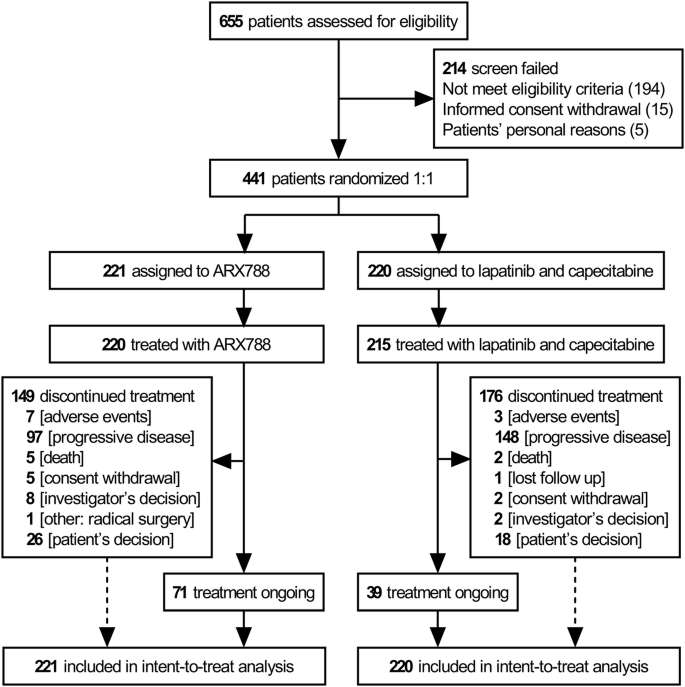
这项III期试验旨在比较ARX788(一种位点特异性、结构均质抗体-药物偶联物)与拉帕替尼加卡培他滨在接受单抗治疗的人类表皮生长因子受体2 (HER2)阳性晚期乳腺癌(ABC)患者中的疗效。符合条件的患者随机(1:1)接受ARX788 (1.5 mg/kg, IV, Q3W)或拉帕替尼加卡培他滨(LC:拉帕替尼1250 mg QD;卡培他滨1000mg /m2 BID,第1 - 14天,Q3W),并根据既往化疗线(0-1 vs >1)和内脏转移(是vs否)进行分层。主要终点是通过盲法独立中心评价(BICR)评估的无进展生存期(PFS)。共有441名患者被随机分配接受ARX788 (n = 221)或LC (n = 220)。根据BICR, ARX788组的中位PFS为11.3个月(95%可信区间[CI], 8.4-13.8), LC组为8.2个月(95% CI, 6.9-8.7)(风险比[HR] 0.64, p = 0.0006)。ARX788和LC的治疗相关不良事件(TRAEs)发生率分别为98.6%和99.1%。≥3级trae分别为41.4%和40.0%,ARX788最常见的不良事件是视力模糊(12.3%)、干眼(9.1%)、角膜病变(5.9%)和间质性肺疾病(ILD, 5.9%);手足综合征(18.1%)和低钾血症(5.1%)合并LC;ARX788患者所有≥3级的血液学和胃肠道事件均小于3%。发生6例与治疗相关的死亡,其中3例可能与ILD有关。与LC相比,ARX788显著改善了her2阳性ABC患者的PFS,具有明显的毒性,支持其作为潜在的治疗选择。
ACE-Breast-02: a randomized phase III trial of ARX788 versus lapatinib plus capecitabine for HER2-positive advanced breast cancer
This phase III trial aimed to compare ARX788, a site-specific, construct-homogeneous antibody-drug conjugate, with lapatinib plus capecitabine in patients with human epidermal growth factor receptor 2 (HER2)-positive advanced breast cancer (ABC) who had progressed on one line of trastuzumab based regimen. Eligible patients were randomized (1:1) to receive ARX788 (1.5 mg/kg, IV, Q3W) or lapatinib plus capecitabine (LC: lapatinib 1250 mg QD; capecitabine 1000 mg/m2 BID, days 1–14, Q3W) and stratified by prior chemotherapy lines (0-1 versus >1) and visceral metastasis (yes versus no). The primary outcome was progression-free survival (PFS) assessed by a blinded independent central review (BICR). A total of 441 patients were randomly assigned to receive either ARX788 (n = 221) or LC (n = 220). The median PFS was 11.3 (95% confidence interval [CI], 8.4–13.8) months with ARX788 compared with 8.2 (95% CI, 6.9–8.7) months with LC, as per BICR (hazard ratio [HR] 0.64, p = 0.0006). Frequencies of treatment-related adverse events (TRAEs) of any grade were 98.6% and 99.1% for ARX788 and LC, respectively. Grade ≥3 TRAEs were 41.4% and 40.0%, respectively, the most common adverse events were blurred vision (12.3%), dry eye (9.1%), keratopathy (5.9%), and interstitial lung disease (ILD, 5.9%) with ARX788; hand-foot syndrome (18.1%) and hypokalemia (5.1%) with LC; all the hematological and gastrointestinal events of grade ≥3 with ARX788 were less than 3%. Six treatment-related deaths occurred, with three cases possibly related to ILD. ARX788 significantly improved PFS compared with LC in patients with HER2-positive ABC with a distinct toxicity profile, supporting it as a potential treatment option.
期刊介绍:
Signal Transduction and Targeted Therapy is an open access journal that focuses on timely publication of cutting-edge discoveries and advancements in basic science and clinical research related to signal transduction and targeted therapy.
Scope: The journal covers research on major human diseases, including, but not limited to:
Cancer,Cardiovascular diseases,Autoimmune diseases,Nervous system diseases.




 京公网安备 11010802042870号
京ICP备2023020795号-1
京公网安备 11010802042870号
京ICP备2023020795号-1

 分享
分享
 求助内容:
求助内容: 应助结果提醒方式:
 扫码关注我们
