Fengli Xu, Qi Wang, Esteban Moro, Lin Chen, Arianna Salazar Miranda, Marta C. González, Michele Tizzoni, Chaoming Song, Carlo Ratti, Luis Bettencourt, Yong Li, James Evans
{"title":"利用人口流动数据量化城市的不平等现象","authors":"Fengli Xu, Qi Wang, Esteban Moro, Lin Chen, Arianna Salazar Miranda, Marta C. González, Michele Tizzoni, Chaoming Song, Carlo Ratti, Luis Bettencourt, Yong Li, James Evans","doi":"10.1038/s41562-024-02079-0","DOIUrl":null,"url":null,"abstract":"The lived experience of urban life is shaped by personal mobility through dynamic relationships and resources, marked not only by access and opportunity, but also inequality and segregation. The recent availability of fine-grained mobility data and context attributes ranging from venue type to demographic mixture offer researchers a deeper understanding of experienced inequalities at scale, and pose many new questions. Here we review emerging uses of urban mobility behaviour data, and propose an analytic framework to represent mobility patterns as a temporal bipartite network between people and places. As this network reconfigures over time, analysts can track experienced inequality along three critical dimensions: social mixing with others from specific demographic backgrounds, access to different types of facilities, and spontaneous adaptation to unexpected events, such as epidemics, conflicts or disasters. This framework traces the dynamic, lived experiences of urban inequality and complements prior work on static inequalities experience at home and work. Xu et al. review applications of urban mobility behaviour data and propose a temporal bipartite network that reveals mobility patterns between people and places. It helps to track urban inequalities in social mixing, facility access and adaptation.","PeriodicalId":19074,"journal":{"name":"Nature Human Behaviour","volume":"9 4","pages":"654-664"},"PeriodicalIF":15.9000,"publicationDate":"2025-02-17","publicationTypes":"Journal Article","fieldsOfStudy":null,"isOpenAccess":false,"openAccessPdf":"","citationCount":"0","resultStr":"{\"title\":\"Using human mobility data to quantify experienced urban inequalities\",\"authors\":\"Fengli Xu, Qi Wang, Esteban Moro, Lin Chen, Arianna Salazar Miranda, Marta C. González, Michele Tizzoni, Chaoming Song, Carlo Ratti, Luis Bettencourt, Yong Li, James Evans\",\"doi\":\"10.1038/s41562-024-02079-0\",\"DOIUrl\":null,\"url\":null,\"abstract\":\"The lived experience of urban life is shaped by personal mobility through dynamic relationships and resources, marked not only by access and opportunity, but also inequality and segregation. The recent availability of fine-grained mobility data and context attributes ranging from venue type to demographic mixture offer researchers a deeper understanding of experienced inequalities at scale, and pose many new questions. Here we review emerging uses of urban mobility behaviour data, and propose an analytic framework to represent mobility patterns as a temporal bipartite network between people and places. As this network reconfigures over time, analysts can track experienced inequality along three critical dimensions: social mixing with others from specific demographic backgrounds, access to different types of facilities, and spontaneous adaptation to unexpected events, such as epidemics, conflicts or disasters. This framework traces the dynamic, lived experiences of urban inequality and complements prior work on static inequalities experience at home and work. Xu et al. review applications of urban mobility behaviour data and propose a temporal bipartite network that reveals mobility patterns between people and places. It helps to track urban inequalities in social mixing, facility access and adaptation.\",\"PeriodicalId\":19074,\"journal\":{\"name\":\"Nature Human Behaviour\",\"volume\":\"9 4\",\"pages\":\"654-664\"},\"PeriodicalIF\":15.9000,\"publicationDate\":\"2025-02-17\",\"publicationTypes\":\"Journal Article\",\"fieldsOfStudy\":null,\"isOpenAccess\":false,\"openAccessPdf\":\"\",\"citationCount\":\"0\",\"resultStr\":null,\"platform\":\"Semanticscholar\",\"paperid\":null,\"PeriodicalName\":\"Nature Human Behaviour\",\"FirstCategoryId\":\"102\",\"ListUrlMain\":\"https://www.nature.com/articles/s41562-024-02079-0\",\"RegionNum\":1,\"RegionCategory\":\"心理学\",\"ArticlePicture\":[],\"TitleCN\":null,\"AbstractTextCN\":null,\"PMCID\":null,\"EPubDate\":\"\",\"PubModel\":\"\",\"JCR\":\"Q1\",\"JCRName\":\"MULTIDISCIPLINARY SCIENCES\",\"Score\":null,\"Total\":0}","platform":"Semanticscholar","paperid":null,"PeriodicalName":"Nature Human Behaviour","FirstCategoryId":"102","ListUrlMain":"https://www.nature.com/articles/s41562-024-02079-0","RegionNum":1,"RegionCategory":"心理学","ArticlePicture":[],"TitleCN":null,"AbstractTextCN":null,"PMCID":null,"EPubDate":"","PubModel":"","JCR":"Q1","JCRName":"MULTIDISCIPLINARY SCIENCES","Score":null,"Total":0}
Using human mobility data to quantify experienced urban inequalities
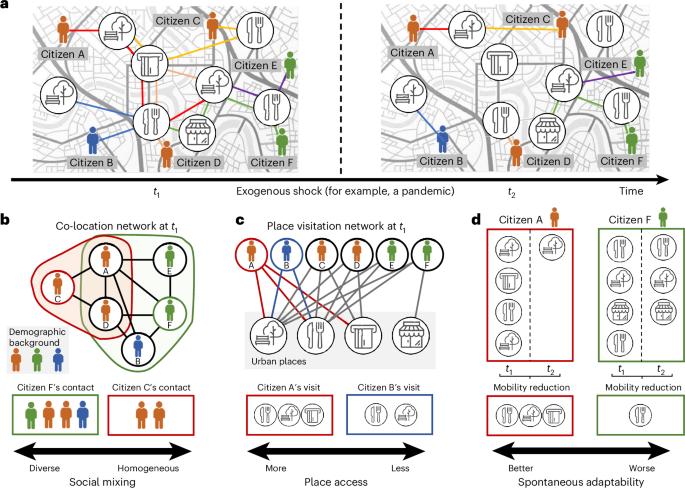
The lived experience of urban life is shaped by personal mobility through dynamic relationships and resources, marked not only by access and opportunity, but also inequality and segregation. The recent availability of fine-grained mobility data and context attributes ranging from venue type to demographic mixture offer researchers a deeper understanding of experienced inequalities at scale, and pose many new questions. Here we review emerging uses of urban mobility behaviour data, and propose an analytic framework to represent mobility patterns as a temporal bipartite network between people and places. As this network reconfigures over time, analysts can track experienced inequality along three critical dimensions: social mixing with others from specific demographic backgrounds, access to different types of facilities, and spontaneous adaptation to unexpected events, such as epidemics, conflicts or disasters. This framework traces the dynamic, lived experiences of urban inequality and complements prior work on static inequalities experience at home and work. Xu et al. review applications of urban mobility behaviour data and propose a temporal bipartite network that reveals mobility patterns between people and places. It helps to track urban inequalities in social mixing, facility access and adaptation.
期刊介绍:
Nature Human Behaviour is a journal that focuses on publishing research of outstanding significance into any aspect of human behavior.The research can cover various areas such as psychological, biological, and social bases of human behavior.It also includes the study of origins, development, and disorders related to human behavior.The primary aim of the journal is to increase the visibility of research in the field and enhance its societal reach and impact.




 京公网安备 11010802042870号
京ICP备2023020795号-1
京公网安备 11010802042870号
京ICP备2023020795号-1

 分享
分享
 求助内容:
求助内容: 应助结果提醒方式:
 扫码关注我们
