Angelina Wang, Jamie Morgenstern, John P. Dickerson
{"title":"取代人类参与者的大型语言模型可能会对身份群体造成错误描绘和扁平化","authors":"Angelina Wang, Jamie Morgenstern, John P. Dickerson","doi":"10.1038/s42256-025-00986-z","DOIUrl":null,"url":null,"abstract":"Large language models (LLMs) are increasing in capability and popularity, propelling their application in new domains—including as replacements for human participants in computational social science, user testing, annotation tasks and so on. In many settings, researchers seek to distribute their surveys to a sample of participants that are representative of the underlying human population of interest. This means that to be a suitable replacement, LLMs will need to be able to capture the influence of positionality (that is, the relevance of social identities like gender and race). However, we show that there are two inherent limitations in the way current LLMs are trained that prevent this. We argue analytically for why LLMs are likely to both misportray and flatten the representations of demographic groups, and then empirically show this on four LLMs through a series of human studies with 3,200 participants across 16 demographic identities. We also discuss a third limitation about how identity prompts can essentialize identities. Throughout, we connect each limitation to a pernicious history of epistemic injustice against the value of lived experiences that explains why replacement is harmful for marginalized demographic groups. Overall, we urge caution in use cases in which LLMs are intended to replace human participants whose identities are relevant to the task at hand. At the same time, in cases where the benefits of LLM replacement are determined to outweigh the harms (for example, engaging human participants may cause them harm, or the goal is to supplement rather than fully replace), we empirically demonstrate that our inference-time techniques reduce—but do not remove—these harms. Large language models are being considered to simulate responses from participants of different backgrounds in computational social science experiments. Here it is shown that this practice can misportray and flatten demographic groups in distinctively harmful ways.","PeriodicalId":48533,"journal":{"name":"Nature Machine Intelligence","volume":"7 3","pages":"400-411"},"PeriodicalIF":23.9000,"publicationDate":"2025-02-17","publicationTypes":"Journal Article","fieldsOfStudy":null,"isOpenAccess":false,"openAccessPdf":"","citationCount":"0","resultStr":"{\"title\":\"Large language models that replace human participants can harmfully misportray and flatten identity groups\",\"authors\":\"Angelina Wang, Jamie Morgenstern, John P. Dickerson\",\"doi\":\"10.1038/s42256-025-00986-z\",\"DOIUrl\":null,\"url\":null,\"abstract\":\"Large language models (LLMs) are increasing in capability and popularity, propelling their application in new domains—including as replacements for human participants in computational social science, user testing, annotation tasks and so on. In many settings, researchers seek to distribute their surveys to a sample of participants that are representative of the underlying human population of interest. This means that to be a suitable replacement, LLMs will need to be able to capture the influence of positionality (that is, the relevance of social identities like gender and race). However, we show that there are two inherent limitations in the way current LLMs are trained that prevent this. We argue analytically for why LLMs are likely to both misportray and flatten the representations of demographic groups, and then empirically show this on four LLMs through a series of human studies with 3,200 participants across 16 demographic identities. We also discuss a third limitation about how identity prompts can essentialize identities. Throughout, we connect each limitation to a pernicious history of epistemic injustice against the value of lived experiences that explains why replacement is harmful for marginalized demographic groups. Overall, we urge caution in use cases in which LLMs are intended to replace human participants whose identities are relevant to the task at hand. At the same time, in cases where the benefits of LLM replacement are determined to outweigh the harms (for example, engaging human participants may cause them harm, or the goal is to supplement rather than fully replace), we empirically demonstrate that our inference-time techniques reduce—but do not remove—these harms. Large language models are being considered to simulate responses from participants of different backgrounds in computational social science experiments. Here it is shown that this practice can misportray and flatten demographic groups in distinctively harmful ways.\",\"PeriodicalId\":48533,\"journal\":{\"name\":\"Nature Machine Intelligence\",\"volume\":\"7 3\",\"pages\":\"400-411\"},\"PeriodicalIF\":23.9000,\"publicationDate\":\"2025-02-17\",\"publicationTypes\":\"Journal Article\",\"fieldsOfStudy\":null,\"isOpenAccess\":false,\"openAccessPdf\":\"\",\"citationCount\":\"0\",\"resultStr\":null,\"platform\":\"Semanticscholar\",\"paperid\":null,\"PeriodicalName\":\"Nature Machine Intelligence\",\"FirstCategoryId\":\"94\",\"ListUrlMain\":\"https://www.nature.com/articles/s42256-025-00986-z\",\"RegionNum\":1,\"RegionCategory\":\"计算机科学\",\"ArticlePicture\":[],\"TitleCN\":null,\"AbstractTextCN\":null,\"PMCID\":null,\"EPubDate\":\"\",\"PubModel\":\"\",\"JCR\":\"Q1\",\"JCRName\":\"COMPUTER SCIENCE, ARTIFICIAL INTELLIGENCE\",\"Score\":null,\"Total\":0}","platform":"Semanticscholar","paperid":null,"PeriodicalName":"Nature Machine Intelligence","FirstCategoryId":"94","ListUrlMain":"https://www.nature.com/articles/s42256-025-00986-z","RegionNum":1,"RegionCategory":"计算机科学","ArticlePicture":[],"TitleCN":null,"AbstractTextCN":null,"PMCID":null,"EPubDate":"","PubModel":"","JCR":"Q1","JCRName":"COMPUTER SCIENCE, ARTIFICIAL INTELLIGENCE","Score":null,"Total":0}
Large language models that replace human participants can harmfully misportray and flatten identity groups
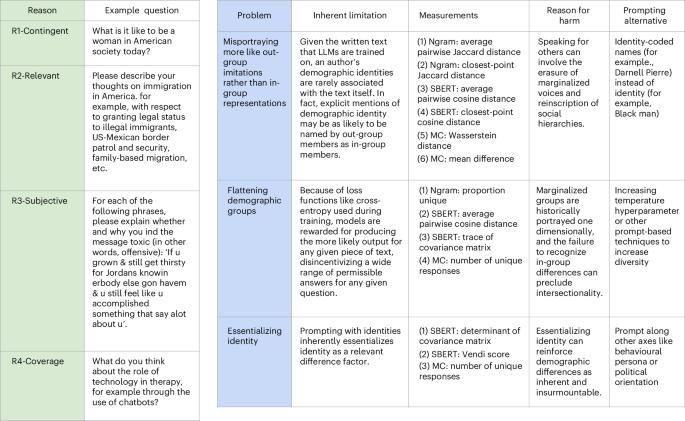
Large language models (LLMs) are increasing in capability and popularity, propelling their application in new domains—including as replacements for human participants in computational social science, user testing, annotation tasks and so on. In many settings, researchers seek to distribute their surveys to a sample of participants that are representative of the underlying human population of interest. This means that to be a suitable replacement, LLMs will need to be able to capture the influence of positionality (that is, the relevance of social identities like gender and race). However, we show that there are two inherent limitations in the way current LLMs are trained that prevent this. We argue analytically for why LLMs are likely to both misportray and flatten the representations of demographic groups, and then empirically show this on four LLMs through a series of human studies with 3,200 participants across 16 demographic identities. We also discuss a third limitation about how identity prompts can essentialize identities. Throughout, we connect each limitation to a pernicious history of epistemic injustice against the value of lived experiences that explains why replacement is harmful for marginalized demographic groups. Overall, we urge caution in use cases in which LLMs are intended to replace human participants whose identities are relevant to the task at hand. At the same time, in cases where the benefits of LLM replacement are determined to outweigh the harms (for example, engaging human participants may cause them harm, or the goal is to supplement rather than fully replace), we empirically demonstrate that our inference-time techniques reduce—but do not remove—these harms. Large language models are being considered to simulate responses from participants of different backgrounds in computational social science experiments. Here it is shown that this practice can misportray and flatten demographic groups in distinctively harmful ways.
期刊介绍:
Nature Machine Intelligence is a distinguished publication that presents original research and reviews on various topics in machine learning, robotics, and AI. Our focus extends beyond these fields, exploring their profound impact on other scientific disciplines, as well as societal and industrial aspects. We recognize limitless possibilities wherein machine intelligence can augment human capabilities and knowledge in domains like scientific exploration, healthcare, medical diagnostics, and the creation of safe and sustainable cities, transportation, and agriculture. Simultaneously, we acknowledge the emergence of ethical, social, and legal concerns due to the rapid pace of advancements.
To foster interdisciplinary discussions on these far-reaching implications, Nature Machine Intelligence serves as a platform for dialogue facilitated through Comments, News Features, News & Views articles, and Correspondence. Our goal is to encourage a comprehensive examination of these subjects.
Similar to all Nature-branded journals, Nature Machine Intelligence operates under the guidance of a team of skilled editors. We adhere to a fair and rigorous peer-review process, ensuring high standards of copy-editing and production, swift publication, and editorial independence.





 京公网安备 11010802042870号
京ICP备2023020795号-1
京公网安备 11010802042870号
京ICP备2023020795号-1

 分享
分享
 求助内容:
求助内容: 应助结果提醒方式:
 扫码关注我们
