{"title":"分散铋酸钠体系对镅和Curium分离的吸附和色谱行为","authors":"Samantha A. Labb, Ralf Sudowe","doi":"10.1021/acs.iecr.4c03483","DOIUrl":null,"url":null,"abstract":"The selective partitioning of americium (Am) and curium (Cm) is integral for nuclear science areas such as the nuclear fuel cycle, stockpile stewardship, and isotope production but remains a long-standing radioanalytical challenge due to nearly identical chemical properties. Differences in redox chemistry can be exploited since Am can be oxidized to the hexavalent oxidation state. Sodium bismuthate (NaBiO<sub>3</sub>) exhibits favorable oxidation and ion exchange characteristics conducive to a rapid and efficient Am/Cm chromatographic separation. Contact of nitric acid with NaBiO<sub>3</sub> was shown to significantly decrease the nitric acid concentration and solution volume. The adsorption, kinetic, and chromatographic behavior of Am and Cm in systems that disperse NaBiO<sub>3</sub> in filter aids was evaluated. Dispersion of NaBiO<sub>3</sub> increased separation factors to over 100, with rapid kinetics achieved within 1 min of contact and sustained for at least 2 h. The adsorption capacity was more than doubled from 0.066 mequiv g<sup>–1</sup> for solid NaBiO<sub>3</sub> alone to 0.149(6) and 0.156(9) meq g<sup>–1</sup> when dispersed in Celite 545 and silica gel, respectively. Complete separation was achieved in all systems with ∼100% recovery in the respective eluted fractions.","PeriodicalId":39,"journal":{"name":"Industrial & Engineering Chemistry Research","volume":"35 1","pages":""},"PeriodicalIF":3.9000,"publicationDate":"2025-02-17","publicationTypes":"Journal Article","fieldsOfStudy":null,"isOpenAccess":false,"openAccessPdf":"","citationCount":"0","resultStr":"{\"title\":\"Adsorption and Chromatographic Behavior of Dispersed Sodium Bismuthate Systems for the Separation of Americium from Curium\",\"authors\":\"Samantha A. Labb, Ralf Sudowe\",\"doi\":\"10.1021/acs.iecr.4c03483\",\"DOIUrl\":null,\"url\":null,\"abstract\":\"The selective partitioning of americium (Am) and curium (Cm) is integral for nuclear science areas such as the nuclear fuel cycle, stockpile stewardship, and isotope production but remains a long-standing radioanalytical challenge due to nearly identical chemical properties. Differences in redox chemistry can be exploited since Am can be oxidized to the hexavalent oxidation state. Sodium bismuthate (NaBiO<sub>3</sub>) exhibits favorable oxidation and ion exchange characteristics conducive to a rapid and efficient Am/Cm chromatographic separation. Contact of nitric acid with NaBiO<sub>3</sub> was shown to significantly decrease the nitric acid concentration and solution volume. The adsorption, kinetic, and chromatographic behavior of Am and Cm in systems that disperse NaBiO<sub>3</sub> in filter aids was evaluated. Dispersion of NaBiO<sub>3</sub> increased separation factors to over 100, with rapid kinetics achieved within 1 min of contact and sustained for at least 2 h. The adsorption capacity was more than doubled from 0.066 mequiv g<sup>–1</sup> for solid NaBiO<sub>3</sub> alone to 0.149(6) and 0.156(9) meq g<sup>–1</sup> when dispersed in Celite 545 and silica gel, respectively. Complete separation was achieved in all systems with ∼100% recovery in the respective eluted fractions.\",\"PeriodicalId\":39,\"journal\":{\"name\":\"Industrial & Engineering Chemistry Research\",\"volume\":\"35 1\",\"pages\":\"\"},\"PeriodicalIF\":3.9000,\"publicationDate\":\"2025-02-17\",\"publicationTypes\":\"Journal Article\",\"fieldsOfStudy\":null,\"isOpenAccess\":false,\"openAccessPdf\":\"\",\"citationCount\":\"0\",\"resultStr\":null,\"platform\":\"Semanticscholar\",\"paperid\":null,\"PeriodicalName\":\"Industrial & Engineering Chemistry Research\",\"FirstCategoryId\":\"5\",\"ListUrlMain\":\"https://doi.org/10.1021/acs.iecr.4c03483\",\"RegionNum\":3,\"RegionCategory\":\"工程技术\",\"ArticlePicture\":[],\"TitleCN\":null,\"AbstractTextCN\":null,\"PMCID\":null,\"EPubDate\":\"\",\"PubModel\":\"\",\"JCR\":\"Q2\",\"JCRName\":\"ENGINEERING, CHEMICAL\",\"Score\":null,\"Total\":0}","platform":"Semanticscholar","paperid":null,"PeriodicalName":"Industrial & Engineering Chemistry Research","FirstCategoryId":"5","ListUrlMain":"https://doi.org/10.1021/acs.iecr.4c03483","RegionNum":3,"RegionCategory":"工程技术","ArticlePicture":[],"TitleCN":null,"AbstractTextCN":null,"PMCID":null,"EPubDate":"","PubModel":"","JCR":"Q2","JCRName":"ENGINEERING, CHEMICAL","Score":null,"Total":0}
Adsorption and Chromatographic Behavior of Dispersed Sodium Bismuthate Systems for the Separation of Americium from Curium
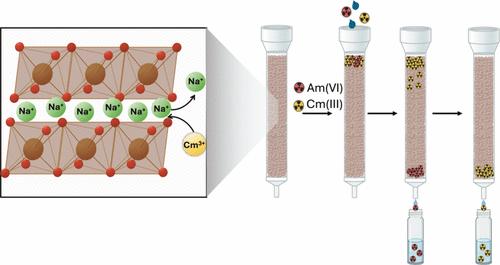
The selective partitioning of americium (Am) and curium (Cm) is integral for nuclear science areas such as the nuclear fuel cycle, stockpile stewardship, and isotope production but remains a long-standing radioanalytical challenge due to nearly identical chemical properties. Differences in redox chemistry can be exploited since Am can be oxidized to the hexavalent oxidation state. Sodium bismuthate (NaBiO3) exhibits favorable oxidation and ion exchange characteristics conducive to a rapid and efficient Am/Cm chromatographic separation. Contact of nitric acid with NaBiO3 was shown to significantly decrease the nitric acid concentration and solution volume. The adsorption, kinetic, and chromatographic behavior of Am and Cm in systems that disperse NaBiO3 in filter aids was evaluated. Dispersion of NaBiO3 increased separation factors to over 100, with rapid kinetics achieved within 1 min of contact and sustained for at least 2 h. The adsorption capacity was more than doubled from 0.066 mequiv g–1 for solid NaBiO3 alone to 0.149(6) and 0.156(9) meq g–1 when dispersed in Celite 545 and silica gel, respectively. Complete separation was achieved in all systems with ∼100% recovery in the respective eluted fractions.
期刊介绍:
ndustrial & Engineering Chemistry, with variations in title and format, has been published since 1909 by the American Chemical Society. Industrial & Engineering Chemistry Research is a weekly publication that reports industrial and academic research in the broad fields of applied chemistry and chemical engineering with special focus on fundamentals, processes, and products.




 京公网安备 11010802042870号
京ICP备2023020795号-1
京公网安备 11010802042870号
京ICP备2023020795号-1

 分享
分享
 求助内容:
求助内容: 应助结果提醒方式:
 扫码关注我们
