Xiaohui Xue, Huanhuan Gao, Zhihao Sun, JianZhong Liu
{"title":"分割与跟踪:基于深度学习的铝团块动态特征分析方法","authors":"Xiaohui Xue, Huanhuan Gao, Zhihao Sun, JianZhong Liu","doi":"10.1016/j.powtec.2025.120785","DOIUrl":null,"url":null,"abstract":"<div><div>The phenomenon of aluminum agglomeration, which occurs during the combustion of aluminized solid propellants, can have a series of adverse effects on solid rocket motors. High-speed microimaging has been demonstrated to be an effective technique for investigating this phenomenon. Consequently, an efficient and accurate analysis of aluminum agglomerates in high-speed video is a crucial aspect of this research. However, traditional analysis methods often produce unsatisfactory segmentation results in complex images and show low efficiency in extracting the features of the same agglomerate across multiple frames. To address these issues, this study proposes an online analysis method based on deep learning, which allows for the real-time segmentation and cross-frame tracking of aluminum agglomerates. Comparative experiments with the classical threshold-based method demonstrate the effectiveness and superior accuracy of the proposed method, with the <em>AP50</em> metric improving significantly from 0.546 to 0.940, achieving impressive segmentation performance. Subsequently, the method was employed to analyze the overall velocity characteristics, features of individual agglomerates, and the second mergence phenomenon of aluminum agglomerates. The analysis captured the complete dynamic process of agglomerates from formation to exiting the frame and yield a linear correlation between the projected area and maximum vertical velocity. The proposed method markedly simplifies the analysis process for aluminum agglomerates, furnishes more detailed dynamic information, and provides robust support for further studies on aluminum particle combustion and agglomeration mechanisms.</div></div>","PeriodicalId":407,"journal":{"name":"Powder Technology","volume":"455 ","pages":"Article 120785"},"PeriodicalIF":5.5000,"publicationDate":"2025-04-15","publicationTypes":"Journal Article","fieldsOfStudy":null,"isOpenAccess":false,"openAccessPdf":"","citationCount":"0","resultStr":"{\"title\":\"Segmentation and tracking: A deep learning-based method for analyzing dynamic features of aluminum agglomerates\",\"authors\":\"Xiaohui Xue, Huanhuan Gao, Zhihao Sun, JianZhong Liu\",\"doi\":\"10.1016/j.powtec.2025.120785\",\"DOIUrl\":null,\"url\":null,\"abstract\":\"<div><div>The phenomenon of aluminum agglomeration, which occurs during the combustion of aluminized solid propellants, can have a series of adverse effects on solid rocket motors. High-speed microimaging has been demonstrated to be an effective technique for investigating this phenomenon. Consequently, an efficient and accurate analysis of aluminum agglomerates in high-speed video is a crucial aspect of this research. However, traditional analysis methods often produce unsatisfactory segmentation results in complex images and show low efficiency in extracting the features of the same agglomerate across multiple frames. To address these issues, this study proposes an online analysis method based on deep learning, which allows for the real-time segmentation and cross-frame tracking of aluminum agglomerates. Comparative experiments with the classical threshold-based method demonstrate the effectiveness and superior accuracy of the proposed method, with the <em>AP50</em> metric improving significantly from 0.546 to 0.940, achieving impressive segmentation performance. Subsequently, the method was employed to analyze the overall velocity characteristics, features of individual agglomerates, and the second mergence phenomenon of aluminum agglomerates. The analysis captured the complete dynamic process of agglomerates from formation to exiting the frame and yield a linear correlation between the projected area and maximum vertical velocity. The proposed method markedly simplifies the analysis process for aluminum agglomerates, furnishes more detailed dynamic information, and provides robust support for further studies on aluminum particle combustion and agglomeration mechanisms.</div></div>\",\"PeriodicalId\":407,\"journal\":{\"name\":\"Powder Technology\",\"volume\":\"455 \",\"pages\":\"Article 120785\"},\"PeriodicalIF\":5.5000,\"publicationDate\":\"2025-04-15\",\"publicationTypes\":\"Journal Article\",\"fieldsOfStudy\":null,\"isOpenAccess\":false,\"openAccessPdf\":\"\",\"citationCount\":\"0\",\"resultStr\":null,\"platform\":\"Semanticscholar\",\"paperid\":null,\"PeriodicalName\":\"Powder Technology\",\"FirstCategoryId\":\"5\",\"ListUrlMain\":\"https://www.sciencedirect.com/science/article/pii/S0032591025001809\",\"RegionNum\":2,\"RegionCategory\":\"工程技术\",\"ArticlePicture\":[],\"TitleCN\":null,\"AbstractTextCN\":null,\"PMCID\":null,\"EPubDate\":\"2025/2/11 0:00:00\",\"PubModel\":\"Epub\",\"JCR\":\"Q2\",\"JCRName\":\"ENGINEERING, CHEMICAL\",\"Score\":null,\"Total\":0}","platform":"Semanticscholar","paperid":null,"PeriodicalName":"Powder Technology","FirstCategoryId":"5","ListUrlMain":"https://www.sciencedirect.com/science/article/pii/S0032591025001809","RegionNum":2,"RegionCategory":"工程技术","ArticlePicture":[],"TitleCN":null,"AbstractTextCN":null,"PMCID":null,"EPubDate":"2025/2/11 0:00:00","PubModel":"Epub","JCR":"Q2","JCRName":"ENGINEERING, CHEMICAL","Score":null,"Total":0}
Segmentation and tracking: A deep learning-based method for analyzing dynamic features of aluminum agglomerates
The phenomenon of aluminum agglomeration, which occurs during the combustion of aluminized solid propellants, can have a series of adverse effects on solid rocket motors. High-speed microimaging has been demonstrated to be an effective technique for investigating this phenomenon. Consequently, an efficient and accurate analysis of aluminum agglomerates in high-speed video is a crucial aspect of this research. However, traditional analysis methods often produce unsatisfactory segmentation results in complex images and show low efficiency in extracting the features of the same agglomerate across multiple frames. To address these issues, this study proposes an online analysis method based on deep learning, which allows for the real-time segmentation and cross-frame tracking of aluminum agglomerates. Comparative experiments with the classical threshold-based method demonstrate the effectiveness and superior accuracy of the proposed method, with the AP50 metric improving significantly from 0.546 to 0.940, achieving impressive segmentation performance. Subsequently, the method was employed to analyze the overall velocity characteristics, features of individual agglomerates, and the second mergence phenomenon of aluminum agglomerates. The analysis captured the complete dynamic process of agglomerates from formation to exiting the frame and yield a linear correlation between the projected area and maximum vertical velocity. The proposed method markedly simplifies the analysis process for aluminum agglomerates, furnishes more detailed dynamic information, and provides robust support for further studies on aluminum particle combustion and agglomeration mechanisms.
期刊介绍:
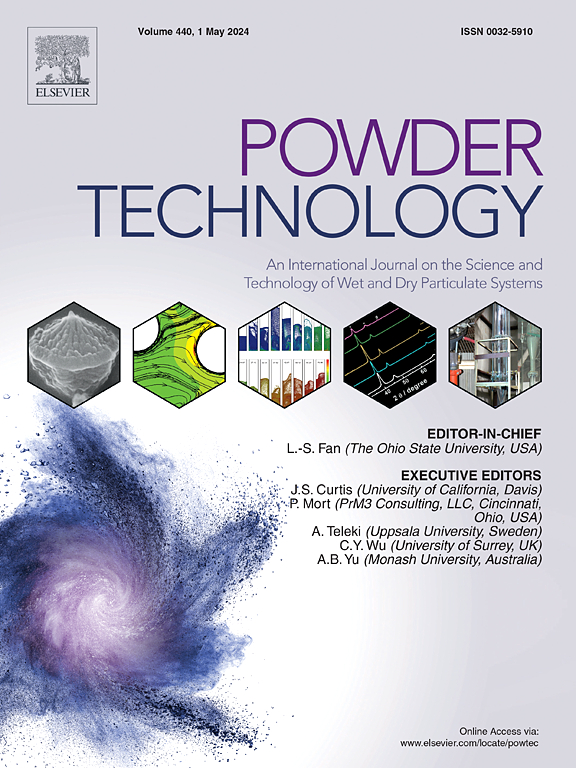
Powder Technology is an International Journal on the Science and Technology of Wet and Dry Particulate Systems. Powder Technology publishes papers on all aspects of the formation of particles and their characterisation and on the study of systems containing particulate solids. No limitation is imposed on the size of the particles, which may range from nanometre scale, as in pigments or aerosols, to that of mined or quarried materials. The following list of topics is not intended to be comprehensive, but rather to indicate typical subjects which fall within the scope of the journal's interests:
Formation and synthesis of particles by precipitation and other methods.
Modification of particles by agglomeration, coating, comminution and attrition.
Characterisation of the size, shape, surface area, pore structure and strength of particles and agglomerates (including the origins and effects of inter particle forces).
Packing, failure, flow and permeability of assemblies of particles.
Particle-particle interactions and suspension rheology.
Handling and processing operations such as slurry flow, fluidization, pneumatic conveying.
Interactions between particles and their environment, including delivery of particulate products to the body.
Applications of particle technology in production of pharmaceuticals, chemicals, foods, pigments, structural, and functional materials and in environmental and energy related matters.
For materials-oriented contributions we are looking for articles revealing the effect of particle/powder characteristics (size, morphology and composition, in that order) on material performance or functionality and, ideally, comparison to any industrial standard.





 京公网安备 11010802042870号
京ICP备2023020795号-1
京公网安备 11010802042870号
京ICP备2023020795号-1

 分享
分享
 求助内容:
求助内容: 应助结果提醒方式:
 扫码关注我们
