Ali Ebrahimpoor Gorji, Juho-Pekka Laakso, Ville Alopaeus, Petri Uusi-Kyyny
{"title":"基于qspr的COSMO描述符对离子液体中甲醇无限稀释活度系数(IDAC)的预测:考虑温度效应的机器学习","authors":"Ali Ebrahimpoor Gorji, Juho-Pekka Laakso, Ville Alopaeus, Petri Uusi-Kyyny","doi":"10.1016/j.fuel.2025.134674","DOIUrl":null,"url":null,"abstract":"<div><div>In this study, the ‘Quantitative Structure-Activity/Property Relationship’ (QSAR/QSPR) approach has been applied for the prediction of infinite dilution activity coefficient (IDAC) of Methanol (MeOH) in Ionic Liquids (ILs) using an extensive dataset. A new predictive QSPR model including novel molecular descriptors, called ‘COSMO-RS descriptors’, has been developed for the first time. In this study, the dataset was divided to a training set for the development of models, and a validation set for external validation. According to the obtained results of statistical parameters (R<sup>2</sup> = 0.92 and Q<sup>2</sup><sub>LOO-CV</sub> = 0.91), the predictive capability of the developed QSPR model was acceptable for training set. Regarding the external validation, other statistical parameters such as AAD = 0.2034 and RMSE = 0.2926 were also satisfactory for validation set. While the values of IDAC increase or decrease with increasing temperature, the QSPR model based on the van’t Hoff equation takes into account the ‘negative’ and ‘positive’ effects of temperature on the IDAC of MeOH in ILs well, depending on the nature of ILs. It was also shown that the IDAC value in some new ILs, which had not been experimentally studied before, can be predicted using QSPR model. These predicted data can be considered as ‘Pseudo Experimental data’ for future efforts.</div></div>","PeriodicalId":325,"journal":{"name":"Fuel","volume":"390 ","pages":"Article 134674"},"PeriodicalIF":7.5000,"publicationDate":"2025-06-15","publicationTypes":"Journal Article","fieldsOfStudy":null,"isOpenAccess":false,"openAccessPdf":"","citationCount":"0","resultStr":"{\"title\":\"Towards the prediction of infinite dilution activity coefficient (IDAC) of methanol in ionic liquids (ILs) using QSPR-based COSMO descriptors: Considering temperature effect using machine learning\",\"authors\":\"Ali Ebrahimpoor Gorji, Juho-Pekka Laakso, Ville Alopaeus, Petri Uusi-Kyyny\",\"doi\":\"10.1016/j.fuel.2025.134674\",\"DOIUrl\":null,\"url\":null,\"abstract\":\"<div><div>In this study, the ‘Quantitative Structure-Activity/Property Relationship’ (QSAR/QSPR) approach has been applied for the prediction of infinite dilution activity coefficient (IDAC) of Methanol (MeOH) in Ionic Liquids (ILs) using an extensive dataset. A new predictive QSPR model including novel molecular descriptors, called ‘COSMO-RS descriptors’, has been developed for the first time. In this study, the dataset was divided to a training set for the development of models, and a validation set for external validation. According to the obtained results of statistical parameters (R<sup>2</sup> = 0.92 and Q<sup>2</sup><sub>LOO-CV</sub> = 0.91), the predictive capability of the developed QSPR model was acceptable for training set. Regarding the external validation, other statistical parameters such as AAD = 0.2034 and RMSE = 0.2926 were also satisfactory for validation set. While the values of IDAC increase or decrease with increasing temperature, the QSPR model based on the van’t Hoff equation takes into account the ‘negative’ and ‘positive’ effects of temperature on the IDAC of MeOH in ILs well, depending on the nature of ILs. It was also shown that the IDAC value in some new ILs, which had not been experimentally studied before, can be predicted using QSPR model. These predicted data can be considered as ‘Pseudo Experimental data’ for future efforts.</div></div>\",\"PeriodicalId\":325,\"journal\":{\"name\":\"Fuel\",\"volume\":\"390 \",\"pages\":\"Article 134674\"},\"PeriodicalIF\":7.5000,\"publicationDate\":\"2025-06-15\",\"publicationTypes\":\"Journal Article\",\"fieldsOfStudy\":null,\"isOpenAccess\":false,\"openAccessPdf\":\"\",\"citationCount\":\"0\",\"resultStr\":null,\"platform\":\"Semanticscholar\",\"paperid\":null,\"PeriodicalName\":\"Fuel\",\"FirstCategoryId\":\"5\",\"ListUrlMain\":\"https://www.sciencedirect.com/science/article/pii/S0016236125003989\",\"RegionNum\":1,\"RegionCategory\":\"工程技术\",\"ArticlePicture\":[],\"TitleCN\":null,\"AbstractTextCN\":null,\"PMCID\":null,\"EPubDate\":\"2025/2/17 0:00:00\",\"PubModel\":\"Epub\",\"JCR\":\"Q2\",\"JCRName\":\"ENERGY & FUELS\",\"Score\":null,\"Total\":0}","platform":"Semanticscholar","paperid":null,"PeriodicalName":"Fuel","FirstCategoryId":"5","ListUrlMain":"https://www.sciencedirect.com/science/article/pii/S0016236125003989","RegionNum":1,"RegionCategory":"工程技术","ArticlePicture":[],"TitleCN":null,"AbstractTextCN":null,"PMCID":null,"EPubDate":"2025/2/17 0:00:00","PubModel":"Epub","JCR":"Q2","JCRName":"ENERGY & FUELS","Score":null,"Total":0}
Towards the prediction of infinite dilution activity coefficient (IDAC) of methanol in ionic liquids (ILs) using QSPR-based COSMO descriptors: Considering temperature effect using machine learning
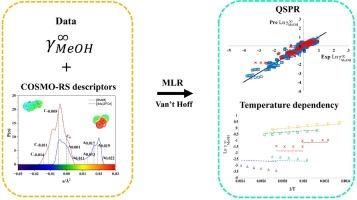
In this study, the ‘Quantitative Structure-Activity/Property Relationship’ (QSAR/QSPR) approach has been applied for the prediction of infinite dilution activity coefficient (IDAC) of Methanol (MeOH) in Ionic Liquids (ILs) using an extensive dataset. A new predictive QSPR model including novel molecular descriptors, called ‘COSMO-RS descriptors’, has been developed for the first time. In this study, the dataset was divided to a training set for the development of models, and a validation set for external validation. According to the obtained results of statistical parameters (R2 = 0.92 and Q2LOO-CV = 0.91), the predictive capability of the developed QSPR model was acceptable for training set. Regarding the external validation, other statistical parameters such as AAD = 0.2034 and RMSE = 0.2926 were also satisfactory for validation set. While the values of IDAC increase or decrease with increasing temperature, the QSPR model based on the van’t Hoff equation takes into account the ‘negative’ and ‘positive’ effects of temperature on the IDAC of MeOH in ILs well, depending on the nature of ILs. It was also shown that the IDAC value in some new ILs, which had not been experimentally studied before, can be predicted using QSPR model. These predicted data can be considered as ‘Pseudo Experimental data’ for future efforts.
期刊介绍:
The exploration of energy sources remains a critical matter of study. For the past nine decades, fuel has consistently held the forefront in primary research efforts within the field of energy science. This area of investigation encompasses a wide range of subjects, with a particular emphasis on emerging concerns like environmental factors and pollution.




 京公网安备 11010802042870号
京ICP备2023020795号-1
京公网安备 11010802042870号
京ICP备2023020795号-1

 分享
分享
 求助内容:
求助内容: 应助结果提醒方式:
 扫码关注我们
