Xuefei Cui , Ji Chen , Tao Zheng , Hao Su , Shengli Li , Chuansong Wu
{"title":"超声频率脉冲电流辅助水下湿药芯电弧焊中电弧和气泡动态特性的实验与仿真研究","authors":"Xuefei Cui , Ji Chen , Tao Zheng , Hao Su , Shengli Li , Chuansong Wu","doi":"10.1016/j.ijheatmasstransfer.2025.126853","DOIUrl":null,"url":null,"abstract":"<div><div>In this study, a three-dimensional numerical model is established to investigate the dynamic behavior of the arc and bubble in ultrasonic frequency pulse current-assisted underwater wet flux cored arc welding (UFPC-UWFCAW). The aim is to deepen the understanding of the interaction between the arc and bubble in UFPC-UWFCAW process and evaluate its impact on welding quality. The mathematical model account for the effects of UFPC from both microscale and macroscale perspectives. On the one hand, a microscopic model of plasma under a non-equilibrium state is established to analyze the influence of UFPC on the thermophysical properties of plasma. This analysis reveals that UFPC influenced the plasma thermophysical parameters by altering the number density and velocity distribution function of particles in the plasma. On the other hand, the ultrasonic field excited by UFPC is added to the model as a momentum source term to investigate the influence of UFPC on the heat transfer and fluid flow process of the arc and bubble. To explore the effect of UFPC on the behavior of the arc and bubble, a comparison is conducted between conventional underwater wet flux cored arc welding (C-UWFCAW) and UFPC-UWFCAW. The simulation results demonstrate that UFPC effectively control the arc shape and bubble behavior, reducing instability during the welding process and improving the weld quality. This optimization effect is attributed to the high-frequency characteristics of UFPC, allowing for better control over the arc's heat input and affecting the bubble's growth, necking, and separation processes. The research provides a new theoretical basis for optimizing UFPC-UWFCAW and offers guidance for enhancing the welding process in practical industrial applications.</div></div>","PeriodicalId":336,"journal":{"name":"International Journal of Heat and Mass Transfer","volume":"242 ","pages":"Article 126853"},"PeriodicalIF":6.6000,"publicationDate":"2025-06-01","publicationTypes":"Journal Article","fieldsOfStudy":null,"isOpenAccess":false,"openAccessPdf":"","citationCount":"0","resultStr":"{\"title\":\"Experimental and simulation research on the dynamic behavior of arc and bubble in ultrasonic frequency pulse current-assisted underwater wet flux cored arc welding\",\"authors\":\"Xuefei Cui , Ji Chen , Tao Zheng , Hao Su , Shengli Li , Chuansong Wu\",\"doi\":\"10.1016/j.ijheatmasstransfer.2025.126853\",\"DOIUrl\":null,\"url\":null,\"abstract\":\"<div><div>In this study, a three-dimensional numerical model is established to investigate the dynamic behavior of the arc and bubble in ultrasonic frequency pulse current-assisted underwater wet flux cored arc welding (UFPC-UWFCAW). The aim is to deepen the understanding of the interaction between the arc and bubble in UFPC-UWFCAW process and evaluate its impact on welding quality. The mathematical model account for the effects of UFPC from both microscale and macroscale perspectives. On the one hand, a microscopic model of plasma under a non-equilibrium state is established to analyze the influence of UFPC on the thermophysical properties of plasma. This analysis reveals that UFPC influenced the plasma thermophysical parameters by altering the number density and velocity distribution function of particles in the plasma. On the other hand, the ultrasonic field excited by UFPC is added to the model as a momentum source term to investigate the influence of UFPC on the heat transfer and fluid flow process of the arc and bubble. To explore the effect of UFPC on the behavior of the arc and bubble, a comparison is conducted between conventional underwater wet flux cored arc welding (C-UWFCAW) and UFPC-UWFCAW. The simulation results demonstrate that UFPC effectively control the arc shape and bubble behavior, reducing instability during the welding process and improving the weld quality. This optimization effect is attributed to the high-frequency characteristics of UFPC, allowing for better control over the arc's heat input and affecting the bubble's growth, necking, and separation processes. The research provides a new theoretical basis for optimizing UFPC-UWFCAW and offers guidance for enhancing the welding process in practical industrial applications.</div></div>\",\"PeriodicalId\":336,\"journal\":{\"name\":\"International Journal of Heat and Mass Transfer\",\"volume\":\"242 \",\"pages\":\"Article 126853\"},\"PeriodicalIF\":6.6000,\"publicationDate\":\"2025-06-01\",\"publicationTypes\":\"Journal Article\",\"fieldsOfStudy\":null,\"isOpenAccess\":false,\"openAccessPdf\":\"\",\"citationCount\":\"0\",\"resultStr\":null,\"platform\":\"Semanticscholar\",\"paperid\":null,\"PeriodicalName\":\"International Journal of Heat and Mass Transfer\",\"FirstCategoryId\":\"5\",\"ListUrlMain\":\"https://www.sciencedirect.com/science/article/pii/S0017931025001942\",\"RegionNum\":2,\"RegionCategory\":\"工程技术\",\"ArticlePicture\":[],\"TitleCN\":null,\"AbstractTextCN\":null,\"PMCID\":null,\"EPubDate\":\"2025/2/18 0:00:00\",\"PubModel\":\"Epub\",\"JCR\":\"Q1\",\"JCRName\":\"ENGINEERING, MECHANICAL\",\"Score\":null,\"Total\":0}","platform":"Semanticscholar","paperid":null,"PeriodicalName":"International Journal of Heat and Mass Transfer","FirstCategoryId":"5","ListUrlMain":"https://www.sciencedirect.com/science/article/pii/S0017931025001942","RegionNum":2,"RegionCategory":"工程技术","ArticlePicture":[],"TitleCN":null,"AbstractTextCN":null,"PMCID":null,"EPubDate":"2025/2/18 0:00:00","PubModel":"Epub","JCR":"Q1","JCRName":"ENGINEERING, MECHANICAL","Score":null,"Total":0}
Experimental and simulation research on the dynamic behavior of arc and bubble in ultrasonic frequency pulse current-assisted underwater wet flux cored arc welding
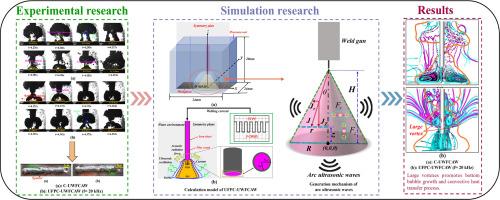
In this study, a three-dimensional numerical model is established to investigate the dynamic behavior of the arc and bubble in ultrasonic frequency pulse current-assisted underwater wet flux cored arc welding (UFPC-UWFCAW). The aim is to deepen the understanding of the interaction between the arc and bubble in UFPC-UWFCAW process and evaluate its impact on welding quality. The mathematical model account for the effects of UFPC from both microscale and macroscale perspectives. On the one hand, a microscopic model of plasma under a non-equilibrium state is established to analyze the influence of UFPC on the thermophysical properties of plasma. This analysis reveals that UFPC influenced the plasma thermophysical parameters by altering the number density and velocity distribution function of particles in the plasma. On the other hand, the ultrasonic field excited by UFPC is added to the model as a momentum source term to investigate the influence of UFPC on the heat transfer and fluid flow process of the arc and bubble. To explore the effect of UFPC on the behavior of the arc and bubble, a comparison is conducted between conventional underwater wet flux cored arc welding (C-UWFCAW) and UFPC-UWFCAW. The simulation results demonstrate that UFPC effectively control the arc shape and bubble behavior, reducing instability during the welding process and improving the weld quality. This optimization effect is attributed to the high-frequency characteristics of UFPC, allowing for better control over the arc's heat input and affecting the bubble's growth, necking, and separation processes. The research provides a new theoretical basis for optimizing UFPC-UWFCAW and offers guidance for enhancing the welding process in practical industrial applications.
期刊介绍:
International Journal of Heat and Mass Transfer is the vehicle for the exchange of basic ideas in heat and mass transfer between research workers and engineers throughout the world. It focuses on both analytical and experimental research, with an emphasis on contributions which increase the basic understanding of transfer processes and their application to engineering problems.
Topics include:
-New methods of measuring and/or correlating transport-property data
-Energy engineering
-Environmental applications of heat and/or mass transfer




 京公网安备 11010802042870号
京ICP备2023020795号-1
京公网安备 11010802042870号
京ICP备2023020795号-1

 分享
分享
 求助内容:
求助内容: 应助结果提醒方式:
 扫码关注我们
